September 22, 2026
Why Update Brand Messaging: Essential Guide for Growth


Discover how B2C, C2C, and B2B are types of e-commerce models that impact pricing, sales, and marketing strategies for founders.
B2C, C2C, and B2B are types of e-commerce business models defined by one thing: who is buying and who is selling. That single distinction shapes everything else, from how you price to how long a sale takes to close. Get it wrong and your marketing, pricing, and operations will all pull in different directions.
Here is the short version before we go deeper:
The model you operate under determines your sales cycle length, your average order size, your customer support load, and which marketing channels actually move the needle. A founder who treats a B2B audience like a B2C shopper will burn budget and wonder why nothing converts.
Business-to-Consumer is the model most people picture when they think of e-commerce. A business builds a product or service, puts it online, and sells it to individual shoppers. Amazon, Netflix, and Uber all run B2C operations in the US, each built around removing friction between the offer and the buyer.
The defining feature of B2C is speed. Consumers make purchase decisions fast, often within minutes, based on price, reviews, and how the product makes them feel. Order values tend to be lower than in B2B, but volume compensates. A single B2C brand can process thousands of transactions a day with no negotiation required.
Advantages of the B2C model:
Challenges B2C founders face:
Pro Tip: Map your B2C customer’s decision journey from first scroll to checkout. Most lost sales happen at the point where trust breaks down, not at the price point. Fix the trust gap before you cut the price.
For founders building a consumer brand, B2C marketing fundamentals around authenticity and speed-to-trust tend to outperform pure discount strategies over time.

| B2C factor | Typical profile |
|---|---|
| Decision maker | Individual consumer |
| Sales cycle | Minutes to hours |
| Average order value | Low to mid |
| Marketing focus | Emotion, convenience, brand |
| Key challenge | Retention and differentiation |
B2B transactions happen between two businesses. A SaaS company selling software licenses to a corporation, a manufacturer supplying parts to an assembler, or a wholesaler moving inventory to a retailer are all B2B. US examples include Salesforce selling CRM software to enterprise clients and Grainger supplying industrial parts to facilities teams.

The core difference from B2C is complexity. B2B sales involve negotiated pricing, net payment terms, multi-stakeholder approvals, and formal contracts. A single deal might require sign-off from a procurement manager, a department head, and a CFO. That process takes weeks or months, not minutes.
Advantages of the B2B model:
Challenges B2B founders face:
Pro Tip: In B2B, the person who signs the contract is rarely the person who uses the product. Build your messaging for the end user who champions the purchase internally, not just the executive who approves it.
A well-structured B2B marketing strategy accounts for every stakeholder in the buying committee, not just the decision-maker at the top.
| B2B factor | Typical profile |
|---|---|
| Decision maker | Buying committee or procurement team |
| Sales cycle | Weeks to months |
| Average order value | High |
| Marketing focus | ROI, reliability, relationships |
| Key challenge | Sales cycle length and complexity |
Consumer-to-Consumer is the peer-to-peer model. One individual sells directly to another, with a third-party platform handling the transaction infrastructure. eBay and Facebook Marketplace are the most prominent US examples, connecting millions of private sellers with buyers every day.
C2C platforms do not hold inventory. They provide the marketplace, the payment rails, and some degree of trust verification, but the seller is a private individual, not a business. That distinction creates a fundamentally different dynamic around pricing, quality, and accountability.
Advantages of the C2C model:
Challenges C2C participants face:
Pro Tip: If you are testing a product idea through C2C before committing to a B2C build, track which listings get the most questions. Those questions are your future FAQ page and your first content marketing brief.
The right model depends on three things: what you are selling, who you are selling it to, and how much operational complexity you can absorb right now. Choosing based on what sounds most familiar or what a competitor does is one of the most common and costly mistakes early founders make.
Volume and stability point toward B2B. If your product solves a recurring business problem and your buyer has a budget line for it, the longer sales cycle is worth the predictable contract revenue. Retail speed and mass appeal point toward B2C. If your product is something an individual buys on impulse or out of personal desire, B2C gives you the fastest path to transaction volume. Peer-to-peer trust and low overhead point toward C2C, especially for testing ideas before committing to a full business build.
Hybrid models are increasingly common. Many US platforms operate across all three simultaneously. A marketplace might let businesses sell to consumers (B2C), businesses sell to other businesses (B2B), and individuals resell to each other (C2C) depending on the seller type and order volume. The same product can move through all three channels with entirely different pricing, marketing, and compliance requirements attached to each.
Pro Tip: Reasonate Studio’s Aligned Impact Model™ starts with audience clarity before any channel or model decision. Knowing exactly who your buyer is and what motivates them makes the B2B vs. B2C vs. C2C choice almost obvious. Founders who skip that step tend to pick the wrong model and rebuild later at real cost.
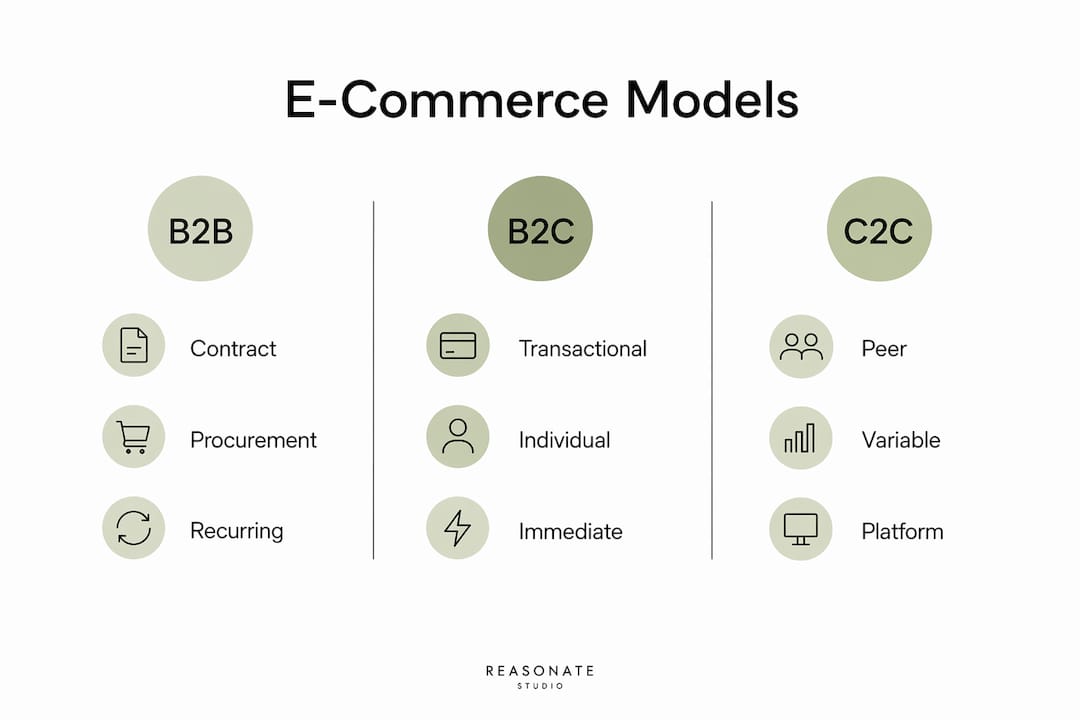
The revenue structure of each model is as distinct as the buyer relationship itself.
B2B revenue tends to be contract-based, with annual or multi-year agreements, net-30 or net-60 payment terms, and volume discounts negotiated upfront. Cash flow is predictable once contracts are signed, but the time from first contact to first payment can stretch across a quarter or more. Sales teams, proposals, and legal review are standard parts of the process.
B2C revenue is transactional and immediate. A consumer pays at checkout, and the money clears within days. The challenge is that each transaction is independent unless you build a subscription or loyalty structure around it. Subscription B2C models, like Netflix, convert one-time buyers into recurring revenue, which is why so many consumer brands have moved in that direction.
C2C revenue is the most variable of the three. Individual sellers earn per transaction with no guaranteed volume, no contracts, and no recurring structure. Platform fees eat into margins, and pricing power is limited by what comparable listings show nearby. Scaling C2C into a real business usually requires moving toward a B2C model with proper inventory, branding, and customer service infrastructure.
| Model | Revenue type | Payment timing | Scalability |
|---|---|---|---|
| B2B | Contract, recurring | Net 30 days | High with systems |
| B2C | Transactional, subscription | Immediate | High with volume |
| C2C | Per-transaction | Immediate | Limited without pivot |
Technology has compressed the gap between all three models in ways that were not possible a decade ago. A solo founder can now run a B2B SaaS product, a B2C subscription box, and a C2C resale shop from the same laptop, using platforms built specifically for each.
For B2C, platforms like Shopify have made it possible to launch a consumer storefront in hours, complete with payment processing, inventory tracking, and email automation. The barrier to entry is low, which means competition is fierce. The brands that win in B2C today invest heavily in content, community, and social media management to build recognition before a buyer ever reaches the product page.
B2B has been transformed by SaaS tools that automate the parts of the sales cycle that used to require a full team. CRM platforms, proposal software, and contract management tools let small B2B teams punch well above their weight. The shift to digital-first buying behavior means B2B buyers now do most of their research independently before ever contacting a sales rep, which puts content and SEO at the center of B2B demand generation.
C2C has scaled through mobile-first platforms that handle trust, payments, and logistics in ways individual sellers never could on their own. Facebook Marketplace and eBay have built rating systems, buyer protections, and dispute resolution processes that give C2C transactions enough structure to function at scale.
Each model carries its own compliance profile, and the US regulatory environment treats them differently in ways that affect day-to-day operations.
B2B transactions often involve sales tax nexus rules under the South Dakota v. Wayfair Supreme Court decision, which requires businesses to collect sales tax in states where they exceed certain sales thresholds, even without a physical presence. B2B contracts also fall under the Uniform Commercial Code (UCC), which governs the sale of goods between businesses and sets default rules for delivery, payment, and warranties when contracts are silent on those points.
B2C businesses face the broadest consumer protection obligations. The Federal Trade Commission (FTC) enforces rules around advertising claims, endorsements, and data privacy. The Children’s Online Privacy Protection Act (COPPA) applies to any B2C platform that collects data from users under 13. State-level privacy laws, led by the California Consumer Privacy Act (CCPA), add additional requirements for businesses that collect consumer data at scale.
C2C platforms carry a different risk profile. Individual sellers on C2C platforms are generally not classified as businesses for tax purposes unless their sales volume crosses IRS reporting thresholds. The IRS requires platforms like eBay to issue 1099-K forms to sellers who exceed $5,000 in gross payments in a calendar year as of 2024 reporting rules. Sellers who treat C2C income as invisible to the IRS do so at real risk.
Understanding which regulatory framework applies to your model is not optional. It shapes how you structure contracts, collect taxes, handle customer data, and report income from day one.