September 22, 2026
Why Update Brand Messaging: Essential Guide for Growth


Learn what marketing alignment really means, why it drives 20% more revenue, and how founders and consultants can build it fast with practical frameworks.

TL;DR:
- Marketing misalignment often causes more failure than content or ad issues.
- True marketing alignment unites teams around shared goals, consistent messaging, and integrated data.
- Implementing shared KPIs, clear lead definitions, and regular syncs boosts revenue and efficiency.
Most founders assume their marketing problems come down to not posting enough, not running the right ads, or not having a polished enough website. But the real culprit is often something quieter: misalignment. When your message, audience strategy, and revenue goals are pulling in different directions, even your best content falls flat. Aligned teams achieve 20% annual revenue growth, while misaligned teams can actually see a 4% decline. That gap is not a rounding error. It is the difference between a brand that compounds over time and one that stays stuck. This article breaks down what marketing alignment actually means, why it matters more than most experts admit, and how you can start building it today.
| Point | Details |
|---|---|
| Alignment drives revenue | Unified marketing and sales efforts can boost revenue growth by 20% or more. |
| Start with shared foundations | Focus on shared goals, SLAs, and an integrated CRM for the quickest impact. |
| Tackle root causes | Most alignment failures come from systems or data issues, not just poor communication. |
| Frameworks enable clarity | Following a proven, step-by-step alignment framework ensures predictable, sustainable business growth. |
Marketing alignment is one of those phrases that gets used a lot but rarely gets defined clearly. At its core, marketing alignment means uniting your marketing and sales efforts around shared revenue goals using unified processes, data, and metrics. It is sometimes called “smarketing,” a blend of sales and marketing working as one cohesive unit rather than two separate departments with competing priorities.
But alignment is not the same as collaboration. Collaboration is two teams being friendly and attending the same meetings. Alignment is structural. It means your buyer personas are identical across every team, your lead definitions are standardized, your messaging is consistent from the first touchpoint to the final sale, and your technology stack is integrated so no data falls through the cracks.
Here is what the core mechanics of alignment actually look like in practice:
When you learn how to align marketing and sales, you stop wasting effort on leads that go nowhere and start building a system where every piece of your marketing reinforces the next.
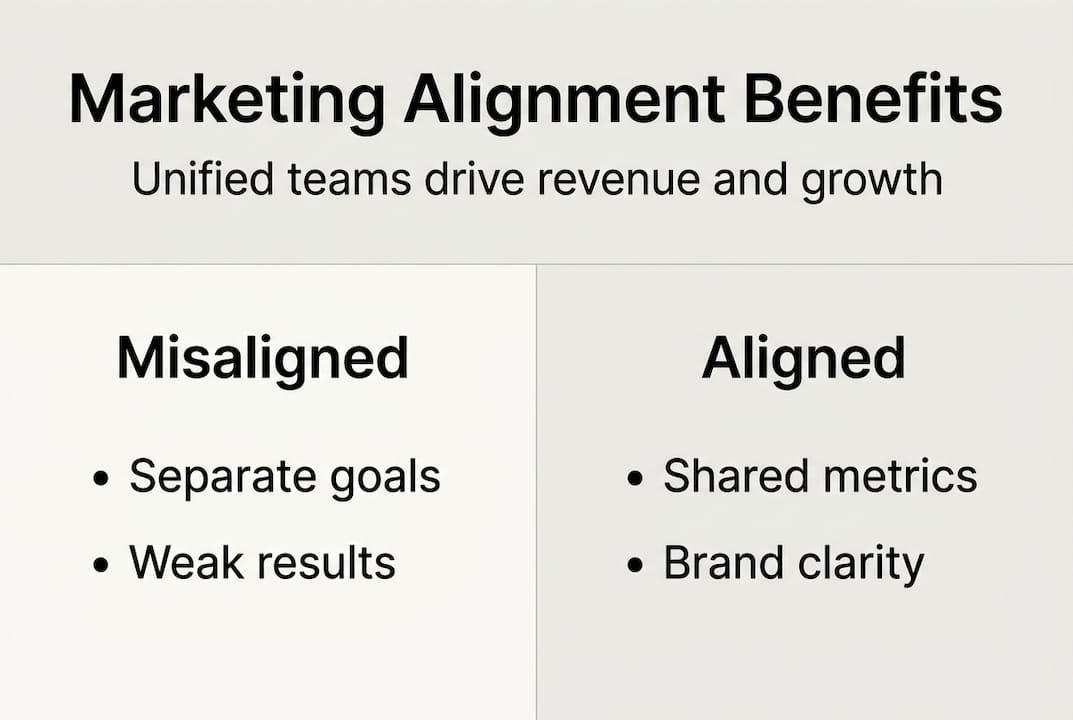
| Element | Misaligned | Aligned |
|---|---|---|
| Goals | Separate metrics per team | Shared revenue targets |
| Buyer personas | Inconsistent across teams | Unified and documented |
| Lead definitions | Vague or disputed | Clearly standardized |
| Messaging | Varies by channel | Consistent everywhere |
| Data | Siloed in separate tools | Integrated and shared |
Understanding the brand alignment benefits goes beyond just smoother internal operations. It creates a brand experience that feels coherent to your audience, which builds trust faster and shortens the time it takes for someone to say yes.

Pro Tip: Do not start your alignment work by fixing communication. Start by unifying incentives. When your team is rewarded for the same outcomes, the communication tends to fix itself.
If you have ever felt like you were doing all the right things but still not seeing consistent growth, misalignment is likely a major factor. The numbers here are hard to ignore. Aligned teams enjoy 208% higher marketing-driven revenue, 38% higher win rates, and 30% lower customer acquisition costs and shorter sales cycles compared to misaligned teams.
Those are not statistics from massive enterprise companies with hundreds of employees. They apply to small teams too, including solo founders and boutique consultancies where one person is wearing both the marketing and sales hat.
Here is a direct comparison of what alignment versus misalignment looks like in practice:
| Metric | Misaligned teams | Aligned teams |
|---|---|---|
| Annual revenue growth | Up to 4% decline | Up to 20% growth |
| Marketing-driven revenue | Baseline | Up to 208% higher |
| Win rates | Lower, inconsistent | 38% higher |
| Customer acquisition cost | Higher, unpredictable | Up to 30% lower |
| Sales cycle length | Longer, stalled | Noticeably shorter |
The pitfalls of ignoring alignment go beyond revenue. Misaligned marketing creates frustrated teams, wasted budget, and a brand that feels inconsistent to potential clients. You end up spending money on content that does not convert, running campaigns that attract the wrong audience, and losing deals that should have been easy wins.
For founders and consultants in particular, this is especially costly because there is no large team to absorb the inefficiency. Every misaligned dollar and every misaligned hour comes directly out of your growth potential.
Building an aligned brand strategy workflow is one of the most direct ways to protect your marketing budget and make sure every effort is pulling in the same direction. When you optimize your marketing budget with alignment as the foundation, you stop funding disconnected tactics and start investing in a system that compounds.
Knowing alignment matters is one thing. Building it is another. The good news is that you do not need a complex enterprise system to get started. Proven alignment frameworks follow a clear sequence that any founder or consultant can adapt.
Here is a practical, step-by-step approach:
When you set marketing goals using this kind of structured approach, you create accountability that goes beyond good intentions. A solid marketing strategy template can help you organize these steps into a repeatable system.
“Alignment is not a one-time project. It is an ongoing operating rhythm. The teams that stay aligned are the ones that build review cycles into their calendar, not just their strategy decks.”
Pro Tip: Do not try to fix everything at once. Start with a shared CRM, a written SLA (service level agreement) for lead handoffs, and one set of OKRs. Those three changes alone can produce measurable results within 30 days.
Even when you understand alignment and commit to building it, things can still break down. Knowing where the cracks typically appear makes it much easier to catch and fix them before they cost you.
Common alignment failures include broken lead handoffs, poor follow-up rates below 35%, audience misalignment, perception gaps between leadership and staff, and CRM data issues that make it impossible to track what is actually happening.
Here is a quick diagnostic checklist. If you recognize more than two of these, alignment work should be your next priority:
| Challenge area | Symptom | Fix |
|---|---|---|
| Lead handoffs | Leads go cold after first contact | Write and enforce a clear SLA |
| Audience clarity | Wrong people applying or inquiring | Revisit and document your ICP |
| Data gaps | Cannot track marketing ROI | Integrate CRM and analytics tools |
| Messaging inconsistency | Brand feels different across channels | Create a brand messaging guide |
| Perception gaps | Leadership and staff see results differently | Shared dashboards and weekly syncs |
For deeper execution support, reviewing B2B marketing best practices can surface additional gaps you might be missing. And if your social presence feels disconnected from your overall strategy, learning how to improve social media marketing within an aligned framework makes a significant difference.
Pro Tip: When alignment breaks down, most people assume it is a communication problem. Nine times out of ten, it is actually a systems or data problem. Fix the infrastructure first, then address the culture.
Here is something most alignment articles will not tell you: not all misalignment is a mistake. Some of it is intentional and strategic. Cold outreach, for example, often operates separately from inbound marketing on purpose. That is not a failure. That is a deliberate choice to reach different audiences through different channels.
The real problem is not that teams are misaligned in their conversations. It is that their systems are tangled, their lead definitions are outdated, and their CRM data is unreliable. You can have the most collaborative team culture in the world and still produce inconsistent results if the underlying infrastructure is broken.
For Texas founders, coaches, and consultants, this is especially relevant. When you are running a lean operation, you do not have the luxury of blaming a “culture problem” and moving on. You need your systems to work. That means regular audits of your processes, not just your content calendar.
The brand alignment perspective that actually moves the needle is one that treats alignment as an operational discipline, not a soft skill. Prioritize your systems, your data, and your definitions. The culture will follow.
Marketing alignment is not a luxury for large teams with big budgets. It is the foundation that makes every other marketing effort work harder and go further. If your content is not converting, your leads are inconsistent, or your brand feels scattered across channels, alignment is almost always part of the answer.
At Reasonate Studio, we help founders, coaches, and consultants build exactly this kind of strategic clarity. Through our Aligned Impact Model™, we take you from scattered tactics to a focused, revenue-generating brand system. Whether you need a brand audit, social media management, or one-on-one coaching, we are here to help you build marketing that actually works. Reach out today and let us show you what aligned marketing can do for your business.
Marketing alignment means true goal and process unity, not just working together informally. It requires shared revenue targets, unified buyer definitions, standardized lead stages, and integrated data across every team.
Check whether you have shared KPIs, written SLAs for lead handoffs, unified buyer personas, consistent messaging, and integrated CRM data across all tools and channels.
Failures typically come from broken handoffs, poor follow-up, unclear lead stage definitions, disconnected data systems, and perception gaps between leadership and the people executing the work.
Absolutely. Aligned teams achieve higher growth regardless of size. For solo founders and small consultancies, alignment is even more critical because there is no room to absorb the cost of wasted effort or misdirected spend.
Start with shared goals, SLAs, and a unified CRM before you try to optimize anything else. Those three foundations will surface the most important gaps and give you a clear starting point for everything that follows.