
November 24, 2026
Marketing Operations Consulting for Chicago Small Businesses


How Chicago coaches, consultants and interior designers can define, attract and qualify leads: criteria, a one-page client profile, channels and follow-up.

A qualified lead is a person or company that fits the clients you want to serve and shows real intent to hire you, with a problem you solve, a budget that matches your fees, the authority to say yes and a timeline. If you are a coach, consultant or interior designer in Chicago, qualified lead generation means building a steady flow of those people so you stop spending your week on inquiries that were never going to close. It is not about collecting more names. It is about tightening who you attract, how you screen them and how quickly you respond. This guide walks through each step in the order you would do it. Reasonate Studio is led by a founder who connects strategy with execution, and the same logic runs through the steps below: positioning first, channels second, follow-up third.
Most definitions come down to the same four checks. HubSpot’s sales qualification guide describes a qualified lead as someone with a problem your product or service solves, a budget that lines up with your pricing, authority or influence over the purchase, and a defined timeline. Salesforce uses the same logic under the name BANT: budget, authority, need and timing.
For a coach or consultant, translate each letter into plain terms:
There is a second layer that matters just as much. ZoomInfo’s guide argues that a qualified lead matches your ideal customer profile and also shows active buying intent, such as a direct inquiry, a pricing-page visit or a content download. A passive signal, like one accidental ad click, does not count. Fit without intent is a pleasant contact who will never buy. Intent without fit is a person who wants to hire you for something you do not do. You need both.
That is why the question “how do I get more leads” tends to produce disappointing results. The better question is “how do I get more of the right people to raise their hand.”
The clearest way to teach yourself the difference is to write down what each looks like in your own work. Here are three examples, built from the criteria above.
An executive coach. A qualified lead is a vice president at a Loop professional services firm who has just been promoted, has an approved development budget through HR and wants to start before the next quarter. An unqualified lead is a person curious about coaching in general, with no employer support and no particular reason to begin.
A management consultant. A qualified lead is the founder of a 25-person firm who says referrals have flattened, asks about your process on the website and replies to a follow-up email with their revenue target. An unqualified lead is an intern or analyst collecting proposals for a research document. Constant Contact lists an intern researching options and a prospect without budget as typical unqualified examples.
An interior designer. A qualified lead owns a home or commercial space in the area you serve, has closed or is about to close on the property, and wants the work done in a stated window. An unqualified lead is browsing for inspiration photos, lives outside your service area or wants a result at a fraction of your minimum project size.
Notice that unqualified does not mean bad. HubSpot points out that leads who fit but are not ready, for example because of budget constraints, belong in a nurture sequence rather than your active pipeline. Someone who cannot start this year may be your best client next year, as long as you stay visible and do not spend sales time on them today.
If you read about lead generation for long, you will meet two acronyms. A marketing qualified lead (MQL) is someone whose behavior and profile suggest interest: they downloaded a guide, attended a webinar or visited your pricing page more than once. A sales qualified lead (SQL) is someone you or your team have actually spoken with and confirmed has a real need, budget, authority and timeline. HubSpot draws the same line, noting that an SQL has been vetted through a human touchpoint.
In a firm of one to fifteen people, you may be both marketing and sales. You do not need a formal scoring system. You do need to keep the two stages separate in your head:
The reason this matters is that form data alone is unreliable. HubSpot notes that people fill in forms inaccurately or incompletely, so a call, chat or email exchange is needed to validate the details before a lead counts as qualified. A booked call is therefore not a qualified lead. It is an opportunity to find out whether you have one.
When marketing and sales are handled by different people, the handoff is where leads get lost. Our piece on aligning marketing and sales covers how to agree on what counts as ready for a conversation.
Every qualification rule depends on knowing who you want. A practical small-business guide from Startbuddi recommends a one-page profile that covers the type of organization, who decides, the trigger event that starts a search, a typical budget and the red flags. That structure works well for Chicago service firms. Fill it in like this.
Pull up your last five to ten engagements that were profitable and enjoyable. For each, write down what they had in common: the size of the business, the industry, the role of the person who hired you, how they found you and what was happening in their business when they called. Patterns appear quickly. A coach may find that every strong client was a first-time executive. A designer may find that the best projects came from owners of newly purchased buildings.
People rarely hire a consultant or designer on a random Tuesday. Something happens: a promotion, a funding round, a move, a failed hire, a competitor launch. Listing your three most common triggers tells you what to write about, what to search for and when to follow up.
Red flags are as useful as the target. Typical ones include an unclear decision-maker, a budget far below your minimum, a location outside your service area, a request for free work first, or a deadline with no real reason behind it. Writing them down makes it easier to decline politely, and protects your calendar.
Quo’s small-business qualification guide frames qualification around budget, buying authority, need and urgency. Convert your profile into four questions you can ask in a first call or an intake form:
These questions are conversational rather than a checklist. Their job is to let the prospect describe their situation so you can compare it with your profile.
Channels do not qualify leads by themselves. What they do is decide which kind of person reaches you. Salesforce explains that lead generation starts with awareness, through educational blog posts and social media, then captures interest through sign-ups and gated content such as webinars and guides, followed by personalized communication. For a professional service firm, three channel types work together.
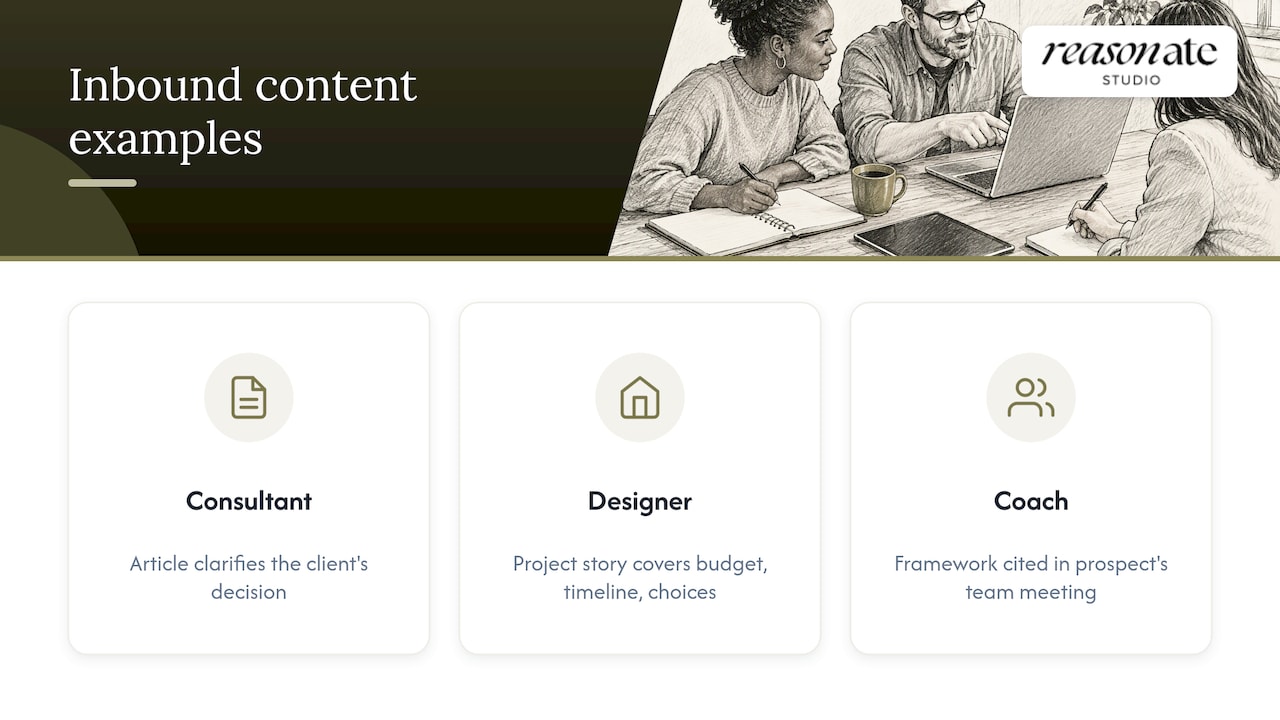
Inbound means content and search that answers the questions your ideal clients ask before they hire. A consultant writes a clear article on the decision the client faces. A designer publishes a project story that explains the budget, timeline and choices. A coach shares a framework that gets referenced in the prospect’s next team meeting. The goal is not traffic. It is a page that makes the right reader think “these people understand my situation.” Our inbound marketing services cover this kind of work, from content to landing pages and email.
TechTarget’s demand generation manual adds a useful refinement: instead of one cumulative score, act on specific signals. A visitor who downloads a template tied to a purchase decision is more sales-ready than one who reads a trends piece, so the first gets a personal follow-up while the second joins a nurture stream. You can apply that with a two-column list: actions that trigger a personal reply, and actions that trigger a helpful email.
Outbound is the opposite approach: you choose the firms that match your profile and contact them directly. Done well, it begins with something specific about the company. A Chicago-focused guide from AutoReach recommends opening with a detail about the prospect, stating the value in one sentence and closing with a low-commitment question rather than a request for an hour. Because you chose the account, fit is already confirmed, and you only need to find intent. Our B2B outbound marketing page explains how we approach it.
If you have grown on referrals, you already have the most qualified lead source there is. A referred prospect usually arrives with trust and context. The weakness is that referrals are unpredictable and depend on other people’s memory. The aim is not to replace them but to add inbound and outbound so that a quiet quarter does not threaten the business. A practical rule from Startbuddi is to start with one inbound method, one outbound method and referrals, and give each at least two months before judging it.
All three channels depend on one thing: a clear statement of who you help and what changes for them. When the message is vague, inbound attracts the wrong readers, outbound gets ignored and referrers cannot describe you accurately. That is why we start with brand messaging strategy for firms whose reputation is stronger than the way they present it.
Generating interest is half the work. The rest is what happens in the first two weeks after someone reaches out.
Startbuddi suggests asking four questions early, covering need, timing, budget and decision-maker, and giving every lead a status: new, contacted, qualified, not a fit or nurture. A spreadsheet or a simple CRM board is enough. The point is that nobody sits in an inbox without a label.
When a lead is not a fit, exit gracefully. Quo’s guidance is that spotting unqualified leads early is about prioritizing your time, not dismissing people, since some will qualify later. A line such as “reach out when the timing is right” protects the relationship.
Speed and consistency separate firms that convert from firms that wonder why they do not. The Startbuddi schedule is a good template:
| When | Action |
|---|---|
| Within one hour | Personal reply to the inquiry |
| Day 1 | Summary of the conversation and, if relevant, a quote |
| Day 3 | Short check-in |
| Day 7 | A useful piece of content related to their problem |
| Day 14 | A direct question: is this still a priority? |
| Day 30 onward | Monthly nurture |
The last step gives you a clean answer. Either the lead is active, or they move to the nurture list without you chasing them.
Activity numbers such as clicks and form fills are easy to count and easy to misread. TechTarget recommends holding marketing accountable to lead conversion rate, win rate and the time leads spend in each stage. For a small firm, a monthly view of these is enough:
After a few months, the picture often differs from your instinct. A channel that produces fewer leads may produce most of your clients. That is the evidence to use when deciding where to invest next.
Qualified lead generation is not a standalone tactic. It sits inside a marketing strategy that defines who you serve, what you offer and how a stranger becomes a client. If you are still shaping that foundation, our guides on building a marketing strategy and on what drives growth give the wider picture.
Most coaches, consultants and designers know what to do. What stalls is doing it every week: publishing, emailing, updating landing pages and posting while client work fills the calendar. Marketing Momentum is our recurring monthly partnership at $1,500 per month, covering social media, email, blog content and landing pages. Firms that need senior direction over the whole system can look at our Chicago fractional marketing leadership, where marketing priorities, decisions and partner direction are owned by a leader rather than left to chance.
Most firms we meet do not have a lead problem. They have a clarity problem. Their best clients arrived through reputation and referrals, so the business is stronger than the way it is described online. When we turn on more channels without fixing that, the volume goes up and the quality goes down.
That is why every engagement at Reasonate Studio is led directly by me, and why we keep our client roster deliberately small. Qualification starts with positioning: who you serve, what you are known for and what a good client looks like. Content, email, search and outbound all carry that message. When they work from the same profile, the people who raise their hands are people you want to work with.
My advice to a founder in Chicago is to write the one-page profile first, define what counts as qualified second and only then decide on channels. Marketing should be accountable to clients signed, not to clicks. Strategy and execution belong together, with one person responsible for both.
Kaitlyn Cole
Start with a one-page profile of your best past clients, then publish content that speaks to their trigger events, contact matching firms directly and keep referrals active. Screen each lead on need, budget, authority and timing, and track which source produces clients, not just inquiries.
A qualified lead fits your ideal client profile and shows real intent: a problem you solve, a workable budget, decision authority and a timeline. An unqualified lead lacks one or more of these. Some, such as those not yet ready, can be nurtured and qualify later.
An MQL shows interest through marketing, for example downloading a guide or returning to your pricing page. An SQL has been vetted in a conversation with sales and has confirmed budget, need, authority and timing. In a small firm, think of it as interested versus ready for a proposal.
A personal reply within an hour is a sensible standard for a service firm, followed by a summary the next day and a check-in on day three. Quick, specific replies show the prospect what working with you is like.
That depends on your close rate and engagement size. Work backward: decide how many new clients you want, divide by your lead-to-client rate and you have the number of qualified leads to aim for. Tracking by source for a few months gives you a real figure.


