
November 19, 2026
Customer Research Services for Chicago Coaches and Designers


A practical marketing plan for independent Chicago medical, dental and wellness practice owners: positioning, local search, patient trust, HIPAA basics and measurement.

If you own an independent practice in Chicago, your marketing has one job: make the quality your patients already know about visible to the people who have not met you yet. The practices that do this well do not start with ads or a new logo. They start with positioning (who you want to serve and why you are the right choice), then build a website, local listings and content that say the same thing everywhere. Compliance rules shape how you say it. A senior marketing lead who owns the plan end to end is how most owner-led practices make it stick. That is the work we do at Reasonate Studio, where our founder, Kaitlyn, leads every engagement herself.
This guide is written for Chicago practice owners: physicians, dentists, therapists, wellness and specialty clinic founders who have grown on referrals and reputation and now want steadier, more predictable growth.
Most independent practices we describe in this guide share a pattern. The clinical work is excellent. Patients refer their families. A few colleagues send cases. Then growth flattens, because referrals are not something you can turn up on demand, and a new patient who does not know you has only your website, your Google listing and your reviews to judge you by.
That is the gap. It is not a quality problem. It is a presentation problem: the practice is stronger than the way it is described online.
Chicago adds its own pressure. Patients choose by neighborhood and by transit line as much as by specialty, and a search such as “dentist in Lincoln Park” or “therapist near the Loop” returns a crowded page. A practice that looks like every other practice on that page loses to the one that says something specific.
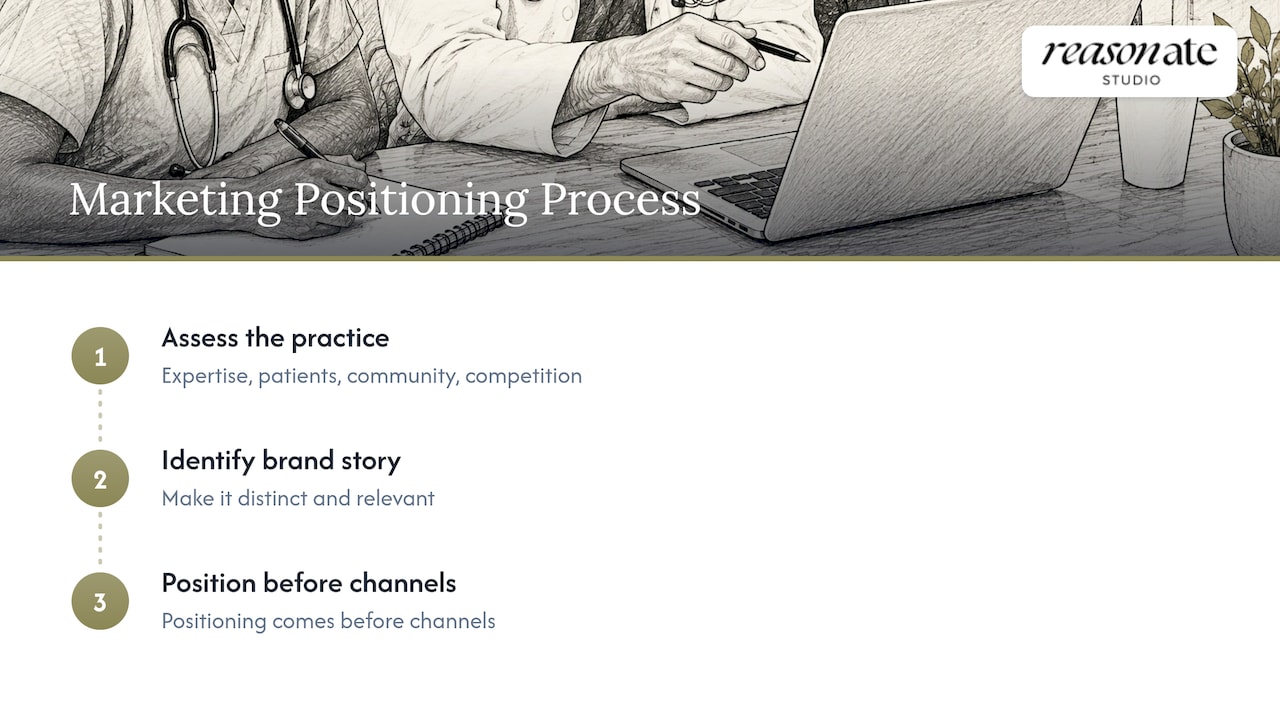
The AMA makes the same point in its guide for private practices: assess your expertise, your patients’ needs, your community and your competitive environment, then use what you find to identify a distinct, relevant brand story (AMA guide to identifying your practice’s marketing advantage). That is positioning work, and it comes before channels.
The AMA guide suggests looking at your current patient population and the one you want, including age, lifestyle, employment, special health needs, retirees and new movers, and asking which groups you want to add and how you can meet their needs (AMA).
Make this concrete with a one-page exercise:
The common mistake is trying to speak to everyone. A website that tries to appeal to every possible patient reads as interchangeable. The practices that grow tend to choose.
Once you have your sentences, they become the backbone of your homepage, your provider biographies, your Google description and your email welcome. This is brand messaging, and it is where a founder’s expertise has to be translated into words a patient understands. If you want help with it, our brand messaging strategy work is built for exactly this step.
The American Academy of Family Physicians recommends setting realistic, measurable goals across immediate (1 to 6 months), short-term (6 to 12 months) and long-term (12 to 24 months) horizons (AAFP Family Practice Management). Its sample targets are useful models: raising new patients by 5% within six months and 10% by year-end, or shifting a patient mix from 15% to 25% pediatric and adolescent visits within 18 months. The article dates from 2001, but the discipline of a number plus a deadline has not aged.
For a Chicago practice, a good first-year goal sounds like this: “Add 12 new patients a month for our two priority services by June, and have half of them tell us they found us through search or a review.” It names a count, a service, a date and a source you can check.
Research cited by the AMA found that more than 60% of potential patients search for a physician or health professional before scheduling, 94% use online reviews to evaluate providers, 43% prefer to book appointments online, and 41% say social media influenced their choice of doctor (AMA, Draw patients to your practice with the right digital footprint). Put plainly: your first appointment is often won or lost before the phone rings.

The AMA guide recommends checking whether your online information is actually useful to patients and referral sources, including locations, hours, contact numbers, online scheduling, provider biographies and listings on review or directory sites (AMA). Run that audit like a patient would:
A practice with a second location, a move or a departing provider almost always has stale information somewhere.
Generic city pages are weak. A page for your “Pilsen pediatric dentistry” or “Gold Coast dermatology” patients, with parking and transit notes, who the practice is best for and what a first visit involves, is more useful to a patient and gives search engines clearer signals. Our SEO services page explains how we approach search for service businesses.
Because nearly all patients lean on reviews, the question is not whether to care about them but whether you have a routine. Decide who asks, when (after a visit that went well, not at the front desk while the patient is still billing), and who replies. Reply to every review without confirming that the reviewer is a patient or revealing any health detail. Even a thank-you that says “we’re glad your appointment went well” can disclose that the person was treated, which is the kind of detail HIPAA protects.
Content in healthcare has a different job than in most industries. It does not need to go viral. It needs to answer the question a patient types at 10 p.m. and show that a real, specific clinician stands behind the answer.
We cover the approach to this kind of writing in our guide to content marketing for Chicago coaches, therapists and small firms, and the same principles apply to clinical practices.
With 41% of patients saying social media influenced their choice of doctor (AMA), having an active, credible presence matters even if it is not where most bookings start. For most practices, two or three posts a week that show the team, explain a common concern or share a seasonal reminder are enough. Never show a patient, a chart, a screen or a recognizable room detail without checking the rules below. Our Chicago social media management page describes how we handle this for local businesses.
Your site, your listings, your social profiles and your emails should read as one brand. This is what Chicago digital brand management means in practice: the same positioning sentence, the same tone and the same visuals wherever a patient meets you.
This is where a practice owner needs care, and where a mistake costs more than a weak campaign. This section is general information, not legal advice. For your specific situation, talk with a health care attorney or your compliance officer.
Under the HIPAA Privacy Rule, as explained by HHS, “marketing” means a communication about a product or service that encourages the recipient to buy or use it, and it generally requires the individual’s prior written authorization. Exceptions include face-to-face communications by the covered entity and promotional gifts of nominal value. Selling patient lists, or disclosing protected health information to a third party for its own marketing in exchange for payment, always requires authorization (HHS, Marketing).
What that means day to day:
Illinois law also gives people control over commercial use of their identity. The Illinois Right of Publicity Act applies to the commercial use of a person’s name, image, likeness or voice, and HIPAA authorization does not automatically cover those publicity rights, so a patient story or before-and-after photo can need a separate signed release (Jackson LLP overview). Practical rule: no patient name, photo or story goes into marketing without a signed release written for that purpose, and your attorney should review the form. Some practices skip patient testimonials altogether and let public reviews and clinician expertise carry the trust.
Keep outcome claims modest and accurate, and make sure what an ad says matches what a patient will actually get, including insurance coverage. Illinois’s Consumer Fraud and Deceptive Business Practices Act applies to deceptive promotion, including some health-related offers (Illinois Consumer Fraud Act text). Referral and discount programs involving payers or federal health programs carry their own rules, so have them reviewed before launch.
Marketing that is not measured turns into a monthly expense nobody can defend. Keep the measurement simple enough that your office manager can maintain it.
At scheduling, ask one question: “How did you hear about us?” Offer the options you actually run: Google search, a review site, a physician referral, a friend or family member, social media, an event, other. Record the answer in your system. After three months you will see which channels bring patients, not just clicks.
| Measure | Why it matters | How to get it |
|---|---|---|
| New patient inquiries | Top of the funnel | Calls, forms, online booking |
| New patients booked | Inquiries that converted | Scheduling system |
| Source of each new patient | Shows what to keep or cut | Intake question |
| Review count and average rating | Trust signal before the visit | Google and directory profiles |
| Website visits for service pages | Shows interest in priority services | Site analytics |
| Return visit rate | Retention multiplies every acquisition dollar | Scheduling system |
Return visits deserve the same attention as new ones. A patient who books a second visit is worth far more than the ad that found them, so track the share of new patients who come back within a set window, such as 90 days.
Check the scorecard monthly and revisit goals quarterly against the 1 to 6, 6 to 12 and 12 to 24 month horizons described earlier (AAFP). When a number misses, change one variable at a time: the page, the offer, the audience or the message. Changing everything at once teaches you nothing.
Most practice owners we describe have tried the usual options: a freelancer for the website, someone for social posts, an SEO vendor, maybe a one-off branding project. Each does a job. Nobody owns the whole picture. Nobody decides that this quarter’s priority is the two services you want to grow, makes sure the website says so, and checks the numbers at the end of the month.
That missing role is a marketing leader. Hiring a full-time one is out of reach for many practices, which is why a fractional model exists: senior direction on a schedule that fits an independent practice, with the execution connected to it. Our Chicago fractional marketing leadership page explains how that works. If you are weighing it against an agency or a freelancer, our overview of a Chicago marketing consultant sets out the differences.
Reasonate Studio is a boutique brand strategy and marketing leadership studio for established, independently owned businesses, including independent healthcare and dental practices, that have outgrown referral-only growth. Every engagement is led directly by founder Kaitlyn, who connects strategy with execution and takes responsibility for marketing priorities, decisions, team and partner direction, and business performance. We keep a deliberately small client roster and build on the strengths and reputation your practice has already earned.
Two ways to work together fit most practices:
If you are earlier in the process and the question is “what should we even say,” start with brand strategy. You can see the full picture on our Chicago marketing agency page.
The practices that come to us are rarely bad at what they do. They are good at medicine and quiet about it. Their patients would walk through walls for them, and their website reads like a brochure from 2016.
We believe the fix is leadership before tactics. A post calendar does not solve a positioning problem, and a new site does not solve a message problem. Someone senior has to decide who the practice is for, what it says, and what it measures, then make sure every channel carries the same story.
That is why every engagement is led by me directly, not handed to a rotating team. A founder-led practice deserves a founder-led partner who takes responsibility for the priorities, the decisions and the results. It is also why we keep our roster small: we cannot build on your reputation if we do not know it.
If your growth has depended on referrals and you want a steadier second source of patients, start with a clear sentence about who you serve and why you are the right choice. Everything else gets easier from there.
Kaitlyn Cole
The heavy work is at the start: choosing your priority patients and services, and agreeing on your message. After that, the owner’s role is mostly review and approval, plus the clinical expertise that makes the content credible. A marketing leader’s job is to keep that load small and to bring you decisions, not homework.
Start with positioning, then the places patients check before they call: your website, Google listing and review profiles. The AMA’s research shows most patients look you up and read reviews first (AMA). Make sure those show correct hours, locations, providers and a way to book.
Only with a signed release written for that purpose, since HIPAA authorization alone may not cover Illinois publicity rights (Jackson LLP). Have your attorney review the release form. Public reviews and your clinicians’ own expertise are strong trust signals that do not require patient participation.
It can. HHS explains that communications encouraging people to buy or use a product or service generally require written authorization, with specific exceptions (HHS). Ask your compliance advisor to review how your list was built and what each email contains before you send.
Tag the source of every new patient, track bookings and return visits, and review them monthly against goals with a number and a deadline. If the numbers move on your priority services, the work is paying off. If not, change one variable at a time.


