November 18, 2026
Fractional CMO Services for Chicago Coaches and Consultants


What customer research services are, which methods suit Chicago coaches, consultants and interior designers, and how to turn findings into marketing that wins clients.

Customer research services help a Chicago coach, consultant or interior designer learn who their best clients are, what those clients struggle with, and which words make them say yes. The research only pays off when someone turns it into positioning, messaging and campaigns. That is why we build it into senior-led marketing at Reasonate Studio: the founder who runs the research is the same person who uses it to set your marketing priorities.
If you sell expertise, your clients are few, your deals are large, and a single wrong assumption about what buyers want can cost a year of marketing. This guide explains what customer research is, which methods fit a small Chicago practice, how to run a first round yourself, and what to expect from a consultant.
The U.S. government’s customer experience glossary defines customer research as gathering information about customers and customer segments, for example through qualitative interviews with a representative group of people who have tried to meet a need with your service or may use it in the future. The same glossary defines Voice of the Customer as a systematic approach for collecting, analyzing and acting on customer feedback data.
In plain terms, customer research answers questions like these:
A coach might learn that clients do not buy “leadership development” at all but are trying to survive their first year as a managing partner. An interior designer might learn that homeowners in Lincoln Park and the North Shore choose a firm mostly on how well it manages contractors and timelines, not on its portfolio photography. Those findings change the headline on your website, the first five minutes of a consultation and the offers you build.
Three terms get mixed up, and they matter when you shop for help.
For a solo practice or a small firm, customer research is almost always the better starting point. You do not need to know the size of the national coaching market. You need to know why your next ten clients will say yes.
Feedback is what shows up unprompted: a Google review, a thank-you email, a complaint after a project. Research is something you design, with a question in mind. Feedback is useful input, and a good researcher mines it first, but it tells you only what people chose to volunteer. Research lets you ask the questions you actually need answered.
Most small-business guidance sorts methods into two families. Primary research is information you collect directly from people. Secondary research is information others have already published. The guidance from Xero’s U.S. small-business guide recommends starting with secondary research and then filling gaps with targeted primary research. It lists U.S. Census Bureau and Bureau of Labor Statistics data among the secondary sources.
For a Chicago practice, that translates into the following.
| Method | What it tells you | Best for |
|---|---|---|
| One-on-one client interviews | Motivations, objections, the exact language clients use | Coaches, consultants and designers with a small base of past clients |
| Short surveys | How common a preference or problem is | Practices with an email list of a few hundred people or more |
| Focus groups | How a group reacts to your brand, offer or concept | Testing a new program or service name |
| Observation | How people behave on your website, at events, in consultations | Finding where prospects drop out |
| Review of your own records | Which inquiries closed, which did not, and why | Everyone, as a first step |
| Public data (Census, BLS) | Neighborhood demographics, local employment and industry figures | Deciding where to focus geographically |
Qualitative research explores the “why”: interviews, open-ended questions, observation. Quantitative research measures “how many”: structured surveys and numbers. The Greenbook, an industry publication for research buyers, describes mixed methods as pairing the two, for example interviews that identify purchase barriers followed by a survey that measures how widespread each barrier is. Most small businesses benefit from a mix, but in a professional-services market the order matters. Interview first. A survey written without interviews tends to ask about problems you imagined rather than the ones clients have.
If you have 40 past clients, a survey with a 25 percent response gives you ten answers, which is too few to measure anything. Ten interviews with those same people give you ten stories, and patterns show up quickly in stories. You hear the same trigger event, the same hesitation, the same phrase. That repetition is your messaging.
The federal and industry guidance on small-business research follows a similar arc: define the question, gather what you already have, collect new information, interpret it and act. Here is that arc applied to a small service business.
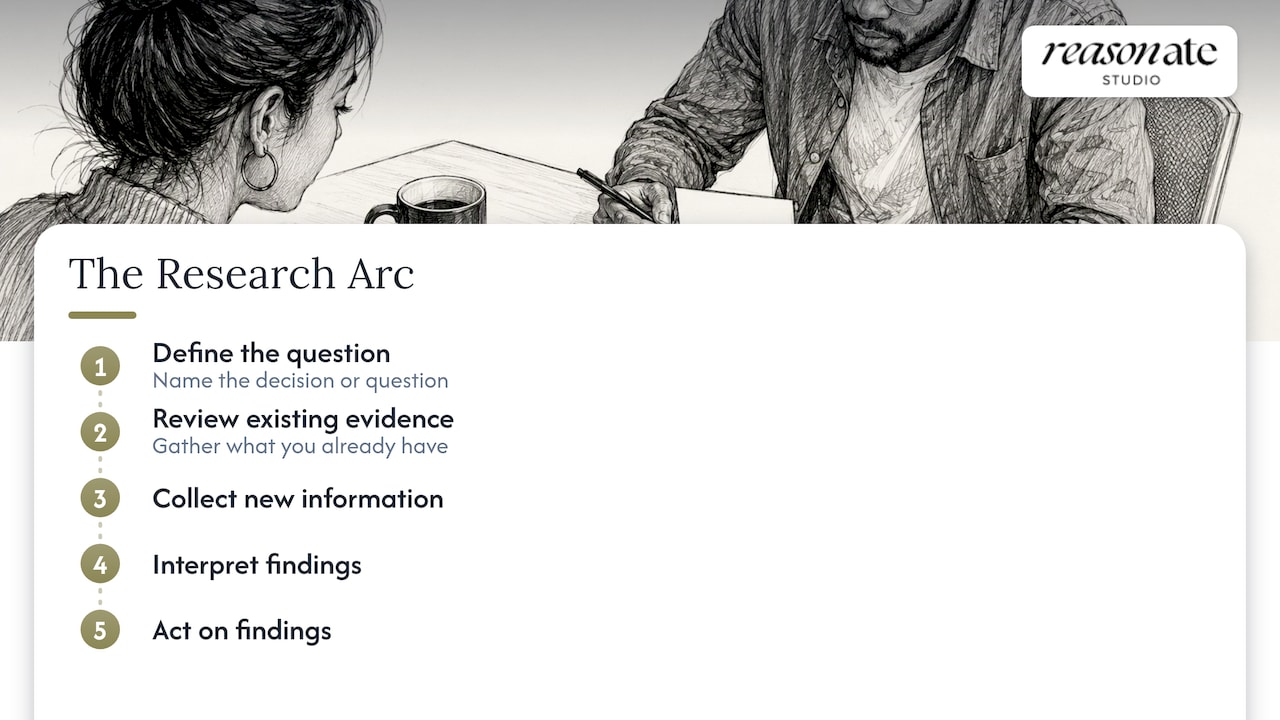
Research with no decision attached produces a slide deck and nothing else. Write one sentence: “We need to decide whether to ___.” For example: whether to launch a group program, whether to narrow your design practice to kitchen and bath renovations, whether to rewrite the website around one type of client.
This is also where most self-run research goes wrong. A vague goal such as “learn about my customers” leads to vague questions and findings you cannot use.
When we work with a firm, this step is part of the senior-level direction. We start from the business decision and the marketing priority it affects, so that the research serves a plan instead of sitting beside one.
Before asking anyone anything, review your own records: inquiry emails, intake forms, proposals won and lost, testimonials, reviews, and notes from discovery calls. Look for the repeated phrases and the common reasons deals stalled. The Greenbook’s buyer checklist lists existing evidence, such as prior studies or customer feedback, as something to document before you approach any research firm, because it keeps you from paying to rediscover what you already know.
You need three groups, and most people only talk to the first:
Aim for eight to twelve conversations across those groups. For an interior designer, that might be five past homeowners, three lost prospects and three trade partners such as contractors or real estate agents.
Good interview questions begin with “tell me about the time when.” Ask what was going on before they looked for help, what else they considered, what nearly made them hesitate, and what they would tell a friend who was thinking about hiring you. Do not ask whether they “like” your services. People are polite, and polite answers are useless.
Record the conversation with permission, and write down the exact words used. Those words belong in your headlines.
The U.S. Chamber of Commerce’s guide to small-business surveys advises keeping a survey to five to 10 questions on one topic, avoiding leading, loaded and double-barreled questions (two questions in one). It also explains how to calculate your response rate, responses divided by invitations, and describes 20 to 30 percent as high, while a rate under 5 percent may not be worth analyzing.
That last number should shape your plan. If your list has 150 people, you will not get a statistically meaningful survey. Use interviews, and use the survey only to check a pattern on a larger list.
Sort what you heard into four piles: who your best clients really are, the problem they hire you to solve, the language they use, and the objections you need to answer. Then change something within 30 days: a homepage headline, an offer name, the first question in your consultation, a follow-up email. Research that does not alter a single piece of marketing was a conversation, not research.
This is the step where our approach differs from a stand-alone research report. At Reasonate Studio, the same senior lead who works with you on brand messaging strategy takes direction of marketing priorities, so findings land in your messaging, website and campaigns rather than in a PDF.
If you sell advice, your product is invisible until someone trusts you. Research helps you make it visible.
Create Coaching Consulting’s guide for coaches says research helps you understand what ideal clients need and want so you can build offers they want to buy, generate ideas for your next offer, and validate a current program before launch. It also stresses learning the language ideal clients use about what they want. Consulting Success makes a similar case for consultants, recommending research into clients’ pain, desires and recommendations, recording their precise language. The aim is to uncover problems clients will pay to solve, how they measure success, what they have already tried and the objections to overcome.
In Chicago, a few patterns are worth testing in your own interviews:
Design is a visual business, so many firms lean on photography and assume it speaks for itself. Research tends to show that clients are comparing something else: process, communication, budget control and how the firm handles the unexpected.
Questions worth asking past clients:
A firm that learns its best clients value predictability can build a clearer onboarding sequence, show a sample timeline on its website and name its process in proposals. That is customer research turning into offer design and marketing in a single move. If your design practice has outgrown referrals, it is also the groundwork for a stronger brand strategy.
Some owners prefer to hand the work to a professional. That is reasonable: interviews take time, and a neutral person often hears things clients would not say to you directly. Whoever you choose, prepare the brief first.
The Greenbook’s buyer checklist advises documenting the decision the findings will drive, the learning need, the audience including essential subgroups, existing evidence, and constraints such as deadline, budget and who must approve the work. A one-page brief covering those points will save you money with any provider.
The Greenbook describes a full-service consultancy as one that designs the project from your objectives with approval at key milestones, recommends the methodology, executes the work, reports results with recommendations, and holds regular status meetings. It also says a good methodology recommendation weighs objectives, geographic scope, the population you need to reach, budget and timeline, and that an agency should tell you plainly when budget or timeline forces a compromise.
You have a role too. The Greenbook’s project management guide notes that clients define objectives and success criteria, approve research instruments and sampling plans, and review progress, for instance by listening to the first three to five interviews as a quality check.
The same buyer’s checklist frames selection as a test of how a firm thinks: how it interprets your brief, reaches the right participants, explains trade-offs and turns findings into something stakeholders can use. For a Chicago practice with a limited budget, add one more question: who will actually do the work, and who will decide what to do with the findings?
That is the gap many small businesses fall into. A research-only vendor hands you a report. Then you still need strategy, messaging, a website and consistent content, usually from other people, with the insight diluted at every handoff.
Research has value only at the moment it changes a decision. For a small professional-services business, the decisions that matter most are these: who you target, what you say, what you sell and where you show up. Those are marketing leadership decisions, and they are made every week, not once.
Our model is built around that. Every engagement at Reasonate Studio is led directly by our founder, Kaitlyn, who connects strategy with execution and takes responsibility for marketing priorities, decisions, team and partner direction, and business performance. We work with a deliberately small client roster and build on the strengths and reputation your business has already earned. Audience and market research is one of the things we do, alongside brand positioning and messaging, offer and customer-journey development, marketing strategy and campaign planning.
That means the person who hears your clients describe their problem is the person who writes the strategy and directs the content, email, SEO and landing pages that follow.
Imagine a Chicago business coach whose clients come only through referrals. Interviews reveal that the best clients are founders in the first year after raising their team beyond ten people, and they describe the problem as “I’m the bottleneck.” That single phrase becomes the headline of the homepage, the subject line of a three-email sequence, the opening of a LinkedIn post series and the first slide of a sales conversation. Research plus execution is one system. This example is illustrative, not a client result.
For firms that want that kind of connected work, our Chicago fractional marketing leadership service gives you senior direction without a full-time executive hire. For more on how research feeds the plan, see our guide to how to build a marketing strategy.
Once you know who you serve and what they say, the work becomes consistency: publishing, emailing, updating pages and measuring what responds. Our Marketing Momentum partnership covers social media, email, blog content and landing pages for $1,500 per month. Firms that need broader senior leadership across strategy, team and vendors can look at Embedded Marketing Leadership.
If you want to talk through which of those fits your practice, start on the Reasonate Studio site.
Most of the owners I meet in Chicago are better than their marketing makes them look. They have loyal clients, strong results and a reputation that took years to build. What they do not have is a clear account of why people choose them, in the words those people actually use.
That is what research is for. It is not a separate project with its own report. It is the first month of good marketing leadership. When I sit down with your best clients and hear how they describe the problem, I am not collecting data for a deck. I am deciding what your homepage says, which offer to lead with and what the next quarter of content should address.
This is why we keep our roster small and why I lead every engagement myself. The same person who hears the insight is accountable for the strategy, the team and the results. Nothing is lost in a handoff, because there is no handoff. If your business has outgrown referral-only growth, the most useful thing you can do is let someone with senior marketing judgment listen to your clients and then act on what they hear.
Kaitlyn Cole
Eight to twelve conversations across best clients, lost prospects and referral sources is enough for most small practices to see repeating patterns. If the answers keep changing after ten, your audience is probably too broad, which is itself a useful finding.
A survey is one method. Customer research is the whole effort: deciding the question, choosing who to hear from, selecting methods such as interviews, observation or surveys, and interpreting results. Surveys measure how common something is, so they work best after interviews have shown you what to measure.
Start with what you already hold, such as inquiries, proposals and testimonials, and with free public sources like the Census Bureau and Bureau of Labor Statistics for local context. Then talk to clients to fill the gaps. This order is the one Xero’s U.S. small-business guidance recommends: secondary first, then targeted primary research.
Write a one-page brief: the decision the findings will drive, who you need to hear from, what evidence you already have, your deadline and budget, and who approves the work. With that in hand, any consultant can scope the project accurately.
It changes marketing when you commit to acting on it within a set window. Typical results are a narrower target client, a rewritten headline in the language clients use, a renamed offer or a different first step in the sales process.