September 22, 2026
Why Update Brand Messaging: Essential Guide for Growth


Learn what a marketing and communications strategy is, how it builds brand trust, the types available, and the key steps for entrepreneurs to scale.

Most american solo entrepreneurs find themselves piecing together scattered marketing efforts without a clear plan. This creates confusion, wastes precious resources, and makes standing out nearly impossible in today’s crowded market. A well-structured marketing and communications strategy offers a powerful solution, helping you align your message, clarify your goals, and attract clients with purpose. Discover how building a thoughtful roadmap can transform random actions into measurable progress and set your brand apart from the competition.
A marketing and communications strategy represents a comprehensive blueprint that guides how an organization connects with its target audience, communicates its core message, and achieves strategic business objectives. At its core, this strategy transforms disconnected marketing activities into a purposeful, synchronized approach that amplifies brand visibility and drives meaningful engagement.
Marketing and communications strategies operate across multiple organizational levels, synthesizing key decisions about product positioning, target market segments, messaging frameworks, and communication channels. Effective marketing strategies integrate organizational choices about products, markets, and communication approaches into a cohesive plan that translates business goals into actionable marketing activities. These strategies are not one-size-fits-all solutions but dynamic frameworks tailored to specific business contexts and audience needs.
The fundamental components of a marketing and communications strategy typically include:
Pro tip: When developing your marketing and communications strategy, start by deeply understanding your target audience’s pain points, preferences, and communication habits before designing any tactical approaches.
Marketing and communications strategies are not monolithic but comprise several distinct strategic types that serve different organizational objectives. These types range from broad organizational approaches to specific tactical implementations, each designed to address unique business challenges and opportunities.
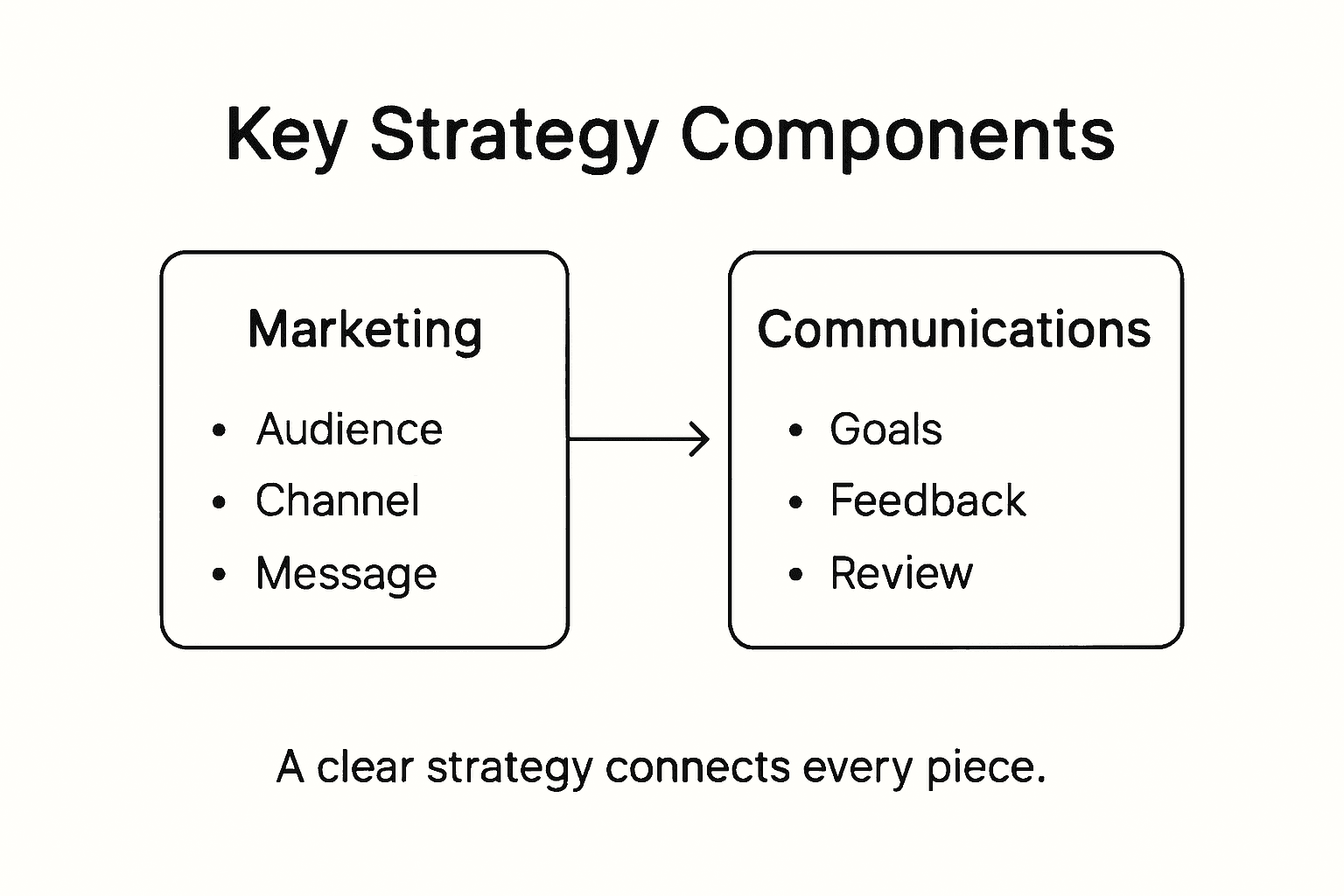
Comprehensive marketing strategies typically break down into four primary categories:
Here’s a comparison of strategic types and their business impact:
| Strategic Type | Main Focus | Most Suitable For | Typical Outcome |
|---|---|---|---|
| Product-Based Strategy | Product differentiation | Innovative brands | Clear market position |
| Market Penetration | Growing existing audience | Established businesses | Increased market share |
| Growth Strategy | Expansion and new markets | Scaling organizations | Access to new segments |
| Brand Positioning | Brand identity strength | Competitive industries | Enhanced brand loyalty |
The marketing mix represents another critical framework for understanding strategic components. Traditionally defined by the four Ps - product, price, promotion, and place - this model provides a structured approach to strategic decision-making. Each component requires careful consideration:
Successful strategies also integrate communication channels that align with target audience preferences. These might include digital platforms, traditional media, direct marketing, social media engagement, and content marketing approaches. The key is selecting channels that maximize audience reach and engagement while maintaining consistent brand messaging.

Pro tip: Develop your marketing strategy by conducting a thorough audience analysis, mapping communication preferences across different channels, and creating flexible approaches that can adapt to changing market dynamics.
Marketing strategy acts as the critical engine that transforms abstract business goals into tangible brand momentum. Brand strategy development fundamentally connects organizational capabilities with market opportunities, creating a roadmap for sustainable competitive advantage and systematic growth.
The mechanism of brand growth through strategic marketing involves several interconnected dynamics. First, strategic approaches enable precise market positioning by identifying unique value propositions that differentiate a brand from competitors. This positioning creates meaningful connections with target audiences, transforming casual consumers into loyal brand advocates. Strategic marketing research allows businesses to uncover nuanced audience insights, enabling more targeted and resonant communication approaches that drive engagement and trust.
Key drivers of brand growth through strategic marketing include:
Successful brand growth strategies also require continuous learning and refinement. Businesses must develop feedback loops that capture audience responses, measure campaign effectiveness, and iterate their approaches. This dynamic approach transforms marketing from a static communication tool into a responsive, intelligent system that evolves with market conditions and consumer preferences.
Pro tip: Design your marketing strategy with built-in measurement mechanisms and quarterly review processes to ensure continuous optimization and alignment with changing market dynamics.
Developing a strategic marketing and communications roadmap requires a systematic approach that transforms conceptual goals into actionable initiatives. Effective marketing strategy templates provide entrepreneurs with a structured framework for translating vision into executable plans that drive meaningful business growth.
The roadmap creation process involves several critical stages of strategic development:
Successful roadmap execution demands continuous monitoring and adaptive flexibility. Entrepreneurs must develop robust feedback mechanisms that allow real-time strategy adjustment. This means creating nimble frameworks that can quickly respond to market shifts, emerging audience preferences, and unexpected competitive challenges. The most effective roadmaps are not static documents but living strategic instruments that evolve with the business ecosystem.
Implementation requires breaking down the overarching strategy into granular, actionable quarterly and monthly objectives. Each milestone should have clear ownership, specific metrics, and defined success criteria. By maintaining this level of strategic granularity, businesses can transform high-level vision into systematic, measurable progress.
The following table summarizes how successful roadmap execution benefits a business:
| Execution Element | Business Benefit | Long-Term Result |
|---|---|---|
| Continuous Monitoring | Quick response to market shifts | Maintained competitiveness |
| Feedback Mechanisms | Improved understanding of needs | Stronger customer loyalty |
| Adaptive Flexibility | Ability to pivot strategy | Sustained brand growth |
| Clear Milestones | Trackable progress | Consistent goal achievement |
Pro tip: Create a quarterly strategy review process where you critically assess your roadmap’s performance, gather team insights, and make data-driven adjustments to maintain strategic momentum.
Marketing and communications strategies are fraught with potential missteps that can derail even the most promising initiatives. Understanding strategic marketing risks is crucial for entrepreneurs seeking to navigate the complex landscape of brand development and audience engagement.
The most prevalent strategic risks fall into several critical categories:
Organizational barriers often compound these strategic risks. Many businesses struggle with internal communication breakdowns, where marketing teams operate in silos, disconnected from broader business objectives. This fragmentation leads to disjointed messaging, wasted resources, and missed opportunities for holistic brand development. Successful strategies require cross-functional alignment, ensuring that marketing initiatives directly support overarching business goals and maintain consistent brand narrative.
Technology and data present both opportunities and significant risks. Entrepreneurs must carefully navigate the complex world of digital marketing analytics, avoiding common pitfalls such as over-reliance on vanity metrics or misinterpreting data signals. The most effective strategies balance quantitative insights with qualitative understanding, creating a nuanced approach that goes beyond surface-level measurements.
Pro tip: Develop a monthly cross-functional review process that brings together marketing, sales, and product teams to critically assess strategy performance and identify potential blind spots.
Struggling to turn your marketing plans into clear, actionable steps that truly resonate with your audience and drive growth This article shows the importance of a well-aligned strategy that understands your target market, consistent messaging, and adaptive frameworks. If you are feeling overwhelmed by strategy frameworks or worried your efforts lack measurable impact you are not alone. Many entrepreneurs face the challenge of balancing brand identity with effective execution without wasting budget on scattershot campaigns.
At Reasonate Studio, we specialize in turning these challenges into opportunities with our proven Aligned Impact Model™. This approach simplifies complex marketing decisions by aligning your brand foundations with audience psychology and business goals. It is built to create sustainable growth, not just quick wins, by combining strategy, storytelling, and operational discipline. Whether you want to transform your side hustle into a full-time business or elevate an existing brand, our flexible DIY, DWY, and DFY tiers meet you exactly where you are.

Take control of your marketing direction today and avoid common pitfalls like inconsistent messaging or resource misallocation. Visit Reasonate Studio to discover how our strategic brand and marketing services can help you build a clear, confident roadmap for success. Learn more about developing an effective marketing plan at What Is a Marketing and Communications Strategy and start turning your vision into measurable results.
A marketing and communications strategy is a blueprint that outlines how an organization connects with its target audience and communicates its core message to achieve business objectives.
Key components include target audience identification, brand positioning, communication objectives, marketing channels, and a messaging framework aligned with the brand identity.
A marketing strategy facilitates brand growth by enabling precise market positioning, consistent messaging, and audience segmentation, helping to create loyal brand advocates and improve engagement.
Common mistakes include misaligned target audiences, inconsistent messaging, inadequate performance tracking, resource misallocation, and developing rigid strategies that fail to adapt to market changes.