September 22, 2026
Why Update Brand Messaging: Essential Guide for Growth


Marketing strategy canvas helps small coaches align brand messaging, target ideal clients, and boost conversion. Covers structure, benefits, mistakes.

Trying to grow your coaching or consulting business in the United States or Canada can feel scattered when your strategy lives on a dozen documents and half-remembered to-do lists. Early-stage coaches and consultants often struggle to define clear positioning and align messaging, which stalls client growth. The Marketing Strategy Canvas gives you a one-page visual guide that uncovers gaps, connects your ideas, and brings your entire marketing approach into focus so you can attract and convert the clients you actually want.
A Marketing Strategy Canvas is a visual one-page tool that helps you map out your marketing approach in a structured, easy-to-understand format. Unlike traditional marketing plans buried in lengthy documents, this canvas consolidates everything that matters into a single visual overview that your entire team can grasp in minutes.
Think of it as a strategic blueprint rather than a marketing document. It shows what you’re selling, who you’re selling to, how you’ll reach them, and why your offer stands out from competitors. The canvas brings clarity to decisions that often feel scattered across spreadsheets, emails, and half-forgotten strategy meetings.
When you’re building a coaching or consulting business, you’re juggling multiple moving pieces simultaneously. You’re developing your expertise, creating content, reaching potential clients, and managing operations all at once.
A Marketing Strategy Canvas solves this by:
The canvas transforms abstract marketing strategy into a concrete, actionable visual guide that keeps your team aligned and focused on what actually drives client growth.
Traditional marketing plans are comprehensive documents, often 20-40 pages long. They’re thorough but overwhelming. A busy coach or consultant rarely refers back to them once they’re written.
The Marketing Strategy Canvas is the opposite. It’s one page. Everything visible at once. This single-page approach forces you to prioritize ruthlessly, identifying only the factors that genuinely matter for your business growth.
When you explore what a marketing strategy actually is, you’ll notice that effective strategies share one trait: clarity. The canvas delivers this by eliminating fluff and focusing on strategic decisions that move the needle.
At its core, a Marketing Strategy Canvas answers these critical questions:
The visual format lets you see relationships between elements immediately. You might notice, for example, that your messaging doesn’t align with where your ideal clients actually spend time online. That’s insight you’d miss in a traditional document.

Pro tip: Start your Marketing Strategy Canvas by identifying your ideal client first—everything else flows from understanding exactly who you serve and why they need your help.
Not all canvas models are created equal. Different frameworks solve different marketing challenges, and choosing the right one depends on your business stage, team size, and what you’re trying to accomplish.
Think of canvas models as different lenses for viewing your marketing strategy. One model might excel at mapping customer relationships, while another focuses on competitive positioning. Understanding the variations helps you pick the tool that actually fits your coaching or consulting business.
Many canvas models build on the foundation of the Business Model Canvas, adapted specifically for marketing. This version structures your entire marketing plan into key building blocks that show how your business creates and delivers value.
The model breaks down into essential components:
This framework works well for coaches and consultants because it connects your marketing directly to business operations. You’re not creating strategy in isolation—you’re mapping how marketing drives the entire business model.
A well-designed canvas model forces you to see marketing as interconnected with every other part of your business, not as an isolated department.
Some canvas models take a broader approach, incorporating dimensions beyond the traditional business model. These models recognize that modern marketing operates across multiple layers simultaneously.
A multi-dimensional canvas typically includes:
This approach works when you need to think beyond acquisition and consider the entire customer lifecycle. For consultants, this means mapping not just who finds you, but how they experience working with you.
The third major approach is the adaptive canvas, designed for businesses operating in fast-changing markets. This model emphasizes flexibility and real-time adjustment rather than static annual planning.
Adaptive canvases integrate both online and offline interactions, allowing your strategy to evolve as market conditions shift. This matters significantly for coaches and consultants building during economic uncertainty or rapid industry changes.
When you’re building a winning marketing plan, adaptability becomes a competitive advantage. You can pivot channels, refine messaging, and adjust positioning without starting from scratch.
The right canvas depends on where you are in your business journey.
Use a business model canvas if you’re clarifying how marketing fits into your overall business. Use a multi-dimensional canvas if you’re thinking holistically about customer experience. Use an adaptive canvas if you need flexibility to test and adjust strategies frequently.
Many successful coaches start with the business model approach, then graduate to multi-dimensional thinking as their client base grows. Your canvas should evolve with your business.
Here’s a quick comparison of the major canvas models for marketing planning:
| Canvas Model | Key Focus | Ideal For | Adaptability |
|---|---|---|---|
| Business Model Canvas | Mapping value creation | Startup coaches, consultants | Moderate |
| Multi-Dimensional | Full customer lifecycle | Growth-focused businesses | Medium |
| Adaptive Canvas | Real-time strategy shifts | Fast-changing markets | High |
Pro tip: Start with whichever canvas resonates most with your thinking style—adoption matters more than perfect fit, since the best canvas is the one you’ll actually use and reference regularly.
A Marketing Strategy Canvas typically contains nine key fields, each designed to capture a specific aspect of your marketing approach. These fields work together as an integrated system, not as isolated components.
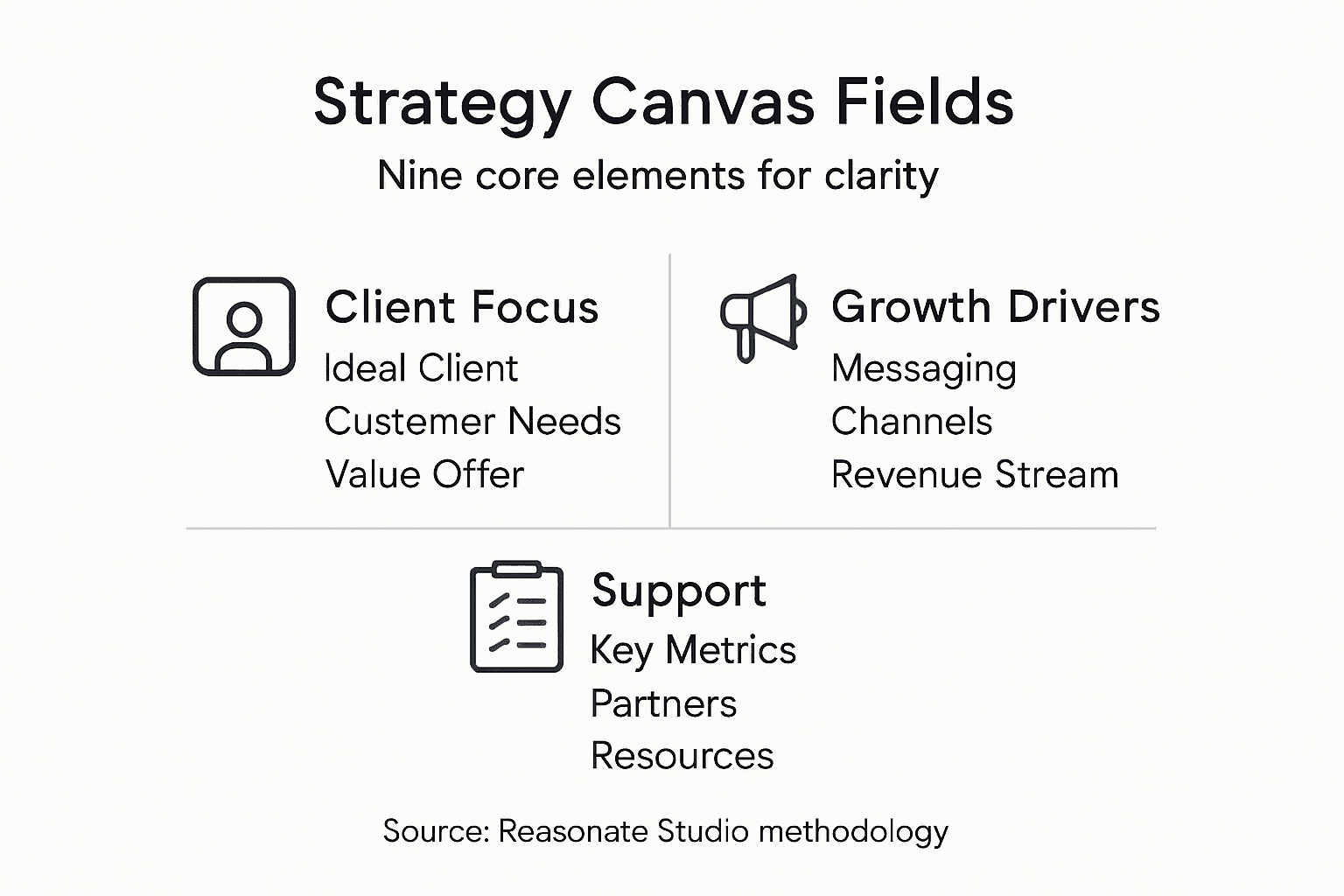
Understand how these elements function, and you’ll see why coaches and consultants can build sustainable client growth without scattered tactics or confused messaging. The canvas forces connections between ideas that often sit separately in traditional marketing plans.
Each field on your canvas answers a specific question about your marketing strategy:
These nine fields connect directly to real business outcomes. Missing or poorly defined fields create gaps where marketing efforts fall apart.
This table summarizes the nine core fields of a Marketing Strategy Canvas and their impact on business growth:
| Canvas Field | What It Explains | Business Impact |
|---|---|---|
| Customer segments | Who you serve | Targets high-fit clients |
| Pain points | Challenges clients face | Increases service relevance |
| Value proposition | Promise or outcome | Drives differentiation |
| Channels | Where clients spend attention | Raises visibility |
| Messaging framework | Language that connects | Builds brand recognition |
| Brand positioning | Unique business stance | Attracts ideal segment |
| Customer journey | Steps from awareness to sale | Improves conversion rates |
| Key metrics | What is measured | Tracks progress |
| Competitive differentiation | Distinctive business angle | Reduces price-based competition |
The power of the canvas lies in seeing how each element depends on the others—change your value proposition, and your messaging framework shifts, which affects which channels matter most.
One of the canvas’s greatest strengths is horizontal axis mapping. This shows how your coaching or consulting services perform against key customer-valued factors, compared to competitors.
Imagine this scenario: You list factors that matter to your ideal client—transformation speed, affordability, personal attention, proven results. You plot where you stand on each factor, then plot where three competitors stand. Immediately, you see gaps.
Maybe you’re better at personal attention but weaker on proven results visibility. That insight drives strategy changes. You don’t guess—you see the gap visually and close it.
When all nine fields are filled in, your canvas reveals hidden connections. You might notice that your messaging doesn’t align with where your customers actually discover services. Or that your value proposition addresses pain point A, but your best customers actually have pain point C.
This 360-degree perspective is what separates the canvas from a simple checklist. When you understand how brand elements build trust and recognition, you’re better positioned to make these connections deliberately rather than accidentally.
The canvas also surfaces knowledge gaps quickly. Empty fields or unclear thinking becomes obvious immediately. You can’t hide behind vague language when everything needs to fit on one page.
The canvas functions as both diagnostic and roadmap. Diagnostically, it reveals where your current marketing strategy has holes or misalignments. As a roadmap, it shows exactly which elements to prioritize fixing first.
For a new coaching business, you might discover that your customer segment definition is too broad. For an established consultant pivoting to a new niche, you might find that your messaging still addresses your old customer’s pain points.
Pro tip: Fill your canvas with one customer segment at a time if you serve multiple niches—this prevents muddied positioning and lets you see exactly where each segment needs different messaging, channels, or value propositions.
The Marketing Strategy Canvas isn’t theoretical. It’s a working tool that coaches and consultants are using right now to clarify positioning, attract better-fit clients, and stop wasting marketing energy on tactics that don’t convert.
Here’s how the canvas solves real problems small businesses face every day.
A coaching business launches with a general positioning: “I help professionals succeed.” Vague. Too broad. Then the founder fills out a canvas, specifically mapping their customer jobs to be done and customer aspirations.
Suddenly, they see it. Their best clients aren’t general professionals—they’re mid-level managers struggling with delegation and team building. That single insight shifts everything.
Messaging changes. LinkedIn content changes. Website copy changes. Client quality improves because they’re attracting the right people, not everyone.
Three life coaches operate in the same geographic market. They all have similar credentials. Without a canvas, they compete on price or claim to be “different” without proving it.
With a canvas, each defines their brand identity and value proposition precisely. One specializes in executive transitions, another in work-life integration, the third in early-career confidence. Now they’re not competing—they’re operating in different lanes.
Small businesses that clearly articulate their differentiation on a canvas attract clients who specifically want what they offer, not clients shopping for the cheapest option.
A consultant assumes she knows what clients want. She builds her service around what she thinks matters. Then she uses the canvas to explicitly map customer pains and gains, and realizes her assumption was wrong.
Her clients don’t primarily want faster results—they want clarity on what to expect. That insight reshapes her entire service delivery, messaging, and pricing structure.
When you develop a marketing strategy grounded in customer reality, you stop guessing and start building on evidence.
The canvas includes an engagement dimension. This isn’t just about acquisition—it’s about how you stay connected with clients post-sale.
A small consulting firm realizes through their canvas that they’re strong at delivery but weak at ongoing value communication. Clients get results but don’t see the coach as a trusted long-term partner. Adding a simple monthly touchpoint changes client retention dramatically.
Small businesses can’t afford expensive mistakes. The canvas becomes your testing framework. You build one version, test it, then adjust specific elements based on what you learn.
Maybe your channels aren’t working. Adjust that field and test new channels. Your messaging falls flat. Refine that section. You’re iterating strategically, not thrashing randomly.
Pro tip: Create canvas variations for different customer segments or service offerings—this lets you test positioning, messaging, and channel strategy in parallel without losing coherence across your overall brand.
Building a Marketing Strategy Canvas is straightforward. But execution often stumbles because coaches and consultants make the same mistakes repeatedly. Knowing what to avoid saves you time, money, and the frustration of discovering flaws after you’ve already launched.
Here are the pitfalls that derail most small businesses—and how to sidestep them.
You list what your competitor offers and build your canvas around proving you’re better. Wrong direction.
The strongest positioning focuses on customer pain points and aspirations, not competitor features. Maybe your competitor emphasizes credentials. But your ideal client actually wants personalized attention and guarantees results. That’s your differentiation angle.
When you obsess over competitors, you’re imitating rather than innovating. You end up in their game, played by their rules. Your canvas should answer: What does my customer need that nobody else is addressing?
Competitors should inform your canvas, but customer needs should drive it.
Coaches and consultants build their canvas once, then file it away. Six months later, the market has shifted, they’ve learned new things about their clients, but the canvas hasn’t changed.
This is where most strategies fail. The canvas isn’t a static deliverable—it’s a living document that evolves as you learn.
Your messaging might need refinement after six months. Your customer segments might split into two distinct groups. Your best-performing channels might change. Without updating your canvas, you’re operating on outdated strategy.
You guess at customer pain points instead of asking actual clients. You assume competitors’ positioning without researching their actual messaging. You estimate marketing channel performance without checking analytics.
Inaccurate data corrupts everything downstream. Your entire strategy rests on flawed assumptions.
Spend time validating. Talk to five of your best clients about their actual pain points. Research what three competitors actually say. Check which channels actually drive inquiries for your business.
Your canvas captures your positioning against current competitors. But what if the market itself is shifting?
Economic downturns, industry consolidation, new technologies, or changing buyer preferences can render your canvas obsolete. You need to periodically assess whether the market fundamentals have changed, not just whether competitors shifted tactics.
When you avoid common branding mistakes that limit growth, you’re also protecting your canvas from irrelevance.
You identify factors that matter to customers, but weight them wrong. You think price is secondary, but for your segment, affordability is primary. You think transformation speed doesn’t matter, but it’s actually what wins contracts.
Misweighting factors skews your entire strategic picture. Spend time ranking factors by actual customer importance, validated through conversations or data.
You build your canvas, launch strategy based on it, then ignore results. If conversion rates stay flat or better-fit clients aren’t appearing, that’s data telling you something is wrong with your canvas assumptions.
The strongest performers treat their canvas as a hypothesis-testing tool. When reality contradicts your canvas, that’s valuable feedback to refine it.
Pro tip: Schedule quarterly canvas reviews where you audit each element against actual business results—if your messaging says one thing but your best clients came from a different channel, that mismatch signals what to adjust.
The article highlights how the Marketing Strategy Canvas brings vital clarity to your coaching or consulting business by focusing on your ideal clients, messaging, and competitive differentiation. If you find yourself overwhelmed by scattered tactics or uncertain about how to connect your value proposition with the right audience, you are not alone. Key challenges include aligning your messaging with actual customer pain points, identifying effective marketing channels, and adapting to market changes swiftly.
At Reasonate Studio, we understand these hurdles deeply. Our proprietary Aligned Impact Model™ offers a strategic framework that begins where the Marketing Strategy Canvas suggests – by uncovering core brand foundations such as positioning, messaging, and audience psychology. We partner with entrepreneurs and small businesses to transform these insights into marketing systems that are sustainable and measurable. Whether you want to make your side hustle a thriving full-time business or take your existing brand to new heights, working with Reasonate Studio means gaining clarity and confidence in your marketing approach.
Ready to move beyond guesswork and build a strategy that truly resonates with your ideal clients?
Explore how our blend of strategy, creativity, and operational discipline can sharpen your marketing vision and accelerate growth. Start your journey toward clarity and client connection today by visiting Reasonate Studio and discover more about building marketing strategies that stick. Take the first step to align your marketing with your business goals now at https://reasonatestudio.com.
A Marketing Strategy Canvas is a visual tool that provides a one-page overview of your marketing approach, consolidating key elements such as your value proposition, target audience, marketing channels, and competitive differentiation.
It helps clarify positioning, aligns messaging, identifies ideal clients, maps go-to-market strategies, and quickly spots gaps in the marketing approach, ultimately leading to better client acquisition and growth.
Unlike traditional marketing plans, which can be lengthy and cumbersome, the Marketing Strategy Canvas distills essential information into a single page, providing a clear and accessible overview that can be quickly referenced and adjusted as needed.
The canvas typically includes nine core fields: customer segments, customer pain points, value proposition, marketing channels, messaging framework, brand positioning, customer journey, key metrics, and competitive differentiation.