November 25, 2026
Fractional CMO for Chicago Professional Services Firms


What marketing analytics consulting covers, what it costs you in time and data, and how Chicago coaches, consultants and designers turn numbers into decisions.

Marketing analytics consulting is the work of turning your marketing numbers into decisions: which channels bring in real clients, which messages get replies, and where the next dollar should go. For a Chicago coach, consultant, interior designer or small firm owner, the hard part is rarely getting a report. It is knowing what the report means for your next quarter. That takes someone who reads the data and also runs the marketing. At Reasonate Studio, every engagement is led directly by our founder, Kaitlyn, who connects strategy with execution, so the numbers feed straight into the work that follows.
Marketing analytics is the practice of collecting, measuring and interpreting data to inform better marketing decisions. Martech.org describes it as covering digital channels, offline interactions, CRM data (the records of your contacts and deals), paid advertising, organic efforts, content performance and sales enablement.
That definition is broad on purpose, and it can overwhelm a business with three people and a founder who is also the lead practitioner. A consultant narrows it. In practice the work comes down to four jobs:
The fourth job is where many engagements stall. A consultant who delivers a slide deck and leaves has handed you homework. A founder-led team that also writes the emails and builds the landing pages can close the loop.
This guide is written for owner-led service businesses in the Chicago area: coaches, consultants, interior designers and similar firms with a real track record and no in-house marketing department. If you are a marketing student or an early-stage founder looking for tactics to try yourself, the sources linked below are a better starting point than an agency engagement.
You will hear a lot of jargon. The useful distinction is what question each type answers. Constant Contact’s overview of campaign insights separates four types:
| Type | Question it answers | Example for a Chicago service firm |
|---|---|---|
| Descriptive | What happened? | Eleven consultation requests last month, up from seven |
| Diagnostic | Why did it happen? | Most came from one email and one referral partner’s introduction |
| Predictive | What might happen next? | If the email list keeps growing at this pace, expect similar volume in spring |
| Prescriptive | What should we do? | Send the email series to past clients too, and rewrite the services page to match the language that worked |
Martech.org groups the same ideas into descriptive, predictive and prescriptive models. Descriptive analytics uses historical data to understand what happened and inform planning. Predictive uses past campaigns to anticipate customer behavior. Prescriptive weighs the impact of each touchpoint.
For a firm with a few hundred contacts and a modest monthly volume of inquiries, the first two rows deliver most of the value. Prediction needs more data than most small practices generate, so a good consultant does not oversell it. They get you reliable descriptive and diagnostic answers first.
Followers, impressions and page views feel good and rarely pay a bill. Constant Contact warns against vanity metrics and says tracking should always be brought back to business goals. A coach does not need to know how many people saw a post. She needs to know how many people who saw it went on to book a call, and how many of those calls became clients.
Engagements differ, but a sound one follows the same arc. Here is what each stage should look like and where it tends to go wrong.
Start from revenue and work backward. How many new clients or projects do you want in the next twelve months? What is an average engagement worth? How many consultations does it usually take to land one? These three answers turn a vague goal (“more visibility”) into a number the marketing can be held to.
This is where things go wrong most often: goals set in marketing terms (traffic, followers) that nobody in the business cares about. Our approach starts with the business, because our work spans brand positioning, marketing strategy and performance optimization, not reporting alone.
The Santa Clara University My Own Business Institute advises small businesses to start with three to five KPIs tied to current goals. It also separates two kinds:
A sensible set for a Chicago interior designer might be: qualified inquiries per month, consultations booked, proposals sent, projects signed, and the source of each. For a coach, it might be discovery calls booked, calls-to-clients rate, and referral share of new clients.
Before anyone analyzes anything, confirm the inputs are sound. Check that your website forms and booking links record each submission, that your CRM or even a simple spreadsheet captures where each new client came from, and that your email platform’s reports line up with what actually reached your team.
Salesforce’s small business guide reports that half of U.S. small and midsize companies have a CRM and recommends pairing CRM and digital marketing platforms with free Google Analytics. It notes that Google Analytics should show data 24 to 48 hours after tracking is set up properly. If your numbers are not showing up a few days after setup, that is a signal something is misconfigured, and it is much cheaper to find that in week one than in month six.
The audit is also a good moment to look at the whole marketing picture. Our guide on how to run a marketing audit walks through that wider review.

The Santa Clara guidance is to review KPIs on a schedule matched to how fast the information changes, not daily. For most small firms that means a short monthly review and a deeper quarterly one. Daily checking mostly produces anxiety and reactive changes to campaigns that have not had time to work.
A monthly report for an owner should fit on one page: the three to five KPIs, the change from last month, a sentence on why, and the decision it points to.
This is the step that separates a useful engagement from a PDF. A finding like “your best-converting inquiries come from past-client referrals and one long-form article” needs a follow-through: a referral program, more content in that vein, a landing page built for that audience. When the same senior person who reads the data also directs the marketing, the recommendation and the execution are not separated by a handoff. That is the design of our fractional CMO and embedded marketing leadership work, where we take responsibility for marketing priorities, decisions, team and partner direction, and business performance.
The most common question owners bring to analytics is simple: is this marketing paying for itself?
Marketing ROI (return on investment) compares what marketing earned against what it cost. The standard formula is:
(Revenue from marketing − cost of marketing) ÷ cost of marketing × 100
Suppose a Chicago consultant spends $6,000 over a quarter on content, email and a landing page, and tracks two new clients from it, each worth $9,000 in first-year fees. Revenue from marketing is $18,000.
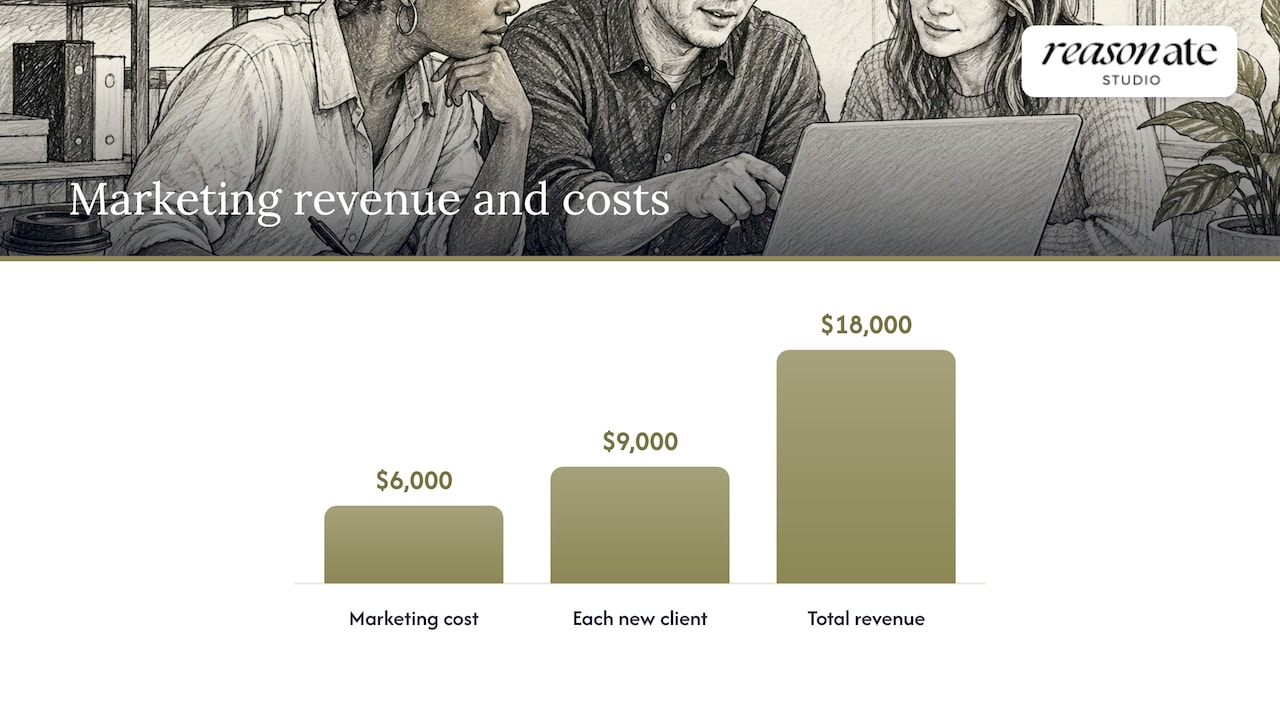
($18,000 − $6,000) ÷ $6,000 × 100 = 200% ROI, or $3 returned for every $1 spent.
The example is hypothetical, but it shows the two places the math usually breaks for service firms:
For a deeper look at planning spend around these numbers, see our pieces on marketing ROI strategies for small businesses and how to optimize your marketing budget.
Many Chicago professional practices have grown mostly through referrals. Referral growth is valuable, and it is also nearly invisible in standard web analytics. A consultant who treats referrals as a tracked channel (asking every new client how they found you and logging it in your CRM) gives you a baseline. Then you can see whether your website, content and email are strengthening referrals, since people often look you up before they call, or whether they are adding a second source of clients.
Analytics services come in several types. Knowing the type tells you what you will and will not get.
| Type of provider | What you typically get | Fit for an owner-led service firm |
|---|---|---|
| Pure analytics or data shop | Tracking setup, dashboards, attribution models | Strong on measurement; you still need someone to decide and act |
| Freelance analyst | Reports and spreadsheets, often hourly | Useful for a one-off setup; limited strategy |
| Full-service ad agency | Campaign management with channel reporting | Reports reflect the channels they run |
| Senior-led fractional marketing leadership | Measurement tied to strategy, messaging and execution | Built for owners without an in-house marketing department |
For a coach, consultant or designer with revenue in the low millions or below, the last row usually fits best. Your constraint is not a shortage of data. It is a shortage of a senior person who can say what the data means and then get the work done.
Questions worth asking any provider, ours included:
That last question matters. We work with a deliberately small client roster, and every engagement is led by Kaitlyn directly, so the person who studies your numbers is the same person making the marketing decisions.
Analytics without positioning tells you which message performed best among messages that were never very clear. If a prospective client lands on your site and cannot tell in a few seconds what you do and for whom, no amount of tracking will fix the conversion rate. It will only measure it precisely.
This is why we connect brand strategy, messaging, demand generation and execution into one system. The measurement shows what is working, the positioning work makes the business easier to understand, trust and choose, and the execution gets it in front of the right people. If your numbers show plenty of visits and few inquiries, the first place to look is often the message. Our brand messaging strategy work addresses exactly that.
A few Chicago-specific realities shape the picture too:
Most small firms we meet are not short on data. They are short on someone senior who owns the question “what should we do next, and did it work?” A dashboard cannot answer that. A person who understands your business, your reputation and your goals can.
That is why we do not treat measurement as a separate product. Every engagement at Reasonate Studio is led directly by me, and I connect strategy with execution. I take responsibility for marketing priorities, decisions, team and partner direction, and business performance. When we look at your numbers, we are also the ones deciding how the next campaign, email or landing page should change.
We keep our client roster deliberately small and build on the strengths and reputation your business has already earned. For an established coach, consultant or design firm, the quality of the work is usually ahead of how it is presented. Good analytics shows where that gap is costing you, and good marketing leadership closes it.
Kaitlyn Cole
If you want measurement and the marketing that acts on it from one team, two of our offers fit most owner-led service firms.
Marketing Momentum is a recurring monthly partnership covering social media, email, blog content and landing pages, at $1,500 per month. It suits a business that needs consistent, well-directed execution without building a team.
For a broader role, Embedded Marketing Leadership puts senior marketing direction inside your business, covering strategy, priorities, reporting and the direction of vendors and team members. If you are weighing the fractional route, our Chicago fractional marketing leadership page explains how it works.
Whatever route you take, here is a realistic sequence for getting analytics working:
A written plan keeps this from drifting. Our marketing plan template for Google Sheets and guide on how to develop a marketing strategy give you a structure to record goals, KPIs and decisions in one place. If your operations around marketing are the bottleneck, our article on marketing operations consulting for Chicago small businesses covers that side.
A marketing analytics consultant defines which numbers matter, confirms your tracking records them correctly, interprets the results and recommends changes. For a small firm, the most useful version also helps carry out those changes. Our work combines that senior direction with execution across content, email, SEO, social media and landing pages.
Start with three to five KPIs tied to your current goals, as the Santa Clara University guidance recommends. Include at least one leading indicator, such as inquiries or booked calls, and one lagging indicator, such as revenue or retention. Review them monthly rather than daily.
Subtract your marketing cost from the revenue it produced, divide by the marketing cost, and multiply by 100. If $6,000 of marketing produced $18,000 in client revenue, ROI is 200%. The hard part is deciding how to credit each client to a source, so pick one simple rule and apply it consistently.
Properly configured Google Analytics should show data within 24 to 48 hours, according to Salesforce’s small business guide. Meaningful patterns take longer, because professional services have longer sales cycles. A quarterly review is a sensible first checkpoint for decisions.
The method is the same, but the inputs differ. Project-based and relationship-driven firms need to track referral sources and long sales cycles, not only web traffic. A designer might track consultations and signed projects, while a consultant might track discovery calls and proposals.