September 1, 2026
Understanding B2C Business to Consumer Dynamics


Learn how to plan social media content effectively. Set clear goals, define content pillars, and create a sustainable schedule for success.
TL;DR:
- Setting a clear goal, defining content pillars, and creating a sustainable calendar are essential for effective social media planning. Establishing roles, measuring progress, and batching content help teams stay consistent and aligned with business outcomes. Senior support can enhance results by providing strategic positioning, structured workflows, and accountability.
Plan social media content by setting one goal per platform, choosing 3–5 content pillars, and building a month-by-month calendar your team can actually sustain. The deliverables are simple: a working calendar with assigned owners, a defined content mix, and KPIs tied to real business outcomes.
Start here — three things you can do in the next 90 minutes:
| Planning element | What to decide | Why it matters |
|---|---|---|
| Goal + KPI | One per platform, SMART framing | Keeps content tied to revenue |
| Content pillars | 3–5 recurring themes | Prevents reinventing content weekly |
| Calendar cadence | 4-week blocks | Reduces planning fatigue |
| Roles | Draft, review, schedule | Creates accountability |
| Measurement | Weekly check, monthly review | Enables iteration |
Social media content planning is the process of deciding what to publish, where, when, and why — before you open a blank document. It sits between your broader marketing strategy (the “why”) and daily execution (the “what goes live today”).
A social media strategy is the high-level blueprint that defines goals, audiences, platforms, and success metrics. A content plan, usually in the form of a calendar, shows what posts go where and when. The strategy explains why you use social; the plan covers daily execution.
A complete plan covers seven components: goals and KPIs, audience research, content pillars, a publishing calendar, assigned roles, selected tools, and a measurement loop. This guide covers all seven, including how to build the calendar and set up a repeatable workflow. It does not go deep on platform-specific creative specs (aspect ratios, character limits) — those change frequently and are best checked in each platform’s native documentation.
One distinction worth making early: a digital content strategy is not the same as a content calendar. The strategy defines the positioning and themes. The calendar operationalizes them. You need both, and they should be built in that order.
The most common social media problem for small businesses and lean marketing teams is not a lack of ideas. It is a lack of structure. Without a plan, content gets created reactively, measurement becomes impossible, and the founder ends up reviewing every post.
Operational benefits:
Performance benefits:
Algorithms on Instagram, LinkedIn, and TikTok reward accounts that post consistently within recognizable themes. When your pillars are stable, the platform learns who to show your content to. Inconsistent posting across unrelated topics confuses that signal. For most small businesses, picking and mastering 1–2 platforms outperforms inconsistent multi-platform posting every time.

Team and scale benefits:
A documented plan turns social media from a founder-dependent task into a system. When roles are written down (who drafts, who reviews, who schedules), the work survives vacations, team changes, and busy quarters. That shift from reactive to repeatable is what separates businesses that grow their social presence from those that plateau.
This is the full workflow. Follow it in order the first time; once the system is running, you will only revisit individual steps during quarterly reviews.

Every platform should have a single primary goal. “Grow our audience” is not a goal. “Add 200 LinkedIn followers from our target buyer segment by September 30” is. Use SMART framing: specific, measurable, achievable, relevant, and time-bound. Then attach no more than two KPIs per goal so reporting stays clean.
Common goal-to-KPI pairings:
Pull the last 60–90 days of posts from each active platform. Record: post date, format, pillar (if you had one), reach, engagement rate, and any conversion action. Look for patterns. Which formats got saved? Which topics drove DMs? Which posts fell flat regardless of how much effort went into them? This audit becomes your baseline and your first idea bank.
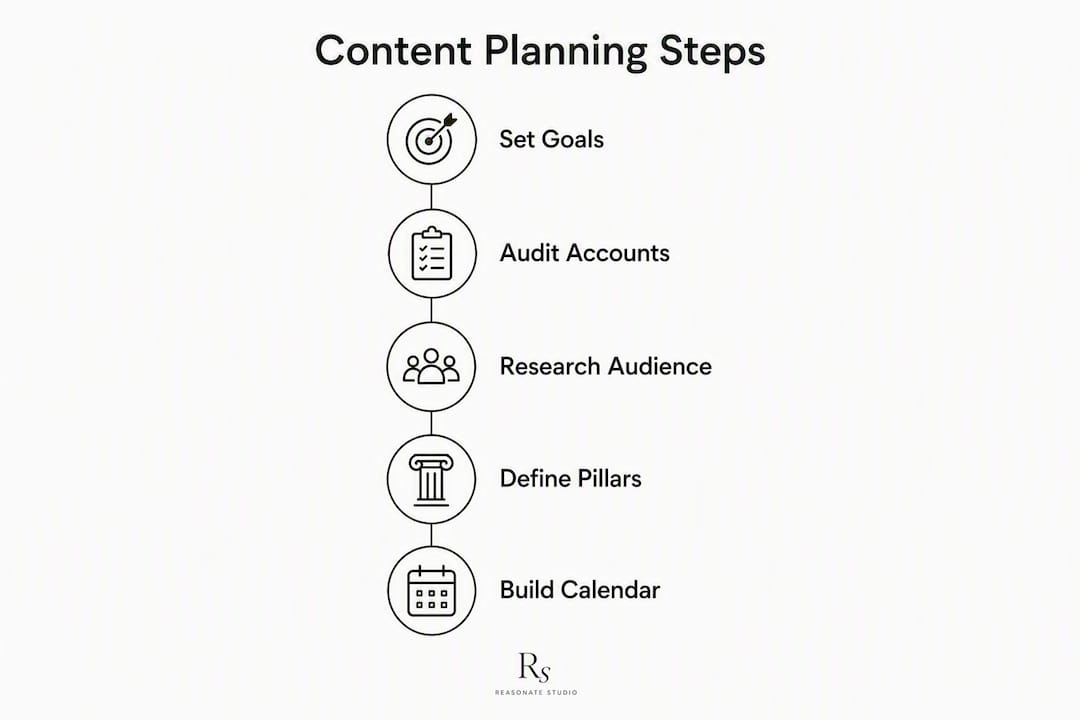
The best content topics come from real customer questions, not guessed trends. Pull questions from three sources before writing a single post: sales calls and support conversations, Google’s People Also Ask results for your core service terms, and community forums or LinkedIn comments where your buyers are active. This approach surfaces the exact language your audience uses, which makes content feel less like marketing and more like a direct answer.
Pro Tip: Keep a running “question log” in a shared Google Doc or Notion page. Every time a prospect asks a question in a sales call or email, add it. Within 30 days, you will have more content ideas than you can use in a quarter.
A content pillar is a recurring theme that connects your business goals to your audience’s interests. The recommended range is 3–5 pillars — enough variety to stay interesting, narrow enough to build recognizable authority.
Follow a niche-down, then niche-out approach: establish one narrow core pillar first, then add adjacent pillars once the core shows engagement and algorithmic clarity. A boutique law firm might start with “client rights in contract disputes” as its core pillar, then add “behind-the-scenes of a legal practice” and “common business mistakes” once the core is performing.
The 30/60/10 rule is a practical content mix guideline:
This ratio keeps your feed from feeling like an ad channel while still making room for conversion content. Adjust based on your goal: if you are in a launch phase, you might push promotional content to 20% temporarily. The key is that the ratio is intentional, not accidental.
Before you open a calendar, fill an idea bank. Capture real customer questions and sales objections as your highest-intent content sources. Add seasonal hooks, industry events, and product milestones. Aim for 20–30 ideas before you start assigning dates. Then map the first four weeks by distributing ideas across your pillars and content mix. A 4-week planning block is the right unit — long enough to see patterns, short enough to stay responsive to what is actually happening in your business.
A simple calendar structure is more likely to be maintained than an overcomplicated one. Use these columns:
| Column | What to enter |
|---|---|
| Week / Date | Publish date |
| Pillar | Which of your 3–5 themes |
| Topic / Headline | Draft title or angle |
| Format | Reel, carousel, static, text post |
| Channel | Instagram, LinkedIn, etc. |
| Owner | Who is responsible |
| CTA | What you want the reader to do |
| Status | Idea / Draft / Review / Scheduled / Published |
Even a solo owner needs to separate the “creator” hat from the “reviewer” hat. For teams, define who drafts, who edits for brand voice, who approves, and who schedules. A simple approvals checklist:
One published post should generate at least three derivative assets before you move to the next topic. A LinkedIn article becomes a carousel, a short video script, and an email newsletter snippet. A podcast clip becomes a quote graphic, a caption, and a blog intro. Repurposing is not laziness — it is how lean teams maintain consistent volume without burning out.
On publish day: schedule the post, set a reminder to reply to comments within the first two hours (early engagement signals matter on most platforms), and share the post internally so team members can engage. At the end of the week, note reach and engagement in your calendar’s status column. That 60-second note is the data you will use in your monthly review.
The planning process does not have to be a quarterly all-day event. The most sustainable approach is a tiered cadence: 90-day themes for strategy, 4-week blocks for content, and a 15-minute weekly habit for execution.
Time benchmarks for small teams and solo owners:
Planning fatigue is real. Teams that try to plan three months of content in one sitting almost always abandon the system by week six. Four-week blocks keep the plan close enough to reality that it stays useful.
Resourcing checklist — roles to cover:
For businesses without a full marketing team, a single person often covers two or three of these roles. That works at low volume. When you are posting three or more times per week across two platforms, the roles need to be separated or the quality degrades. That is typically the inflection point where fractional or agency support becomes cost-effective — not because the work is too hard, but because the cognitive load of wearing all four hats limits strategic thinking.
A marketing content calendar built around these roles and cadences is the operational backbone of any plan that actually gets executed.
The right tool depends on your stage: planning, scheduling, or analytics. Most teams need one tool from each category, not one tool that claims to do everything.
| Tool | Best stage | Collaboration | Free tier | Standout strength |
|---|---|---|---|---|
| Google Sheets | Planning | Basic (shared doc) | Yes | Fully customizable; zero learning curve |
| Notion | Planning | Strong (assign, comment) | Yes (limited) | Idea bank + calendar in one workspace |
| Airtable | Planning + tracking | Strong (views, assign) | Yes (limited) | Flexible views; scales with team size |
| Canva | Production | Yes (brand kit, teams) | Yes | Visual templates; direct social publish |
| Buffer | Scheduling | Basic | Yes | Clean queue; simple analytics |
| Later | Scheduling + planning | Yes | Yes (limited) | Visual Instagram grid; link-in-bio tool |
| Hootsuite | Scheduling + analytics | Strong | No (trial only) | Enterprise-grade; deep analytics |
| Sprout Social | Analytics + scheduling | Strong | No (trial only) | Best-in-class reporting; CRM integration |
Recommended starting setups:
Pro Tip: Do not migrate tools until the process is working. A broken workflow in a premium tool is still a broken workflow. Get the habit right in Google Sheets first, then upgrade.
AI tools can accelerate drafting and repurposing, but they should not replace human strategy or the final review for brand alignment and factual accuracy. Use AI for transforming approved messages into platform-native drafts, then layer in human review before scheduling.
Here is what a working calendar looks like in practice. These rows follow the column structure from Step 7.
Sample calendar rows — B2B professional services firm:
A content calendar built from real customer questions and organized into three content types (problem-answer, how-to, and perspective) naturally covers the full buyer journey from awareness to decision.
The 15-minute Monday planning routine:
Batch drafting on Tuesday through Thursday, publish and monitor on Friday. That rhythm keeps the week predictable and the calendar full.
Measurement only works when it is tied to the goals you set in Step 1. Tracking every available metric produces noise. Tracking two or three metrics per goal produces decisions.
Metrics by goal type:
| Goal | Primary metrics | Secondary metrics |
|---|---|---|
| Awareness | Reach, impressions, follower growth | Profile visits, share rate |
| Engagement | Saves, shares, comments, engagement rate | Replies, DM volume |
| Conversion | Link clicks, form fills, DM inquiries | Click-through rate, landing page visits |
| Retention / loyalty | Repeat engagement, comment sentiment | Saves, return visits |
Reporting cadence:
Optimization checklist:
A content strategy built for social media should make these measurement decisions easier, not harder, because the goals are defined before the content is created.
Most marketing professionals and small business owners can build and run a content plan themselves. But there are specific signals that indicate the DIY approach has hit its ceiling.
Decision signals for bringing in senior support:
The issue is rarely the content itself. It is usually the absence of a clear position. When a business has not defined what makes it worth choosing, no amount of posting frequency fixes that. Content without positioning is just noise with a schedule.
What senior-led support should deliver:
Reasonate Studio’s Fractional CMO engagements and Brand Strategy work are built around exactly these outcomes. Client results have included a 636% increase in Instagram profile visits, a $46.3 million partnership secured after a brand repositioning, and 98% client retention following the development of a branded service pathway. These outcomes are not typical for every engagement, but they reflect what becomes possible when positioning, messaging, and content execution are aligned.
Pro Tip: If you are unsure whether you need strategy or execution support, ask this: “Do we know exactly what we stand for and who we serve best?” If the answer is uncertain, start with Brand Strategy. If the answer is clear but the execution is inconsistent, Fractional CMO support is the faster path.
Most content plans fail for the same reason: they are built for an ideal version of the team, not the actual one. The calendar assumes five posts per week when the team can realistically sustain two. The pillars are broad enough to include almost anything. The measurement section gets skipped because “we’ll figure it out later.”
The behaviors that consistently separate successful plans from mediocre ones are not complicated. A narrow core pillar, maintained consistently, builds more authority than 3–5 loosely defined themes. A living idea bank, updated weekly from real customer conversations, eliminates the blank-page problem. Repurposing every asset before moving to the next topic keeps volume high without burning out the team. And measuring by pillar, not just by post, reveals which themes are actually driving business outcomes.
The mistake I see most often is confusing frequency with quality. Teams that post daily with no clear pillar strategy almost always plateau faster than teams that post three times per week with sharp, consistent 3–5 themes. The algorithm does not reward volume. It rewards relevance and consistency within a recognizable niche.
The corrective actions are straightforward: cut your channel count to the one or two platforms where your buyers actually spend time, define one core pillar before adding others, and commit to a 15-minute weekly planning habit before investing in any new tool. The plan does not need to be perfect. It needs to be specific enough to execute and simple enough to maintain.
Planning social media content is a skill. Turning that plan into consistent growth requires something more: clear positioning, a repeatable system, and someone accountable for keeping it all moving.
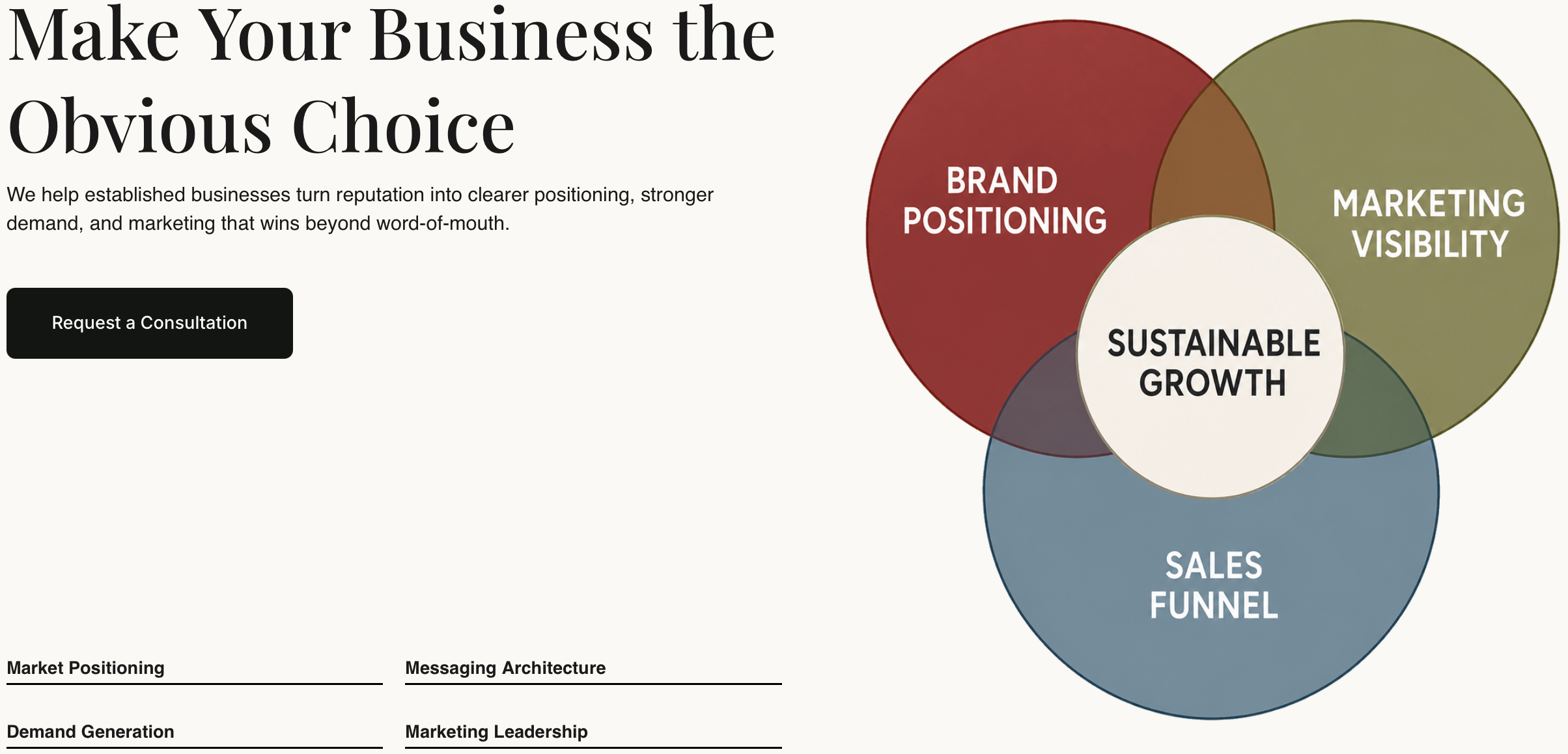
Reasonate Studio works with established businesses that have outgrown patchwork marketing. Through Brand Strategy and Fractional CMO support, we connect positioning, messaging, and content execution into one system that reflects the quality of the business. A typical engagement starts with a discovery conversation, moves into a 90-day strategic plan with defined priorities and workflows, and transitions into managed execution or a structured handoff your team can run independently.
If your content is consistent but not converting, or if the founder is still the de facto marketing department, that is the problem we solve. Explore Reasonate Studio’s services to see how senior-led planning support works in practice.
Editable calendar templates and starter setups:
Key external resources referenced in this article:
Reasonate Studio resources for senior-led support: