September 22, 2026
Why Update Brand Messaging: Essential Guide for Growth


Creative strategy in advertising demystified—learn its core definition, types, key elements, execution steps, and common pitfalls for small brands.

Most American service-based entrepreneurs discover that nearly 68 percent of small businesses struggle to create advertising that stands out in crowded markets. Your brand differentiation depends on more than creative flair, especially when every competitor vies for client attention. A unified creative strategy in advertising offers clarity, cohesion, and measurable impact—empowering you to build authentic connections and drive client acquisition in a market that demands both originality and strategic direction.
A creative strategy in advertising represents a purposeful framework that transforms marketing objectives into compelling visual and narrative experiences. Unlike random creative exercises, this approach systematically connects business goals with imaginative communication that resonates with target audiences. By establishing clear guidelines and creative parameters, brands can produce advertisements that are both original and strategically aligned.
At its core, creative strategy involves two critical dimensions: content function and execution form. The content function addresses the psychological and emotional dimensions of advertising, covering aspects like audience experience, cognitive impact, and affective response. The execution form focuses on tactical elements such as visual design, storytelling techniques, and communication style. Successful advertising creative strategies seamlessly integrate these dimensions to create messaging that is both intellectually compelling and emotionally engaging.
Research highlights several key components that define an effective creative strategy. These include:
By understanding creative strategy not just as an artistic endeavor but as a structured approach to communication, entrepreneurs can develop advertising that genuinely connects with their target market. Creative strategy frameworks transform advertising from a hit-or-miss activity into a systematic process of audience engagement.
Pro tip: Develop a creative brief that explicitly outlines your strategic objectives, target audience psychological profile, and desired emotional response before beginning any advertising design process.
Creative strategies in advertising can be systematically classified into three primary approaches: Above the Line (ATL), Below the Line (BTL), and Through the Line (TTL). Each approach offers distinct advantages and targets different marketing objectives, allowing brands to craft nuanced communication strategies tailored to specific audience segments and campaign goals.
The Above the Line (ATL) approach focuses on broad, mass media channels designed to generate widespread brand awareness. This strategy typically leverages traditional media platforms like television, radio, print advertisements, and large-scale billboard campaigns. ATL strategies are ideal for brands seeking maximum visibility and attempting to reach large, diverse audience demographics with generalized messaging. Understanding advertising campaign strategies can help entrepreneurs select the most appropriate approach for their specific market positioning.
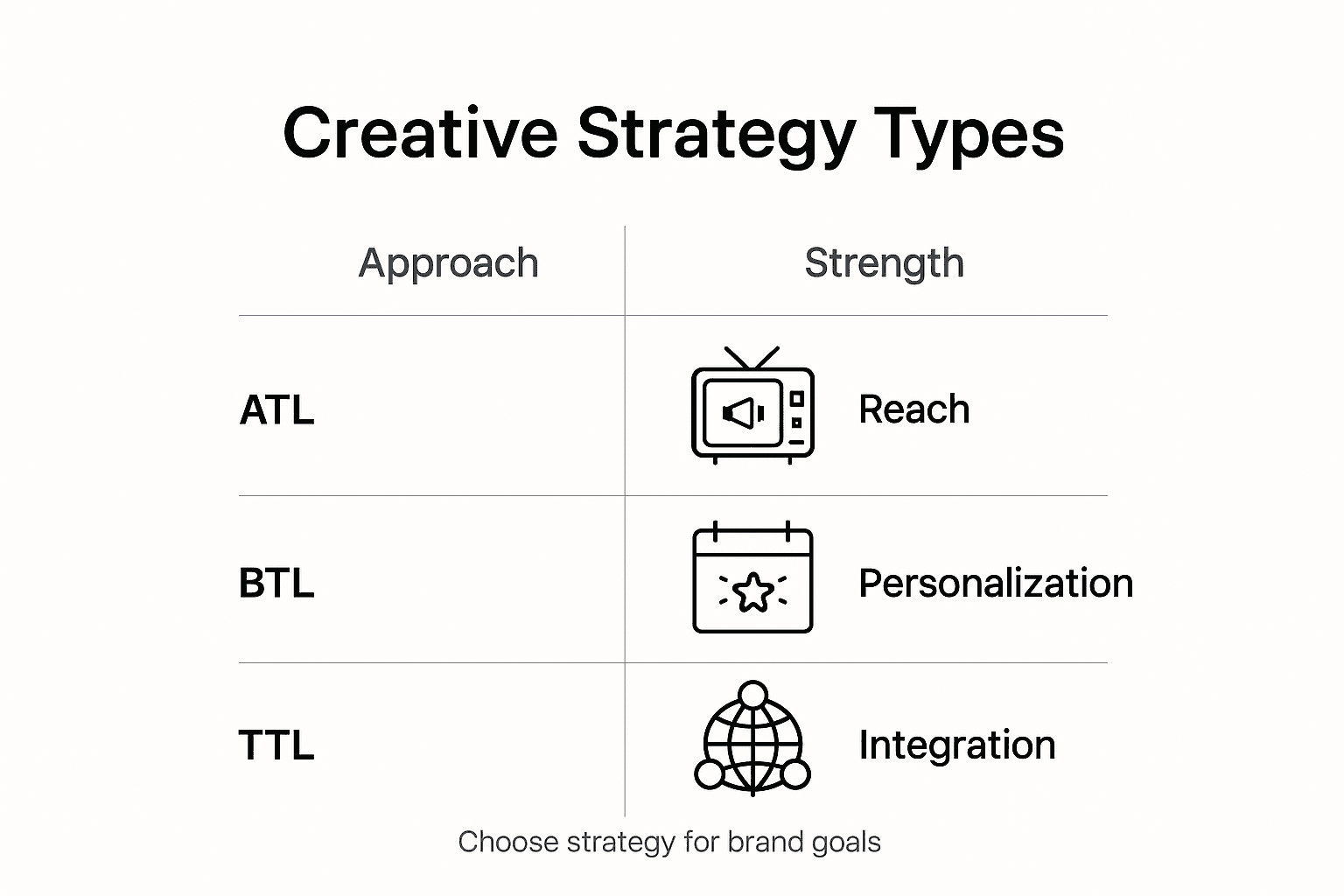
Below the Line (BTL) strategies represent a more targeted, personalized communication approach. These methods concentrate on direct engagement through niche channels such as email marketing, social media campaigns, event sponsorships, and localized promotional activities. BTL strategies enable brands to create more intimate, precise interactions with specific audience segments, allowing for deeper emotional connections and more measurable engagement metrics.
Through the Line (TTL) strategies represent a sophisticated, integrated approach that combines elements from both ATL and BTL methodologies. This holistic strategy synchronizes multiple communication channels to create a cohesive brand narrative across various touchpoints. TTL approaches recognize that modern consumers interact with brands through diverse platforms and seek consistent, interconnected messaging experiences.
Here’s a comparison of major creative strategy approaches and their ideal use cases:
| Approach | Channel Examples | Best For | Key Strength |
|---|---|---|---|
| Above the Line | TV, radio, print, billboards | Mass awareness campaigns | Broad reach |
| Below the Line | Email, social media, events | Targeted audience engagement | Precision focus |
| Through the Line | Integrated, cross-channel | Cohesive brand experience | Consistency |
Pro tip: Develop a comprehensive communication matrix that maps your target audience’s media consumption habits and preferences before selecting your creative strategy approach.
Creative advertising success emerges from a complex interplay of strategic elements that transform ordinary messaging into compelling brand experiences. Research reveals five critical components that consistently distinguish high-performing advertising campaigns: creative quality, brand strength, targeting precision, strategic reach, and timely ad exposure. These interconnected factors work synergistically to capture audience attention and drive meaningful engagement.

At the heart of successful advertising lies creative quality, which accounts for nearly half of an advertisement’s overall effectiveness. This dimension encompasses visual impact, emotional resonance, and storytelling prowess. Strategic design elements like color psychology, typography, and graphic composition play crucial roles in creating memorable brand experiences. Brand strategy insights underscore the importance of developing visual narratives that authentically represent a brand’s core identity and values.
Precise targeting accuracy represents another fundamental success driver. Modern advertising demands laser-focused audience segmentation that goes beyond demographic data. Successful strategies integrate psychological profiling, behavioral insights, and contextual relevance to ensure messages reach the most receptive audience segments. This approach transforms advertising from a broadcast mechanism to a personalized communication tool that speaks directly to individual consumer motivations and needs.
The final critical elements include media placement timing and brand loyalty cultivation. Optimal ad exposure requires understanding audience media consumption patterns and strategically positioning messages at moments of maximum receptivity. Brands that consistently deliver authentic, valuable experiences build incremental trust, which translates into long-term customer retention and increased sales potential.
Pro tip: Develop a comprehensive audience persona that includes not just demographic data, but deep psychological and behavioral insights to enhance your targeting precision and creative resonance.
Developing a robust advertising strategy requires a systematic approach that transforms creative vision into measurable outcomes. Successful campaigns emerge from a carefully structured process that integrates strategic planning, audience insights, creative development, and continuous optimization. This holistic methodology ensures that advertising efforts are not just creative, but strategically aligned with core business objectives.
The strategic planning process begins with clear objective definition. Brands must articulate precise goals that extend beyond generic aspirations, establishing specific, measurable targets that guide the entire campaign development. Marketing strategy essentials emphasize the importance of connecting creative approaches with concrete business outcomes, whether that involves increasing brand awareness, driving sales, or establishing market positioning.
Audience research represents the critical foundation of effective strategy execution. Modern advertising demands deep psychological profiling that goes beyond demographic data. Successful strategies integrate behavioral insights, consumer motivation analysis, and contextual understanding to create messaging that resonates on an emotional and rational level. This approach transforms advertising from a broadcast mechanism to a precision communication tool that speaks directly to specific audience segments and their unique needs.
Strategy implementation requires a dynamic, iterative approach that embraces continuous measurement and optimization. Effective campaigns are not static documents but living frameworks that evolve based on real-time performance data. Brands must establish robust tracking mechanisms, conduct frequent performance assessments, and be prepared to pivot creative and strategic elements rapidly in response to audience engagement metrics and market shifts.
Pro tip: Create a comprehensive performance dashboard that tracks key advertising metrics in real time, enabling swift strategic adjustments and data-driven creative refinements.
Small business advertising often falls victim to critical strategic errors that can quickly drain budgets and undermine brand potential. Entrepreneurs frequently make fundamental mistakes that compromise their marketing efforts, transforming potentially powerful communication strategies into ineffective, costly exercises. Understanding and proactively addressing these common pitfalls is essential for creating advertising that actually drives business growth and customer engagement.
One of the most significant challenges is the lack of clear, measurable objectives. Many small businesses approach advertising with vague aspirations like “getting more customers” instead of establishing specific, quantifiable goals. Branding strategies for small businesses emphasize the importance of defining precise targets that enable strategic tracking and meaningful performance assessment. These objectives should be specific, measurable, achievable, relevant, and time-bound (SMART), providing a concrete framework for evaluating advertising effectiveness.
Another critical pitfall involves poor audience targeting and inadequate market research. Small businesses often cast overly broad marketing nets, hoping to capture anyone and everyone, which paradoxically reduces their chances of connecting with ideal customers. Effective advertising requires deep psychological profiling that goes beyond basic demographics. Successful strategies demand understanding customer motivations, pain points, communication preferences, and behavioral patterns. This nuanced approach transforms advertising from a generalized broadcast to a precision communication tool that speaks directly to specific audience segments.
The final major challenge is inconsistent messaging and brand representation. Small businesses frequently compromise their brand integrity by producing advertising that lacks coherence across different channels. This inconsistency confuses potential customers and dilutes brand recognition. Successful advertising maintains a consistent visual and narrative identity, ensuring that every communication reinforces core brand values and creates a unified, trustworthy brand experience.
To help small businesses succeed, consider these common advertising pitfalls and effective solutions:
| Pitfall | Impact on Business | Proven Solution |
|---|---|---|
| Unclear objectives | Wasted budget, weak ROI | Set SMART goals for campaigns |
| Overly broad targeting | Low conversion, poor fit | Use detailed audience segmentation |
| Inconsistent messaging | Consumer confusion, weak brand | Develop and implement a style guide |
Pro tip: Develop a comprehensive brand style guide that outlines precise messaging parameters, visual standards, and communication principles to maintain advertising consistency across all platforms.
The biggest challenge many entrepreneurs and small business owners face is turning creative strategy concepts into clear, measurable advertising results. This article highlights how vague objectives and scattered messaging can drain your budget and stall growth. At Reasonate Studio, we understand the frustration of crafting ads that lack strategic alignment and emotional impact. Our proprietary Aligned Impact Model™ solves this by uncovering your brand foundations and aligning every marketing effort with your business goals and audience psychology. We help you transform advertising from a hit-or-miss exercise into a focused process that truly resonates.

Ready to break free from the pitfalls of unclear objectives and inconsistent brand messaging? Visit Reasonate Studio and discover how our strategic guidance and intentional design can elevate your brand narrative and targeting precision. Don’t just create ads, create meaningful connections that fuel long-term growth. Start your journey today with our proven framework and take control of your creative advertising strategy.
A creative strategy in advertising is a structured framework that aligns marketing objectives with imaginative communication to create compelling visual and narrative experiences for target audiences.
Key components include clear ideation templates, strategic alignment between marketing objectives and creative executions, frameworks that balance originality with message clarity, and communication approaches that maximize advertising elasticity.
Creative strategies diverge into Above the Line (ATL), Below the Line (BTL), and Through the Line (TTL) approaches. ATL focuses on mass media channels for broad brand awareness, BTL targets specific audience segments directly, and TTL integrates both ATL and BTL for cohesive brand narratives across multiple channels.
Common mistakes include having unclear measurable objectives, overly broad targeting without detailed market research, and inconsistent messaging across different advertising platforms.