September 22, 2026
Why Update Brand Messaging: Essential Guide for Growth


Use competitive messaging to identify market gaps, sharpen your positioning, and give clients a clear reason to choose your business.

TL;DR:
- Competitive messaging involves research to identify market gaps and differentiate your brand. It helps avoid “me too” positioning and find white space for unique positioning. Regular analysis, validation, and refreshing are crucial for maintaining relevant and compelling messaging.
Most founders, coaches, and consultants believe their offer is genuinely different. The problem is their messaging rarely proves it. When you sound like everyone else in your space, potential clients cannot tell you apart, and they default to price, familiarity, or whoever showed up first. Competitive messaging is the strategic layer that fixes this. It is not about writing snappier copy or posting more content. It is about understanding the full landscape of what your competitors are saying, finding the gaps they leave open, and planting your flag in territory that is distinctly yours. This guide breaks down exactly how to do that.
| Point | Details |
|---|---|
| Strategic differentiation | Competitive messaging helps your brand stand out in crowded markets by identifying and occupying unique positioning. |
| Ongoing process | Your messaging must be regularly refreshed as your product and market evolve to maintain relevance. |
| Framework-driven action | Applying a proven step-by-step process ensures your messaging is data-backed, battle-ready, and truly distinctive. |
| Avoid common mistakes | Steer clear of generic claims, competitors’ copycat traps, and static messaging for maximum impact. |
There is a common misconception that competitive messaging is just marketing copywriting with a competitive twist. It is not. It is a research-first discipline that requires you to study the market before you write a single word.
As one framework puts it, competitive messaging is “the strategic process of analyzing competitors’ messaging to identify gaps, craft differentiated positioning, and develop superior brand narratives that enhance market position.” That definition matters because it shifts the work from creative to analytical. You are not just writing, you are investigating.
Competitive messaging starts in a spreadsheet before it ever lands on a website. The research phase is where the real positioning advantage is won or lost.
Understanding brand messaging basics is the foundation, but competitive messaging adds a layer of market intelligence on top of that foundation. It asks: what are your competitors claiming, and what are they leaving unsaid?
Here is what strong competitive messaging actually involves:
The reason this matters for founders, coaches, and consultants specifically is that your market is often saturated with people offering similar services. A business coach competing against dozens of other business coaches cannot win on credentials alone. The one who wins is usually the one whose message clicks first, feels most specific, and speaks most directly to the exact problem the buyer is experiencing right now. That is not an accident. That is competitive messaging working as intended.
When done well, this approach does more than make you sound different. It makes you feel like the obvious, logical choice for a specific type of buyer. That shift in perception is what drives deals, referrals, and long-term brand loyalty.
Once you understand what competitive messaging is, the next question is: what does it actually do for your brand? The benefits go well beyond sounding polished.
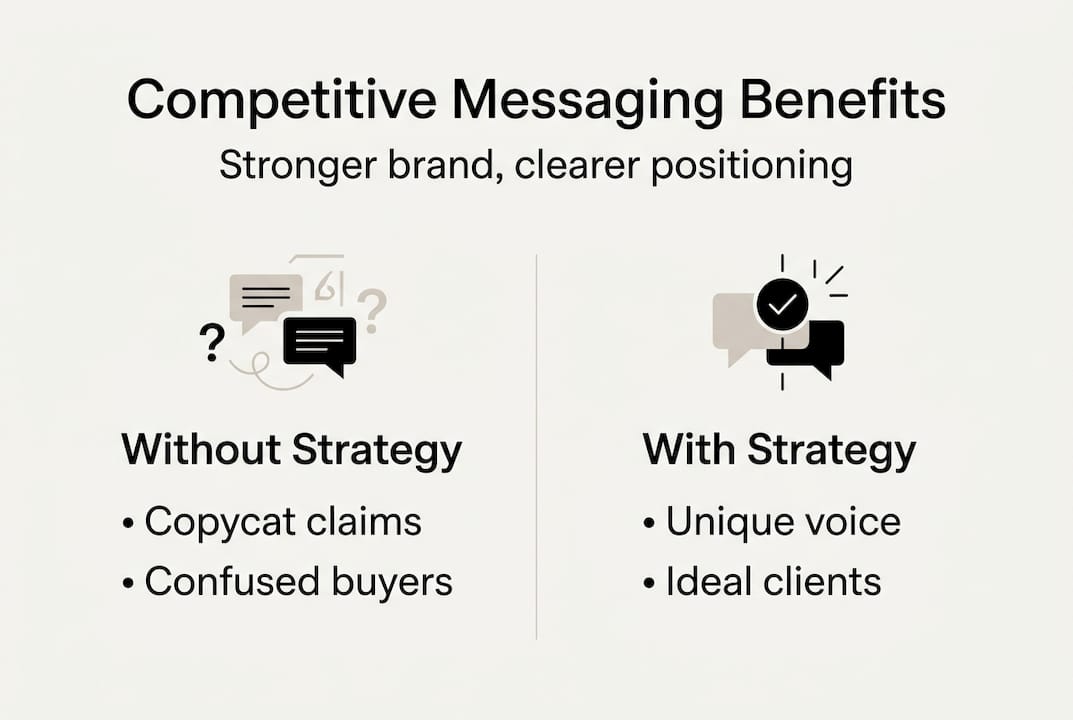
The most immediate benefit is avoiding what is called “me too” positioning. This happens when your messaging mirrors your competitors so closely that buyers cannot distinguish between you. Improving brand perception starts with making sure your audience experiences a clear, distinct point of view when they encounter your brand, not a familiar echo of what they have already seen.

The second major benefit is finding white space. White space is the messaging territory your competitors are not claiming. Maybe every coach in your niche talks about mindset and productivity, but nobody is speaking directly to the emotional exhaustion that comes before a founder decides to hire a coach. That emotional gap is an opening. Owning it in your messaging creates a powerful connection with buyers who feel unseen by everyone else.
Here is a quick comparison of what messaging looks like before and after applying a competitive lens:
| Without competitive messaging | With competitive messaging |
|---|---|
| “I help entrepreneurs grow their business” | “I help service-based founders replace referral anxiety with a repeatable client pipeline” |
| “Customized coaching for your goals” | “Strategy-first coaching built for consultants who are great at their work but invisible online” |
| “Results-driven marketing” | “Emotionally intelligent marketing that turns your story into income” |
| Generic tone, broad audience | Specific tone, defined audience segment |
The right-hand column is not just more creative. It is more strategic. Each phrase signals to a specific buyer that this brand understands them at a level others do not.
Pro Tip: Build what sales teams call a “battlecard,” a one-page document that maps your key differentiators against your top three competitors. When a prospect asks “how are you different from X?” you will have a clear, confident answer ready. This is especially powerful for consultants who sell on calls.
According to research on brand messaging examples, the most effective brands avoid claims shared by their top competitors and instead focus on owning a specific emotional or functional promise. The brand messaging framework research confirms that pre-launch startups and established brands alike benefit from avoiding crowded competitor claims and refreshing messaging when product or market conditions shift.
Knowing why competitive messaging matters is one thing. Knowing how to actually execute it is another. Here is a practical framework built for founders, coaches, and consultants who are doing this work without a full marketing department.
Pro Tip: Use your brand messaging checklist to make sure every element of your positioning is covered before you finalize anything. Missing one piece, like audience specificity or emotional resonance, can undermine an otherwise strong message.
Here is a simple data table to guide your competitive audit:
| Audit element | What to document | Why it matters |
|---|---|---|
| Homepage headline | Exact wording | Reveals primary positioning claim |
| Core promise | Main benefit stated | Shows what they lead with |
| Tone | Formal, casual, bold, warm | Helps you differentiate on voice |
| Target audience language | Who they say they serve | Reveals gaps in audience focus |
| Repeated phrases | Words used 3 or more times | Flags overclaimed territory |
As the brand messaging framework research recommends, founders and consultants should start with a competitive audit to find white space, test rigorously, and use the findings to build battlecards that help win deals. Knowing when to update is equally important, and updating brand messaging at the right moments keeps your positioning relevant as markets shift.
Even founders who understand competitive messaging in theory often make predictable mistakes when they try to apply it. Here are the most common ones and how to sidestep them.
Falling into “me too” messaging. This is the most common trap. You study your competitors, see what is working for them, and unconsciously start borrowing their language. The result is that you sound like a slightly different version of everyone else. The fix is to actively flag any phrase you want to use and ask: is one of my top three competitors already saying this? If yes, cut it.
Skipping the refresh cycle. Competitive messaging is not a one-time exercise. Markets shift, new competitors enter, and your own offer evolves. A message that was sharp and differentiated 18 months ago may now be the industry standard. Build a habit of reviewing your competitive landscape every six months or whenever a significant product or market shift occurs.
Failing to validate claims. Writing a bold positioning statement is easy. Knowing whether it actually lands with real buyers is harder. Many founders skip the testing step and publish messaging that feels right internally but confuses or underwhelms their audience externally. Always validate before you commit.
Ignoring indirect competitors. Most founders focus only on direct competitors, people offering the same service. But indirect competitors, like free resources, DIY tools, or “do nothing” inertia, also shape how buyers evaluate your offer. Your messaging needs to address why working with you is worth it compared to all alternatives, not just the obvious ones.
Pro Tip: Set a calendar reminder every quarter to do a quick 30-minute scan of your top competitors’ websites and social profiles. Note any new language, new offers, or new positioning angles. Small shifts in the landscape can signal bigger moves worth responding to.
Understanding the different brand positioning types available to you makes it easier to spot which territory is already crowded and which is genuinely open. The brand messaging framework research is clear: avoid claims shared by your top competitors and refresh your messaging when your product or market shifts. These are not optional best practices. They are the difference between messaging that compounds over time and messaging that quietly becomes invisible.
Here is something most marketing advice will not tell you directly: founders almost universally believe their solution is unique. And they are usually right about the solution. Where they go wrong is assuming that uniqueness is self-evident to buyers.
It is not. Buyers experience a wall of sameness when they research options in any niche. Everyone is “results-driven,” “passionate,” and “client-focused.” The words have lost meaning through overuse. True differentiation does not come from being different in your head. It comes from making that difference unmistakably clear in every word your brand puts into the world.
The brands that break through are the ones that commit to ongoing, critical investment in understanding competitor narratives. They do not check the competitive landscape once and move on. They treat it as living intelligence. They revisit it, challenge their own assumptions, and make bold, data-backed shifts when the market demands it.
This is also why why brands update messaging is such an important question to keep asking. Agility is not a buzzword here. It is a competitive advantage. The founder who refreshes their positioning before the market forces them to will always be a step ahead of the one who waits until their message stops working.
Building a differentiated message is one of the highest-leverage things you can do for your brand. But it is also one of the areas where outside perspective makes the biggest difference. When you are too close to your own work, it is genuinely hard to see what your competitors are saying and where you have room to own something distinct.
At Reasonate Studio, we specialize in helping founders, coaches, and consultants do exactly this kind of strategic messaging work. From competitive audits to brand voice development, we build the clarity that makes your marketing actually work. If you want to see what sharp, differentiated messaging looks like in practice, explore our successful messaging examples and see how other brands have made the shift from generic to genuinely compelling.
Begin with a thorough competitive audit to understand existing messaging and spot gaps in the market. The competitive audit gives you the landscape data you need before writing a single word of your own positioning.
Refresh your messaging whenever your product or market shifts to stay ahead of competitors. The brand messaging framework research recommends treating this as an ongoing discipline, not a one-time project.
Echoing competitors, failing to validate claims, and ignoring new entrants are the most damaging pitfalls. The clearest rule is to avoid claims shared by your top three competitors, even if those claims feel true for your brand.
Pre-launch startups use competitive messaging to hypothesize positioning and avoid crowded value claims while gathering early feedback. The hypothesis-driven approach allows new brands to stake out territory before they have enough data to validate it fully.