September 1, 2026
Understanding B2C Business to Consumer Dynamics


Discover why revisiting brand foundations can drive growth. Uncover strategies to enhance your brand's clarity and competitive edge!
TL;DR:
- Most brands experience subtle drift over time by neglecting their core identity and messaging. Revisiting the foundational elements of a brand through strategic refounding helps prevent confusion, misalignment, and loss of trust in the market. Regularly assessing and renewing your brand’s foundation ensures clarity, consistency, and long-term growth.
Most founders treat their brand like a piece of furniture they assembled once and never touched again. Set it up, move on, and expect it to keep doing its job forever. But brands are living systems. They respond to the market, your audience’s shifting expectations, and the evolution of your own offer. When you stop paying attention, something called brand drift quietly sets in, and it chips away at your clarity, your conversions, and your competitive edge long before you notice the damage. This guide explains why revisiting your brand’s foundation is not a sign of failure. It’s one of the smartest strategic moves a founder, coach, or consultant can make.
| Point | Details |
|---|---|
| Prevent brand drift | Revisiting your foundation regularly guards against losing your identity and market clarity. |
| Prioritize strategic renewal | Effective change starts below the surface with strategic alignment, not just visuals or slogans. |
| Signs you need a reset | Look for stagnation, misaligned messaging, or declining team and customer engagement as cues for review. |
| Take action sooner | Successful brands realign proactively, not just in crisis, giving themselves a growth advantage. |
With the importance of brand stability in mind, let’s clarify what it actually means to revisit your brand’s core.
The term “brand refresh” gets thrown around a lot, and it often conjures images of new logos, updated color palettes, and font changes. A full rebrand goes further, typically involving a complete overhaul of identity, sometimes including name changes and repositioning. But neither of these is what we’re talking about here. Revisiting your brand foundation is something different entirely. It’s a process of rediscovery, not replacement.
Think of it as returning to the original blueprints of a house you’ve been living in for years. You’re not demolishing the structure. You’re checking whether the foundation still holds, whether the layout still serves the people inside, and whether anything has shifted that needs attention before small cracks become structural problems.
Researchers and brand strategists describe this kind of work as “refounding”, an interpretive process that prevents the loss of core identity without triggering a full restart. Refounding is about rediscovering what made your brand distinctive in the first place and reactivating those strengths in a way that fits where you are now.
Brand drift is what happens when you don’t do this work. Over time, messaging gets diluted. Your offer expands or pivots. New content creators, collaborators, or team members bring their own interpretation of your voice. Market trends pull you toward language that sounds current but doesn’t actually sound like you. Slowly, your brand stops meaning what it once meant, and your audience starts to feel the confusion even if they can’t name it.
Understanding the difference between surface-level updates, identity overhauls, and true foundational work is essential. Here’s when foundational work is actually needed:
“Revisiting brand foundations helps prevent ‘drift’ — a loss of core identity — by doing interpretive refounding rather than a nostalgic backward move or a full restart.”
Refounding is not about starting over. It’s strategic renewal that respects what you’ve built while clearing the fog that’s accumulated over time. For more on how this connects to practical brand foundation strategies, the distinction matters enormously when deciding where to invest your time and energy.
Now that we’ve defined what foundational work really means, let’s see what happens when brands neglect it.
Brand drift rarely announces itself loudly. It sneaks in through small compromises. You use a slightly different tone in one email campaign. You shift your positioning slightly to compete with a new player in your space. You add a service that doesn’t quite fit your original promise but seems to fill a market gap. Each individual decision seems reasonable. Together, they create a version of your brand that’s blurry, inconsistent, and harder for your audience to trust.
Here’s how a brand with strong foundations compares to one experiencing drift:
| Area | Brand with clear foundations | Brand experiencing drift |
|---|---|---|
| Differentiation | Clearly defined, easy to articulate | Vague or inconsistent |
| Team alignment | Everyone understands the brand voice | Confusion and inconsistency |
| Marketing ROI | Higher because messaging converts | Lower due to unclear positioning |
| Customer loyalty | Strong, repeat clients | Unpredictable, hard to retain |
| Content quality | Focused and purposeful | Scattered and reactive |
The real-world costs of drift are not abstract. Here are the five most significant consequences founders and consultants face when they let it go unchecked:
Even legacy brands with years of equity have fallen victim to drift. Think of companies that chased trend after trend until their audience forgot why they loved them in the first place. The problem isn’t growth or evolution. The problem is growing without maintaining the thread back to what you stand for.
Pro Tip: Schedule a brand foundation check-in every six months. Block one hour to review your messaging, compare your recent content to your original brand voice, and ask yourself honestly whether your current marketing reflects who you actually are and who you’re trying to serve.

The earlier you detect drift, the less costly the correction. Waiting until leads dry up or retention tanks means you’re already deep in the consequences.
Once you recognize the cost of brand drift, the next step is to revisit foundational strategy rather than just changing surface elements.
Here is where many founders make a very expensive mistake. They feel the friction of brand drift and immediately assume they need a new logo, a website redesign, or a completely new aesthetic. The impulse is understandable. Visual changes are tangible and feel decisive. But cosmetic changes applied to a strategically misaligned foundation don’t fix anything. They just give the confusion a newer coat of paint.
Marketing strategist Mark Ritson has been direct about this. Most corporate rebrands are expensive nonsense when they don’t address underlying strategic problems. His critique points to exactly what founders need to hear: if the issue is strategic misalignment rather than outdated visuals, you need to diagnose the root cause before reaching for cosmetic solutions.
The signs that your problem is strategic rather than tactical are specific. Watch for these patterns:
“Founders often want a new look when what they actually need is a new level of clarity about who they are and why they exist. Changing the exterior doesn’t change the story people tell themselves about you.”
When you take a strategic approach to rebranding for market alignment, you start from the inside out, not the outside in. That means diagnosing the misalignment first, then deciding what actually needs to change.
Here’s how strategic refoundation compares to cosmetic rebranding in terms of real business impact:
| Approach | Typical cost | Long-term impact | Team alignment | Customer loyalty |
|---|---|---|---|---|
| Cosmetic rebrand | High (design fees, rollout) | Low without strategy | Minimal | Unchanged |
| Strategic refoundation | Moderate (time and facilitation) | High, compounding | Strong | Significantly improved |
| Combined approach | Highest | Very high if sequenced correctly | Strong | Strong |
The data is pretty clear. Strategic refoundation alone delivers better long-term results than cosmetic changes without foundational work. And when both are done together, with strategy leading, the results compound. But strategy must come first. Every time.
With a strategic approach in mind, here’s how to put refounding into action for lasting impact.
Leaders who successfully navigate brand refounding typically do so after recognizing a specific signal: the underlying problem is that the company forgot who they are. That moment of recognition is actually a turning point, not a failure. It’s the beginning of something clearer and stronger.
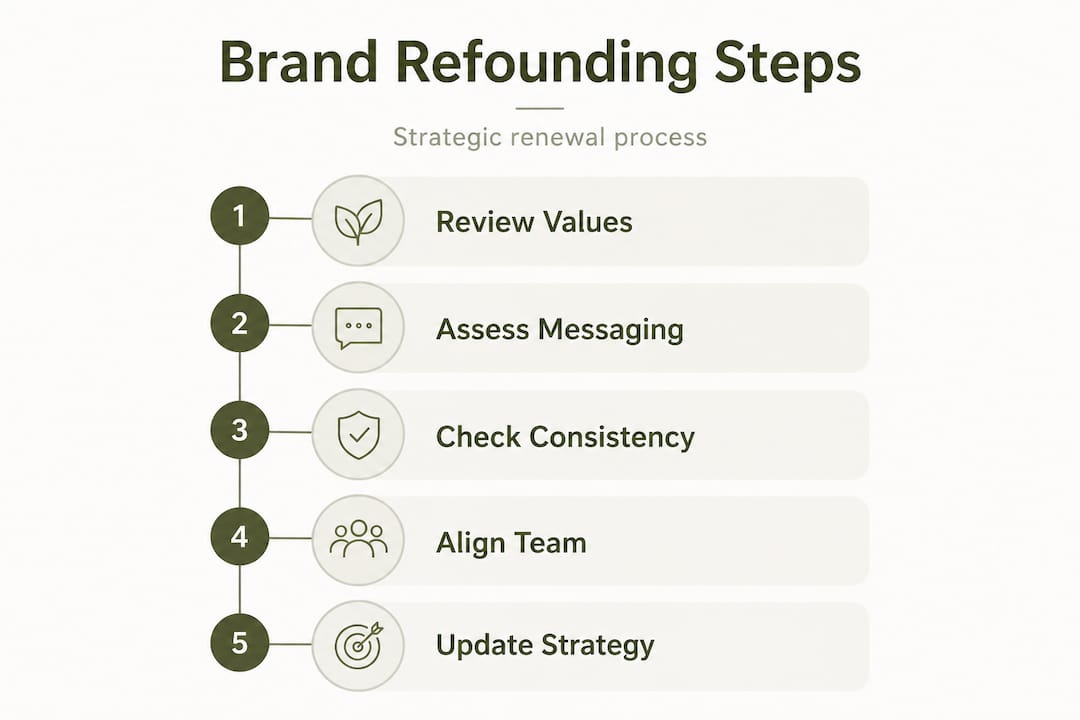
Here is a practical five-step framework you can apply to your own brand, whether you’re a solo coach, a growing consultancy, or a small business with a team:
Diagnose the drift. Start by honestly assessing where your brand stands today versus where it started. Review your messaging across your website, social media, email list, and sales conversations. Look for inconsistencies, conflicting promises, and areas where you’ve drifted toward what sounds good versus what’s true. Gather data: engagement rates, conversion rates, client feedback, and even the language your best clients use when they describe your work.
Audit your core beliefs and promises. Go back to the original questions: Why did you start this? Who were you trying to serve? What problem were you solving that no one else was solving in quite your way? Write these down, then compare them to how your brand currently shows up. The gap between your founding purpose and your current presentation often reveals exactly where the drift happened.
Reconnect with market relevance. Your core identity doesn’t change, but the context your audience operates in does. Interview three to five of your best clients. Ask them what problem they came to you with, what they were afraid of before working with you, and how they describe what you do to others. Their language is a goldmine. It often reflects your real value more accurately than your own marketing copy.
Involve the whole team. If you have a team, this step is non-negotiable. Brand drift accelerates when different people interpret your brand differently. Run an internal workshop. Ask each person to describe your brand’s purpose, your ideal client, and your primary differentiator in their own words. The variation in answers will show you exactly where clarity needs to be rebuilt. Even solo founders benefit from this step with their contractors or collaborators.
Document and relaunch with intention. Once you’ve clarified your foundation, write it down in a brand guide that includes your core purpose, your audience, your messaging pillars, your voice and tone, and your key differentiators. Then reintroduce your brand with intention, not a noisy announcement, but consistent and deliberate expression across every touchpoint.
Here are specific actions that support alignment during this process:
Pro Tip: Don’t try to copy the energy or positioning of a competitor you admire. The goal of refounding is to rediscover what makes you distinctly you, not to become a better version of someone else. Your unique angle is almost always already there. It just needs to be excavated and articulated clearly.
Working from a solid marketing strategy framework is what keeps refounding from becoming just another exercise that collects dust. And if you want to go deeper, reviewing the principles behind developing a brand strategy can give you the structural clarity to make your refounding work stick.
Having explored the step-by-step process, let’s look at why waiting is the most common and most costly mistake.
In our experience working with founders, coaches, and consultants across more than 100 businesses, we’ve noticed a predictable pattern. Most brands don’t revisit their foundations proactively. They wait until something breaks. A launch flops. Revenue plateaus for three straight months. A competitor starts eating their lunch. A great client leaves and can’t explain why.
By the time pain forces the conversation, the drift has usually been happening for a long time. The founder just wasn’t tracking it because there was always something more urgent to do.
The reason for this isn’t laziness. It’s a combination of short-term market pressure and genuine discomfort with the questions that foundational work requires you to ask. Questions like: Is our positioning actually strong or are we just busy? Are we attracting the right people or just anyone? Does our brand truly reflect what we believe or have we been performing what we thought the market wanted?
These are not comfortable questions. They require you to sit with uncertainty for a moment before clarity arrives. Most founders prefer to stay in execution mode, creating more content, running more campaigns, and tweaking more tactics, because motion feels like progress.
But here’s what we’ve learned: the brands that lead their markets with clarity and conviction are almost never the ones who had the best tactics. They’re the ones who did the harder, slower work of knowing exactly who they are and refusing to drift from it. That clarity is magnetic. It builds trust faster. It converts better. It retains clients longer.
Supporting brand identity evolution is not about constant change. It’s about intentional evolution that keeps your brand’s core intact while adapting how that core is expressed. The brands that do this regularly don’t need dramatic interventions. They stay sharp, relevant, and recognizable because they never let the gap between their purpose and their presentation get too wide.
Foundational renewal is genuinely one of the highest-leverage investments a founder can make, and almost no one prioritizes it early enough.
If this article has surfaced some recognition, even just a quiet feeling that your brand might have drifted further than you realized, that’s worth paying attention to. Clarity doesn’t come from doing more. It comes from doing the right foundational work with intention and support.

At Reasonate Studio, we help founders, coaches, and consultants move from scattered marketing to aligned, purposeful brand strategy through The Aligned Impact Model™. Whether you need consistent, strategy-backed social media management that reflects a sharp and clear brand, or support with sales page optimization that converts because your message finally lands the way it should, we are here to help you build marketing that works because your foundation is solid. Start with our free Brand Audit Report or book a coaching call to take your first clear step forward.
Aim to assess your brand foundation at least once a year, or whenever you notice a gap between your vision and how your marketing actually shows up in the world.
A rebrand typically updates surface-level elements like visuals and naming, while refounding addresses deep strategic alignment, core values, and the distinctive purpose that makes a brand worth choosing.
Common signs include inconsistent messaging across platforms, different team members describing your brand differently, declining engagement, and difficulty articulating what makes you different from competitors.
You risk pouring significant resources into cosmetic changes that don’t solve the real strategic problem, which is exactly why many rebrands fail to produce meaningful results even when they look polished on the surface.