September 1, 2026
Understanding B2C Business to Consumer Dynamics


Discover why aligning marketing and sales is crucial for sustainable growth. Unlock the secrets to boosting revenue and improving teamwork!

TL;DR:
- Misalignment between marketing and sales is a revenue drain caused by inconsistent messaging and unclear buyer journeys. When both functions share goals, language, and strategies, conversion rates improve, sales cycle shortens, and customer trust increases. Building alignment through shared frameworks and genuine customer understanding fosters predictable growth and more efficient business operations.
Most founders, coaches, and consultants treat marketing and sales like two separate machines running in adjacent rooms. Marketing creates content and attracts leads. Sales closes deals. Simple enough, right? Except that approach quietly bleeds revenue every single month. When these two functions speak different languages, use different definitions for a qualified lead, or pull prospects in opposite directions, the result is confusion for your customer and wasted effort for your team. This guide breaks down the real cost of that disconnect and gives you a clear, actionable framework for bringing both functions into alignment so your brand can grow without adding more headcount.
| Point | Details |
|---|---|
| Misalignment is costly | Operating marketing and sales separately leads to wasted opportunities and lost revenue. |
| Alignment boosts growth | Founders and consultants who align strategies see stronger leads and faster sales cycles. |
| Blueprint for action | A practical, step-by-step process enables alignment even without in-house teams. |
| Mindset is critical | True alignment comes from a collaborative mindset, not just a new process or tool. |
Here is something most business owners do not realize until it is too late: misalignment between marketing and sales is not a communication problem. It is a revenue problem. When these two functions operate independently, every gap between them becomes a place where potential clients fall through.
Think about the experience from a buyer’s perspective. They read your Instagram content, feel excited about your brand’s message, and reach out. Then during the sales conversation, the language shifts. The offer is described differently. The value proposition changes. The customer suddenly feels like they are talking to a different company. That friction is not just awkward. It is a conversion killer.
For founders, coaches, and consultants running lean operations, this problem is amplified because there is often no dedicated person owning the handoff between marketing activity and sales follow-up. You might be doing both yourself, which means the gap is happening inside your own head. You post content about one thing, pitch something slightly different, and wonder why the conversion rates feel off.
Here is what misalignment typically looks like in practice:
“Organizations with tightly aligned marketing and sales functions experience significantly lower customer acquisition costs and higher revenue growth compared to those where these functions operate in silos.”
The marketing alignment case studies documented across small businesses consistently show that when the two sides connect, conversion rates improve and customer confidence increases. For founders who are working with freelancers or outsourced support rather than in-house teams, this lesson matters even more. Every person touching your brand needs to be working from the same strategy, the same message, and the same definition of success.
The budget reality is brutal. Small brands and solo consultants cannot absorb wasted ad spend, lost leads, or slow sales cycles the way large enterprises can. Every misaligned interaction carries a real dollar cost, whether it shows up in your analytics or not.
When marketing and sales are aligned, the whole business gets easier to run. That might sound like an overstatement, but consider what happens when both functions share the same goals, the same language, and the same picture of who the ideal customer is.

For founders running without in-house departments, alignment is not just a nice operational upgrade. It is the difference between spending 30 hours a week on scattered activity and building a system that compounds over time. Unified strategies reduce overlap, eliminate the need to constantly re-brief collaborators, and create a consistent experience that prospects can trust.
One of the most underrated benefits is what alignment does for your sales cycle. When your content has already done the work of building trust, introducing your offer, and addressing objections, your sales conversations become shorter and easier. Buyers arrive warmer because the marketing has already done heavy lifting. Deals close faster because there is no gap between what the content promised and what the sales conversation delivers.
Predictable growth through alignment requires more than good intentions. It requires a shared framework for understanding the buyer and a shared commitment to moving that buyer forward at every stage.
Here is a quick look at what alignment actually delivers for lean business owners:
Pro Tip: Before you map out your marketing calendar or plan your next launch, sit down and write out your buyer’s complete journey from the first moment they become aware of you to the moment they pay and beyond. That map becomes the shared reference point for every marketing and sales decision your team or collaborators will make.
The biggest shift most founders need to make is treating their content, their outreach, and their sales conversations as chapters in the same story rather than separate activities assigned to different people with different goals.
Understanding the value of alignment is one thing. Building it into your daily operations is another. The good news is that the process does not require a large team or complex software. It requires clarity, shared language, and consistent execution.
Building a marketing strategy that actually supports sales outcomes starts with getting intentional about the following steps:
Define shared goals. Marketing and sales need to agree on what success looks like at each stage of the funnel. That means getting specific: not just “get more leads” but “generate 20 qualified inquiries per month from founders in the health coaching space.”
Unify your messaging. Write a single messaging document that covers your brand’s core value proposition, the language your ideal customer uses, the objections they have, and the outcomes they want. Every piece of content and every sales conversation should draw from this same source.
Align lead qualification criteria. Define what makes a lead “ready” to receive a sales outreach. When marketing and sales share the same definition of a qualified lead, the hand-off becomes clean and the conversion rate improves significantly.
Coordinate your follow-up sequence. After a prospect engages with your content or submits an inquiry, they should receive outreach that feels like a continuation of what they already experienced, not a cold reset. Map your follow-up emails and calls to match the content that attracted them.
Measure together. Stop tracking marketing metrics in one spreadsheet and sales metrics in another. Build a shared scorecard that shows the full picture from first touch to closed deal. That way, you can spot where the gap is and fix it.
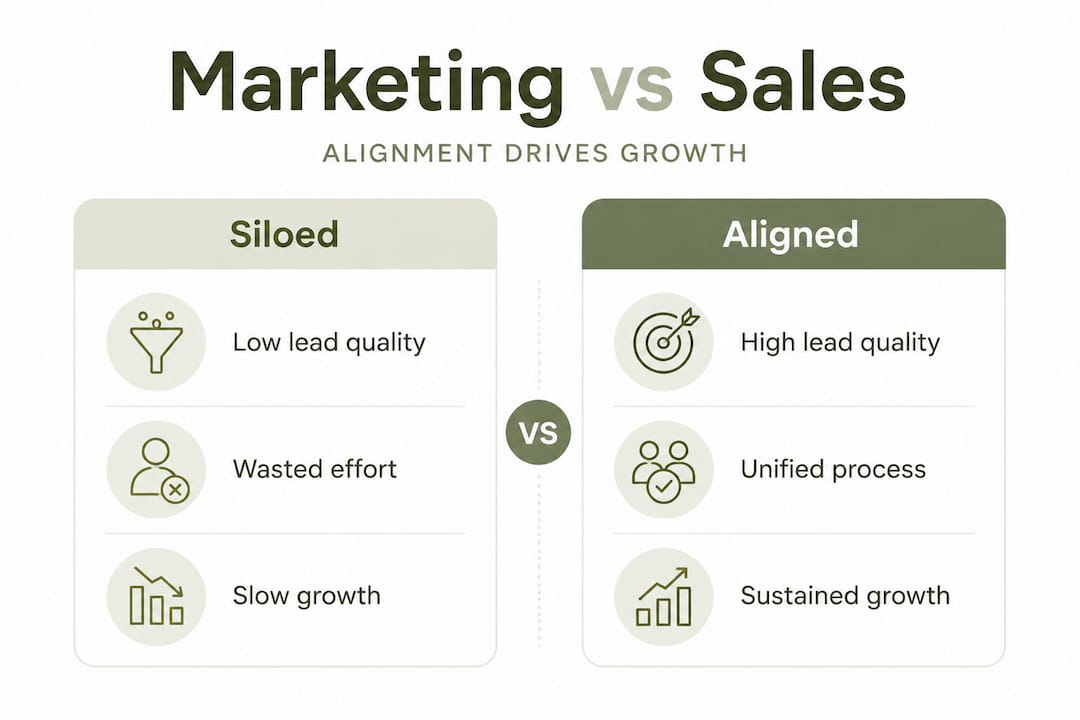
Here is a comparison that shows the difference in outcomes when these two approaches are in play:
| Metric | Siloed approach | Aligned approach |
|---|---|---|
| Lead quality | Mixed, unclear criteria | High, defined by shared ICP |
| Sales cycle length | Long, lots of back-and-forth | Shorter, buyers arrive warmer |
| Messaging consistency | Varies by channel | Unified across all touchpoints |
| Conversion rate | Low to moderate | Noticeably higher |
| Freelancer efficiency | Requires constant re-briefing | Executes from shared strategy |
| Revenue predictability | Unpredictable | More consistent month over month |
Using a simple shared tool like Notion, Trello, or even a Google Drive folder can make a dramatic difference when you are working with freelancers or outside contractors. The key is having one central location where your messaging, buyer persona, offer details, and campaign goals are documented and accessible to everyone who touches your brand.
Pro Tip: When aligning marketing and sales with freelance support, build a short brand brief (one to two pages maximum) that covers your ideal customer, your core message, your offer, and your current campaign goals. Share it with every new collaborator before they start. This single document eliminates most of the misalignment that happens when multiple people are working on your brand without a shared reference point.
If you need a starting framework, a solid marketing strategy template for entrepreneurs can give you the scaffolding to build this out without starting from scratch.
Theory is helpful. But what does alignment actually look like when it works in practice for small businesses and independent consultants?
The evidence across real small business case studies is hard to argue with. When a health coach aligned her content strategy with her enrollment conversation, focusing her Instagram content specifically on the objections and questions that came up most often during sales calls, her close rate on discovery calls jumped significantly. When a travel agency stopped running disconnected promotional posts and built a content journey that mirrored the real steps a buyer takes before booking a trip, their brand alignment case study showed a 636% increase in Instagram profile visits.
The pattern is consistent. When the message people see in the content matches the experience they have in the sales process, trust goes up and hesitation goes down.
Here is what a before-and-after comparison looks like for a typical small business going through this transition:
| Business area | Before alignment | After alignment |
|---|---|---|
| Content strategy | Random, based on trends | Tied directly to buyer journey stages |
| Sales conversations | Starting from scratch each time | Buyers arrive pre-educated and warmer |
| Offer clarity | Described differently in different places | Consistent language everywhere |
| Lead volume | High but low quality | Moderate but highly qualified |
| Monthly revenue | Inconsistent spikes and dips | Steadier, more predictable growth |
| Client retention | Average | Above average due to better fit |
The specific KPIs that tend to show the most improvement after alignment include:
“When B2B brands align their marketing and sales strategies, they consistently see stronger lead generation and conversion rates, with some reporting revenue increases of 20% or more within a single quarter.”
For coaches and consultants, the shift is often less about adding more content and more about making existing content pull its full weight. When every post, email, and landing page is designed with the sales outcome in mind, the entire system becomes more efficient. You are not just building an audience. You are building a pipeline.
Here is something that trips up a lot of founders when they start working on alignment. They treat it as a structural problem. They create more documentation, build more flowcharts, and schedule more sync meetings. And then nothing actually changes because the real issue was never the process. It was the perspective.
True alignment happens when you stop thinking of marketing and sales as two things you alternate between and start seeing every single touchpoint with your customer as one continuous experience. That Instagram post is part of the sale. That welcome email is part of the sale. That bio in your profile is part of the sale. Everything your brand touches is either building trust or eroding it.
The founders and consultants who grow most consistently are the ones who have internalized this idea. They do not compartmentalize. They do not create content in one mode and then put on their sales hat in another. They see the entire customer experience as a unified opportunity to serve, connect, and convert.
Here is the uncomfortable truth about over-structuring alignment: when you focus too much on the mechanics, you can actually kill the thing that makes your brand work. Great marketing, for coaches and consultants especially, is deeply human. It relies on real voice, real empathy, and genuine connection. If you spend all your time documenting processes and not enough time developing a truly shared understanding of your customer, you end up with a polished system that still does not convert. Because the words are right but the feeling is off.
The better approach is to build alignment around shared language and shared empathy. What does your ideal client actually say when they describe their problem? What words do they use? What does success feel like for them? When both your marketing content and your sales conversations are built from the same deep understanding of the person you are serving, alignment happens naturally.
Pro Tip: Instead of starting your alignment process with tools or templates, start with a customer conversation. Talk to three of your best past clients and ask them to describe what they were feeling before they found you, what made them decide to reach out, and what they hoped the outcome would be. The language they use is your alignment foundation.
A growth-driven strategy is not built on process alone. It is built on clarity about who you serve and a genuine commitment to meeting them where they are at every step of the journey. That mindset, more than any tool or template, is what makes alignment stick.
If you have read this far and recognized your own business in some of these gaps, you are not alone. Most founders reach a point where the scattered approach stops working and the need for a real, unified strategy becomes impossible to ignore.
At Reasonate Studio, we help founders, coaches, and consultants build exactly that. Whether you need a full strategy overhaul or focused support on specific areas, we offer hands-on help that is tailored to your brand and your goals. From sales page optimization that closes the gap between content and conversion, to SEO keyword research that brings the right buyers to your door, our work is built to make your marketing and sales work as one unified system. Start with a free Brand Audit Report and find out exactly where your alignment gaps are and what to do about them.
Alignment improves lead quality, shortens sales cycles, boosts customer trust, and increases revenue. Brands that pursue predictable growth through alignment consistently outperform those that keep the two functions separate.
By setting shared goals, unifying messaging, coordinating lead qualification criteria, and choosing the right collaboration tools, founders can align marketing and sales using freelancers or outsourced help. A focused approach to building a marketing strategy gives you the foundation to brief any collaborator effectively.
You risk wasted leads, inconsistent customer experiences, longer sales cycles, and lower conversion rates. Real-world marketing alignment case studies show that these gaps are both common and correctable once you understand where they live.
Start by defining a shared customer journey map and agreeing on common objectives for both functions. From there, use the guidance in building a marketing strategy to build out a unified plan that every collaborator can work from.