September 1, 2026
Understanding B2C Business to Consumer Dynamics


Discover why unify brand communications is essential for boosting revenue and trust. Learn how to create a cohesive brand strategy today!
TL;DR:
- Inconsistent brand messaging can secretly reduce revenue by causing buyer confusion and eroding trust.
- Implementing a flexible, unified communication system across all touchpoints enhances trust, conversion, and revenue growth.
Inconsistent brand messaging quietly drains revenue in ways most founders never trace back to the real source. Up to 23% more revenue is on the table for businesses that present their brand consistently across platforms, yet most founders, coaches, and consultants focus only on their logo colors or font choices when they think about brand consistency. That narrow focus misses the bigger picture entirely. This guide breaks down what unified brand communication actually means, why it matters for trust and revenue, what goes wrong when you ignore it, and how you can start building a more cohesive brand presence starting today.
| Point | Details |
|---|---|
| Unified messaging builds trust | Consistent brand communications reduce buyer confusion and establish credibility. |
| Drives revenue growth | Unified presentation can deliver up to 23% more revenue across platforms. |
| Reduce costly missteps | Avoiding inconsistency prevents confusion, skepticism, and loss in market value during changes. |
| Flexibility beats rigidity | Modern unification means adaptable coherence, not rote repetition across every channel. |
| Start with practical steps | Self-audit and message alignment are essential first actions for founders and coaches. |
Before we talk strategy, we need to get clear on what we’re actually talking about. Unified brand communication is not just about using the same color palette across your website and Instagram profile. It is about delivering a consistent message, voice, and narrative across every single touchpoint your audience encounters, from your first Instagram post to your sales page, your email welcome sequence, your discovery call script, and even how your team answers questions in a Facebook group.
Consistent messaging and voice across channels increase trust and reduce buyer confusion, which is one of the most underrated levers in marketing. When someone reads your website and then jumps over to your Instagram, they should feel the same brand energy without needing to consciously think about it. The moment there’s a disconnect, doubt creeps in. Buyers start wondering which version of you is real.
Here are the key touchpoints where your brand communication shows up, whether you manage them intentionally or not:
Most founders only think about the first two or three items on that list. But your brand is actually speaking on all of them simultaneously.
The concept of message architecture is the secret weapon here. Message architecture is a framework that defines your core story, your primary themes, and the vocabulary your brand uses consistently, while allowing your tone and format to flex based on the channel and audience. Think of it like a brand’s internal constitution. The values and principles stay fixed; how you express them adapts. According to our brand consistency guide, this distinction between rigid visual rules and flexible narrative architecture is what separates brands that last from brands that confuse.
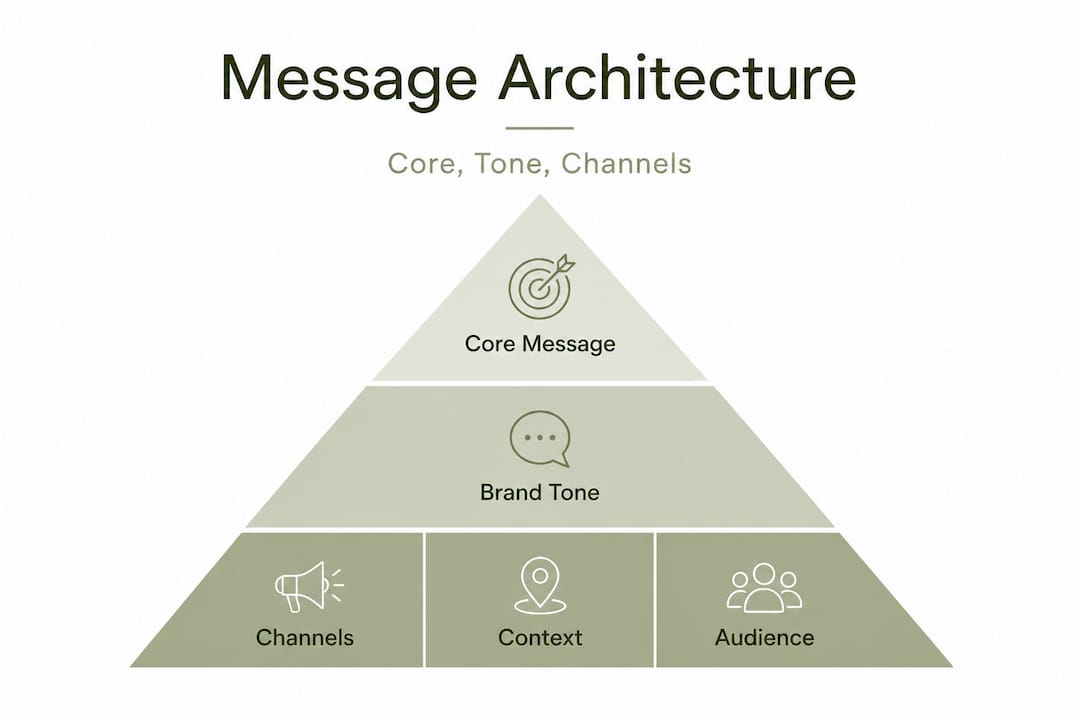
Here’s a quick comparison to make this tangible:
| Scenario | Inconsistent brand | Unified brand |
|---|---|---|
| Social media vs. website tone | Casual and playful online, stiff and formal on the site | Warm and direct across both, format adapts |
| Offer descriptions | Different features highlighted on each page | Core promise stays consistent everywhere |
| Visual identity | Multiple logo versions, no style guide | Controlled visual system with intentional variation |
| Sales language | Pitch sounds different from content | Discovery call feels like a natural extension of the content |
| Client experience | Surprise or confusion at onboarding | Feels like a continuation of the brand story |
This is what consistency in branding looks like in real practice. It is a living, managed system, not a one-time design project.
With that foundation set, let’s talk about the numbers that actually matter to you as a founder or consultant.

Brand consistency is not just a feel-good concept. It is measurable, and the data supports it strongly. Consistent brand presentation across platforms can yield up to a 23% increase in revenue. For a business doing $10,000 a month, that represents over $27,000 in additional annual revenue just from communication clarity. That is not a rounding error. That is a meaningful growth lever that most small business owners are leaving untouched.
Here is a summary of the business metrics most directly affected by brand communication alignment:
| Metric | Impact of unified messaging |
|---|---|
| Revenue growth | Up to 23% uplift reported |
| Customer trust | Faster trust-building reduces sales cycle length |
| Conversion rates | Clarity reduces hesitation at purchase decision points |
| Client lifetime value | Consistent experience strengthens long-term loyalty |
| Referral rate | Clients who understand the brand clearly recommend more easily |
| Onboarding efficiency | Aligned messaging reduces confusion and back-and-forth |
Trust is the currency that makes all of this work. And trust is built through repeated, coherent exposure. When your ideal client sees the same core story, values, and promise reflected across your blog, your Instagram, and your sales call, they stop questioning whether you’re the right fit. They already know. The decision becomes easier.
“Misaligned messaging causes skepticism and lost deals.” When a prospect hears one story on social media and a different story on your sales page, the cognitive dissonance drives doubt and pushes them toward competitors who feel clearer.
The coaches and consultants who see brand consistency revenue growth are not necessarily the ones with the most followers or the biggest ad budgets. They are the ones whose audience immediately understands what they do, who it’s for, and why it works, because that story shows up the same way every single time. That clarity is a competitive advantage, and most people in your space are not fully leveraging it yet.
The practical implication of this is simple: every dollar you spend on content, ads, or outreach performs better when the underlying brand communication is unified. You are not just building a better brand. You are increasing the return on every other marketing investment you make. These brand consistency tips form the foundation of a compounding marketing system.
While the upside is impressive, overlooking brand alignment can cost you more than just growth.
Let’s be specific about the real risks, because vague warnings do not change behavior. Here are the concrete ways brand inconsistency damages your business:
The most striking large-scale example of this is the Warner Bros. Discovery rebrand from HBO Max to Max, and then its reversal back toward the HBO brand identity. The back-and-forth messaging created brand confusion and market damage that industry observers widely criticized. The company spent enormous resources communicating something its audience ultimately rejected. The lesson for smaller brands is pointed: flip-flopping on your story, even for strategic reasons, carries real costs.
For founders undergoing rebrands, this risk is amplified. You have built an audience on a particular story. When you shift that story without a clear narrative bridge, the audience feels abandoned. Some leave. Others become confused ambassadors who describe your brand inaccurately because they are working from outdated information. More guidance on how to navigate this carefully is available in our resource on rebranding for market alignment.
Inconsistent branding does not just confuse buyers. It trains your audience to distrust the next message you send them. Recovery from that takes far longer than prevention would have.
Pro Tip: Check for early signs of narrative inconsistency by reading your website homepage, your last five Instagram captions, and your most recent email side by side. If they feel like they were written by different people with different goals, you have a unification problem. This simple audit takes less than 20 minutes and reveals more than most expensive brand reviews. For a deeper look at common errors, our guide on branding mistakes to avoid covers the patterns that show up again and again with small business owners.
Avoiding pitfalls requires nuance. Unification is not about robotic repetition. It is about smart, scalable alignment.
Here is the problem with most brand guidelines: they focus on the wrong things. Color codes, logo clearance zones, and font rules are useful up to a point. But forcing identical messaging everywhere can actually fail, because different channels require different communication styles, and different audiences respond to different formats. A LinkedIn article demands a different structure than an Instagram carousel, even when both are communicating the same core message.
Rigid visual-first brand rules became the standard in the early 2000s, when most brands were operating across a small number of controlled channels. That world no longer exists. Today a founder might be on LinkedIn, Instagram, TikTok, in a podcast, on a webinar, writing a newsletter, and answering client messages, all in the same week. A rule-bound brand bible will not save you across that many contexts.
What actually works is a message architecture system built around these core principles:
The goal is coherence, not uniformity. Your audience should feel a strong sense of continuity when they move across your channels, even if the format changes dramatically. This is the difference between a brand that feels intentional and one that feels improvised. Our brand messaging checklist covers the specific elements to lock down before you start executing across channels.
Pro Tip: When building your message architecture, write a single paragraph that captures the essence of your brand story. This becomes your north star. Every piece of content you create should, in some way, be a variation of that paragraph’s core idea. If a piece of content does not connect back to it, cut it or reframe it before publishing.
One of the most overlooked mistakes founders make is over-centralizing their communication to the point that they lose contextual relevance. A coach based in Austin speaking to a local audience should not sound identical to the version of themselves speaking to a global podcast audience. The core message stays the same; the frame adjusts. Effective marketing campaign planning accounts for these contextual variations from the start rather than trying to retrofit them after the fact.
Clarity is actionable. Here is how founders, coaches, and consultants can make real progress on brand unification starting right now.
The following numbered checklist gives you a practical starting point for assessing where your brand communication stands today:
Unified communications reinforce a single story across touchpoints, which supports both conversion and revenue growth over time. This is not a one-time fix. It is an ongoing operating practice.
Here is a real-world example of what this looks like in practice. A health coach working with Reasonate Studio came in with three different versions of her offer depending on where you found her. Her Instagram talked about mindset and self-confidence. Her website led with nutrition protocols and her certification credentials. Her emails were warm and conversational but never mentioned either angle clearly. Prospects were confused. The sales cycle was long and inconsistent. After a full brand communication audit and the development of a unified message architecture, every channel started telling the same story: sustainable health for high-achieving women who are tired of starting over. Within 60 days, her conversion rate on discovery calls improved significantly, because her audience arrived on those calls already aligned with her methodology.
Pro Tip: After you launch a new version of your messaging, ask three existing clients and three members of your audience to describe what you do in their own words. If their descriptions match your positioning statement closely, your communication is working. If they vary wildly, you still have alignment work to do. Feedback loops are more honest than self-assessment.
Resources on campaign planning for growth and practical guides on improving brand recognition can help you execute this phase with more confidence and structure.
Here is the part most brand guides skip over entirely, and it is the part that actually determines whether you succeed long-term.
Most templates and brand guidelines are built for a snapshot in time. They capture who your brand is at launch or at a particular growth stage, then assume that version will hold up indefinitely. In reality, your audience evolves. Your offers evolve. The channels you use evolve. The cultural context in which your message lands evolves. A brand guide written in 2022 may already be quietly misaligned with where your business actually stands in 2026.
The real work of unified brand communication is not establishing a system once and walking away. It is developing a practice of thoughtful, iterative review that keeps your communication aligned as your business grows. Many founders mistake consistency for static sameness. They feel guilty changing their messaging because they worry it will look like inconsistency. But adapting your message in response to audience feedback, new market conditions, or a more evolved understanding of your own positioning is not inconsistency. It is strategic growth.
The difference between brands that stay relevant and brands that plateau is judgment. Not rules. The founders who build strong, lasting brands are not the ones with the most detailed style guides. They are the ones who regularly ask hard questions: Is this still true? Is this still resonating? Does this still reflect what we actually deliver?
A brand consistency strategy that is genuinely effective is one built for evolution, not just execution. It has a clear core that does not change, a system for reviewing peripheral messaging regularly, and the willingness to update what no longer fits. That kind of adaptive discipline is rarer than it sounds, and more valuable than any template.
The mindset shift we encourage every founder and consultant to make is this: stop treating your brand communication as a project to complete and start treating it as a practice to maintain. The founders who do this consistently are the ones whose brands feel alive, relevant, and worth paying attention to, which is ultimately what drives trust, loyalty, and revenue.
Knowing the framework is step one. Executing it consistently across every channel is where most founders stall, not because they lack the knowledge but because they lack the bandwidth and the outside perspective to keep it aligned.

At Reasonate Studio, we help founders, coaches, and consultants build and maintain unified brand communication systems that turn clarity into consistent revenue. Whether your biggest gap is your social media management presence or your sales page optimization copy, we build the strategy and execute the work so you can stay focused on delivering your expertise. If you are ready to stop patching together random content and start building a brand that earns real trust, the Reasonate Studio team is here to help you do exactly that, with a boutique, high-touch approach that keeps your story front and center.
Audit your main channels, align your messaging pillars, and ensure every team member is working from the same core narrative and tone. Unified communications reinforce a single story across all touchpoints, which accelerates both trust and conversion.
Yes, research links consistent brand presentation to a revenue increase of up to 23% across platforms, making communication alignment one of the most direct and underused revenue levers for small businesses.
Yes, unclear or flip-flopping messaging during a rebrand can cause real confusion and harm your market perception, as the HBO Max to Max case clearly demonstrated for a much larger audience.
No, it is about maintaining coherence while adapting your core message for each channel. Flexible brand systems allow for controlled variation without sacrificing the consistency that builds audience trust over time.