September 1, 2026
Understanding B2C Business to Consumer Dynamics


Discover why integrated marketing is key to cohesive, predictable growth. Learn how aligning channels boosts your brand's success and scales results.

TL;DR:
- Integrated marketing using three or more channels yields 287% higher purchase rates than single-channel efforts.
- Successful integration aligns messaging, objectives, and measurement across channels, fostering trust and brand coherence.
- Barriers include team silos and disjointed measurement; overcoming them requires shared goals, clear workflows, and system thinking.
Founders who pour everything into one marketing channel often feel like they’re doing everything right but still not growing fast enough. The data tells a different story: campaigns using 3+ channels earn 287% higher purchase rates than single-channel efforts. That gap is not a coincidence. Integrated marketing, where your messaging, channels, and objectives all work together as one unified system, is what separates brands that plateau from brands that scale. This guide walks through what integration actually means, why it outperforms isolated tactics, how to build it, and what stops most founders from getting there.
| Point | Details |
|---|---|
| Integration drives growth | Coordinating channels and messaging multiplies conversion rates and revenue impact. |
| Frameworks prevent chaos | Using a well-defined IMC system keeps every campaign aligned with your business goals. |
| Team silos hurt results | Overcoming organizational barriers is essential for truly unified marketing performance. |
| Omnichannel adds complexity | Personalized, data-driven omnichannel marketing builds on integrated marketing foundations but requires deeper alignment. |
Integrated marketing is a systematic approach to aligning every message, channel, and marketing objective so they work together toward the same goal. It is not about being everywhere at once. It is about making sure that when your ideal client sees your Instagram post on Tuesday, reads your email on Thursday, and lands on your website over the weekend, they feel like they are interacting with the same brand, the same story, and the same clear offer.
The formal framework behind this is Integrated Marketing Communications, commonly called IMC. According to the IMC planning framework, effective IMC methodologies involve business objectives, audience mapping, message architecture, channel roles, orchestration, and unified measurement. Each of those elements builds on the one before it. Without a clear business objective, audience mapping becomes guesswork. Without strong message architecture, channel roles become random. Without unified measurement, you cannot tell what is actually working.
What makes integration so powerful is the cumulative effect it creates. When a potential client encounters your brand five times across five different channels, and each touchpoint reinforces the same positioning and story, trust builds faster. That is the backbone of coherent brand-building. It is also why developing a strong marketing communications strategy before you start posting, emailing, or advertising is so critical for founders who want repeatable results.
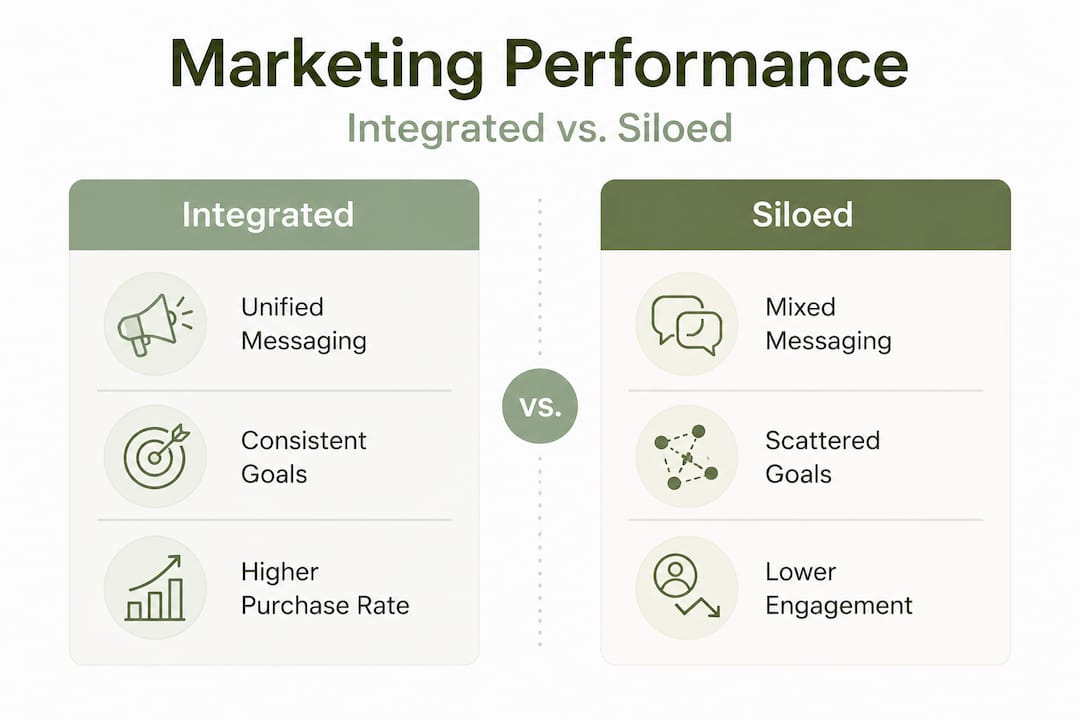
Here is how integrated and traditional siloed marketing compare at a structural level:
| Element | Integrated marketing | Siloed channel marketing |
|---|---|---|
| Messaging | Unified across all channels | Varies by channel or team |
| Goal setting | One shared objective | Separate goals per channel |
| Audience view | Full customer journey | Fragmented by platform |
| Measurement | Unified reporting | Isolated per-channel metrics |
| Brand experience | Seamless and consistent | Inconsistent and disjointed |
| Team coordination | Collaborative and shared | Independent and territorial |
The contrast is sharp. Siloed marketing might look productive on the surface because each channel is “active,” but without alignment, you are essentially running multiple unrelated campaigns that cannibalize each other’s impact.
Pro Tip: Before you build out any marketing calendar or content plan, define your one primary business objective for the next 90 days. Every channel, message, and tactic should be able to trace back to that single goal. If it cannot, cut it.
Now that you understand what integration means, let’s look at what it actually does for your business outcomes. The numbers are not subtle.

Campaigns using 3+ channels earn 287% higher purchase rates compared to single-channel campaigns. Read that again. Nearly three times the purchase rate, simply by ensuring your message reaches your audience through more than one coordinated channel. For a founder selling a $2,000 coaching package, the difference between a 2% conversion rate and a 5.7% conversion rate is the difference between two clients a month and almost six.
Beyond purchase rates, integrated marketing improves engagement quality. When someone sees a brand consistently across social media, email, and organic search, their confidence in that brand increases. They are not just more likely to buy. They are more likely to buy sooner, refer others, and come back again. That is not just a conversion win. It is a retention win.
Here is a direct comparison of what integrated versus non-integrated marketing organizations typically experience:
| Performance metric | Integrated marketing | Non-integrated marketing |
|---|---|---|
| Purchase rate uplift | Up to 287% higher | Baseline |
| Brand recall | Significantly stronger | Weak without repetition |
| Customer retention | Higher due to consistent experience | Lower, inconsistent touchpoints |
| Marketing ROI | More efficient spend | Budget spread thin with overlap |
| Campaign scalability | Easier to replicate and build on | Harder to scale without rebuilding |
| Audience trust | Builds faster through repetition | Slower, fragmented trust signals |
The ROI argument alone is compelling. When your social media content, email sequences, and website copy are all pulling in the same direction, you stop wasting spend on channels that do not reinforce each other. Every dollar works harder because every piece of content is part of a larger, coordinated system.
Here are the core business benefits that founders, coaches, and consultants experience when they shift from scattered tactics to integrated multi-channel strategies:
Each of these benefits compounds over time. The longer you run an integrated system, the stronger the cumulative effect on your brand recognition, audience loyalty, and revenue consistency.
Understanding why integration works is one thing. Knowing what to actually build is another. Successful integrated marketing is not just about using more channels. It requires specific ingredients working together in sequence.
According to the IMC planning framework, the critical components include business objectives, audience mapping, message architecture, channel roles, orchestration, and unified measurement. Let’s break down what each of these means in practice for a founder or consultant running a lean marketing operation.
Clear business objectives. Every campaign and piece of content should connect to a specific, measurable goal. “Get more visible” is not an objective. “Generate 10 qualified discovery calls in 30 days” is. Your objective shapes everything else.
Mapped audience. You need to understand not just who your ideal client is, but where they spend their attention, what language they use to describe their problem, and what triggers their decision to buy. Surface-level demographics are not enough. You need psychographic depth.
Strong core message. Your central message is the through-line that connects every piece of content across every channel. It is the one idea your audience should walk away with after any interaction with your brand. Everything else is a variation of that core theme. Strong brand messaging tips can help you develop this foundation before you build out your channels.
Defined channel roles. Not every channel should do the same job. Instagram might be your awareness engine. Email might be your conversion engine. Your blog might be your long-term SEO and trust-building engine. When each channel has a defined role, they complement each other instead of competing.
Orchestrated delivery. This is where content calendars, campaign timelines, and launch windows come in. Orchestration means your channels are not just saying the same thing. They are saying the right thing at the right time in the right sequence to move someone from awareness to decision.
Unified measurement. This is where most founders drop the ball. They look at Instagram analytics separately from email open rates separately from website traffic. Real integration requires you to measure across channels with shared KPIs so you can see the full picture.
Building a strong brand positioning guide is a useful early step here, because your positioning is the anchor that keeps every channel aligned when execution gets complex.
Pro Tip: Build shared KPIs across every marketing activity, even if you are a solo founder. When your email, social, and content goals are connected to the same outcome, you will make far more strategic decisions about where to spend your time and energy. Integrate accountability, not just tactics.
Despite the advantages, integration is not something most founders stumble into naturally. There are predictable barriers that get in the way, and knowing what they are makes them much easier to overcome.
Common challenges include siloed teams, budget pre-allocation by channel, attribution biases favoring last-click, and execution handoff failures. Even when founders understand integration conceptually, these structural and tactical problems get in the way of actually executing it.
Here are the most common barriers and practical fixes for each:
Team silos. When your social media manager, email copywriter, and SEO strategist work independently with no shared briefing or communication, every channel ends up telling a slightly different version of your brand story. The fix is a shared brand document, a unified content brief, and regular cross-channel check-ins, even if the team is small.
Budget pre-allocated by channel. Many founders budget for “social” and “email” and “ads” as separate line items, without asking how those channels will work together. This leads to uneven investment in a fragmented system. Instead, budget by campaign objective first, then allocate to the channels that best serve that objective together.
Last-click attribution bias. When you only measure the last touchpoint before a conversion, you undervalue the channels that did the heavy lifting earlier in the journey. Someone who found you through a blog post, followed you on Instagram for two months, then converted through an email is not an “email conversion.” They are the product of an integrated system. Use multi-touch attribution to see the full picture.
Execution handoff failures. A campaign strategy is only as good as its execution. When the strategy is created by one person and handed off to another without context, things fall apart. Clear SOPs (standard operating procedures), documented workflows, and shared project management tools close this gap.
“Without integration, great tactics fail due to disconnection. Structure beats isolated excellence every single time.”
The insight behind that statement is something we see constantly with founders who come to us after years of creating great content that simply did not convert. The content itself was often strong. The problem was that nothing was connected. Understanding how aligning marketing and sales plays into this is especially important for coaches and consultants where the sales conversation is part of the marketing experience.
Breaking through these barriers does not require a massive team or a big budget. It requires intentional structure. Shared goals, shared language, shared timelines, and shared measurement tools are the glue that holds an integrated system together.
This is a question that comes up often, especially as “omnichannel” has become one of the most used words in marketing. The short answer is yes, there is a meaningful difference, and understanding it helps you know which model fits your current stage.
Integrated marketing means aligning your messages, goals, and channels so they work together toward a unified outcome. It is primarily a strategic and messaging discipline. Omnichannel marketing takes that foundation and layers on real-time personalization and data unification, so the customer experience adapts dynamically based on behavior, preferences, and stage in the journey.
Omnichannel adds personalization and data unification on top of IMC’s messaging consistency, but demands more organizational alignment. That added complexity is powerful at scale. But it also requires more infrastructure, more data maturity, and more operational sophistication than most founders and small teams have at an early or mid stage.
Here is a practical breakdown of the key distinctions:
“Omnichannel is not a replacement for integrated marketing. It is what integrated marketing grows into when the foundation is strong enough to support personalization at scale.”
The practical takeaway for founders, coaches, and consultants is this: do not skip integrated marketing to chase omnichannel. Build the foundation first. Get your message aligned, your channels coordinated, and your measurement unified. Once that system is producing consistent results, you will have the data and the clarity to layer on the personalization that omnichannel requires.
Trying to implement omnichannel without integrated marketing underneath it is like building a second floor before you have a ground floor. It does not hold.
Here is the uncomfortable truth that most marketing conversations avoid. The channel is almost never the problem. Founders spend enormous energy optimizing individual channels, tweaking their Instagram aesthetic, testing email subject lines, adjusting ad targeting, when the real issue is structural. No amount of optimization fixes a system that is fundamentally fragmented.
We see this constantly. A founder who has a beautifully designed Instagram account with thousands of followers, but no email list and no clear offer on their website, wonders why their engagement is not translating to revenue. The answer is not better content. It is integration. The audience cannot move forward because there is no path forward.
The most significant shift we help founders make is not a tactical one. It is a mindset shift from channel thinking to system thinking. A channel asks, “How do I make this platform perform better?” A system asks, “How does this platform connect to everything else, and how does it move someone from first contact to paying client?”
System thinking also changes how you prioritize your time. Instead of chasing the newest platform or trend, you focus on strengthening the connections between what you already have. Email and social working together. Content and SEO reinforcing each other. Your discovery call and your onboarding experience delivering the same brand story. That kind of coherence is rare, and it is exactly why it builds trust so fast.
The founders who get the most consistent growth are not the ones doing the most. They are the ones doing the most coordinated things. They have fewer channels, but those channels are pulling in the same direction with the same message and the same goal. That is the power of integration, and it is available to any founder willing to step back from the tactical chaos and build a real system underneath their marketing.
If this article made you realize that your marketing is more scattered than strategic, you are not alone. Most founders start with good intentions and end up with a patchwork of tactics that look busy but do not build on each other.

At Reasonate Studio, we help founders, coaches, and consultants go from scattered efforts to an integrated marketing system that creates consistent visibility, stronger messaging, and more reliable revenue. Our Aligned Impact Model™ is built specifically to align your brand, your audience, and your channels into a cohesive growth engine. Whether you are starting fresh or cleaning up a system that is not producing results, we can help you build something that actually works together. Start with our free Brand Audit Report and get a clear picture of where your integration gaps are and exactly how to close them.
Integrated marketing creates a seamless, unified brand experience that increases conversion rates and makes your marketing investment more efficient. Campaigns using 3+ channels earn 287% higher purchase rates than single-channel campaigns.
Integrated marketing ensures every channel has consistent messaging and works toward the same goal, while multichannel marketing simply means using more than one channel without necessarily aligning them. True integration, as defined by IMC methodology, requires shared objectives, unified message architecture, and coordinated measurement across all channels.
Start by defining one clear business objective, then map your audience and establish unified messaging before you plan any channel-level tactics. The IMC planning framework confirms that business objectives and audience mapping must come before message architecture and channel roles.
Breaking down silos between teams and channels is the biggest challenge for most organizations. Siloed teams, budget pre-allocation by channel, and execution handoff failures are the most frequently cited barriers to successful integration, even for brands that understand the strategy well.
You will see aligned goals, consistent messaging across every channel, unified reporting that shows the full customer journey, and improved performance results over time. A simple test is to compare your Instagram bio, your email welcome message, and your website homepage. If they tell three slightly different stories about who you are and who you serve, your marketing is not yet integrated.