
July 25, 2026
McKinsey Marketing Strategy Frameworks for Business Leaders

Discover proven marketing ROI strategies for small businesses in 2026, including email, SEO, AI tools, and how to measure and maximize your returns.

TL;DR:
- Email and SEO marketing deliver higher ROI than paid ads for small businesses.
- Accurate ROI measurement requires including all marketing costs and proper attribution.
- AI tools help automate tasks, improve performance, and free up time for core growth activities.
Most small business owners assume paid ads are the fastest path to real returns. The numbers say otherwise. Email delivers $36 for every $1 spent, and SEO consistently returns $22 for every dollar invested, making both channels far more powerful than most founders realize. Meanwhile, a staggering number of small businesses in Texas keep pouring money into Facebook ads without ever calculating whether those clicks turn into actual revenue. This guide is here to fix that. You will learn exactly what marketing ROI means, how to calculate it accurately, which channels deliver the strongest returns, and how emerging AI tools are reshaping what is possible for lean teams with limited budgets.
| Point | Details |
|---|---|
| ROI calculation essentials | Count all related costs—including content, labor, and tools—for meaningful ROI results. |
| Channel selection | Email and SEO consistently deliver the highest ROI for small businesses. |
| Track and attribute accurately | Use proper attribution models and digital tracking to ensure your ROI measurement is reliable. |
| AI for marketing | AI tools can drastically improve ROI and reduce costs when tested and implemented thoughtfully. |
| Mindset for success | Patience and practical experimentation lead to authentic, sustainable ROI growth. |
Marketing ROI, or return on investment, measures how much revenue your marketing efforts generate compared to what you spent to generate it. At its simplest, it answers one question: is your marketing making you more money than it costs? For small business founders, coaches, and consultants in Texas, understanding this number is the difference between growing confidently and guessing constantly.
The basic formula looks like this: ROI equals revenue generated minus marketing cost, divided by marketing cost. Multiply that result by 100 to get a percentage. So if you spent $1,000 on a campaign and it generated $5,000 in revenue, your ROI is 400%. Simple enough. But most businesses miscalculate ROI because they only count the obvious costs and forget everything else.
Accurate ROI tracking requires including every cost category involved in your marketing effort. Here is what you need to account for:
Most founders forget labor entirely. If you spend eight hours per week managing your own social media and you bill clients at $150 per hour, that is $1,200 per month in hidden cost that never shows up in the ROI calculation. Leaving it out makes your marketing look far more efficient than it actually is.
Now, what counts as a good result? Industry benchmarks suggest a 5:1 ROI, meaning $5 in revenue for every $1 spent, is considered strong for most small businesses. Email marketing clears that bar at $36 to $1. SEO lands at $22 to $1. Paid social and display ads rarely reach these heights for small businesses, especially when you factor in the full cost picture.
“Most businesses do not have a marketing problem. They have a clarity problem. When you know exactly which activities are generating revenue and at what cost, every decision becomes easier.”
Understanding ROI is not just about knowing whether something worked. It gives you the data to double down on what is producing results and stop funding what is not. When you are developing a marketing strategy for your business, ROI tracking becomes the feedback system that sharpens every future decision. It turns marketing from a cost center into a revenue engine you can actually manage.
For Texas founders running lean teams, this matters even more. You do not have unlimited budget to experiment blindly. Tracking ROI forces you to be intentional, and intentional marketing almost always outperforms reactive marketing over time. The businesses that grow most consistently are not the ones spending the most. They are the ones spending most clearly.
Now that we have defined the stakes with real numbers, let us unpack how to measure marketing ROI accurately.
With ROI defined and benchmarks in mind, the next challenge is measuring results. Knowing the formula is one thing. Building a system that actually captures accurate data is another. Most small business owners start tracking ROI and quickly run into one major problem: they cannot figure out which marketing activity caused a customer to buy.
That problem has a name. It is called attribution, and solving it is central to measuring ROI correctly.
The step-by-step calculation process
Here is how to measure ROI in a practical, repeatable way:
The trickiest step is always number three, because customers rarely take a straight line from ad click to purchase. They might see your Instagram post, then Google your name a week later, subscribe to your email list, and finally buy after reading a newsletter. Which touchpoint gets the credit?
Attribution models explained
There are four main attribution models you can use, and each one tells a different story:
| Attribution model | How it assigns credit | Best for |
|---|---|---|
| First-touch | 100% credit to the first interaction | Brand awareness campaigns |
| Last-touch | 100% credit to the final interaction | Direct response campaigns |
| Linear | Equal credit across all touchpoints | Multi-channel nurture funnels |
| Multi-touch | Weighted credit based on influence | Complex, long sales cycles |
For most small businesses and solo consultants, last-touch attribution is the easiest starting point. It is not perfect, but it gets you moving and producing usable data fast. As your systems mature, shifting to linear or multi-touch models gives you a more accurate picture of what is driving real results.
Pro Tip: Track every dollar you spend on marketing in a simple spreadsheet from day one. Even if you only have $200 to spend this month, document where every cent went and what revenue you can trace back to it. Small businesses that build this habit early make far smarter marketing budget decisions as they scale.
Practical tracking tools
You do not need enterprise software to track ROI. Here are three accessible options:
The key is consistency. It does not matter much which tool you choose. What matters is that you capture marketing data consistently over time so you can spot patterns. A single month of data is a snapshot. Six months of data is a trend. Trends are what allow you to make genuinely confident marketing decisions.
Knowing how to measure ROI, you can now focus your efforts on channels that deliver the strongest returns. Not all marketing is created equal, and for small businesses in Texas operating with lean budgets and limited bandwidth, choosing the right channels makes an enormous difference.
The data is clear. Email marketing returns $36 for every $1 invested, and SEO delivers $22 for every dollar spent. Both channels dramatically outperform paid social and display advertising for the average small business. But why?

Why email and SEO outperform paid ads
Paid ads stop the moment you stop paying. The second your budget runs out, your visibility disappears. Email lists and organic search rankings, on the other hand, compound over time. A piece of content you publish today can generate leads two years from now. An email list you build this quarter will still be there next year, ready to be activated with zero additional ad spend.
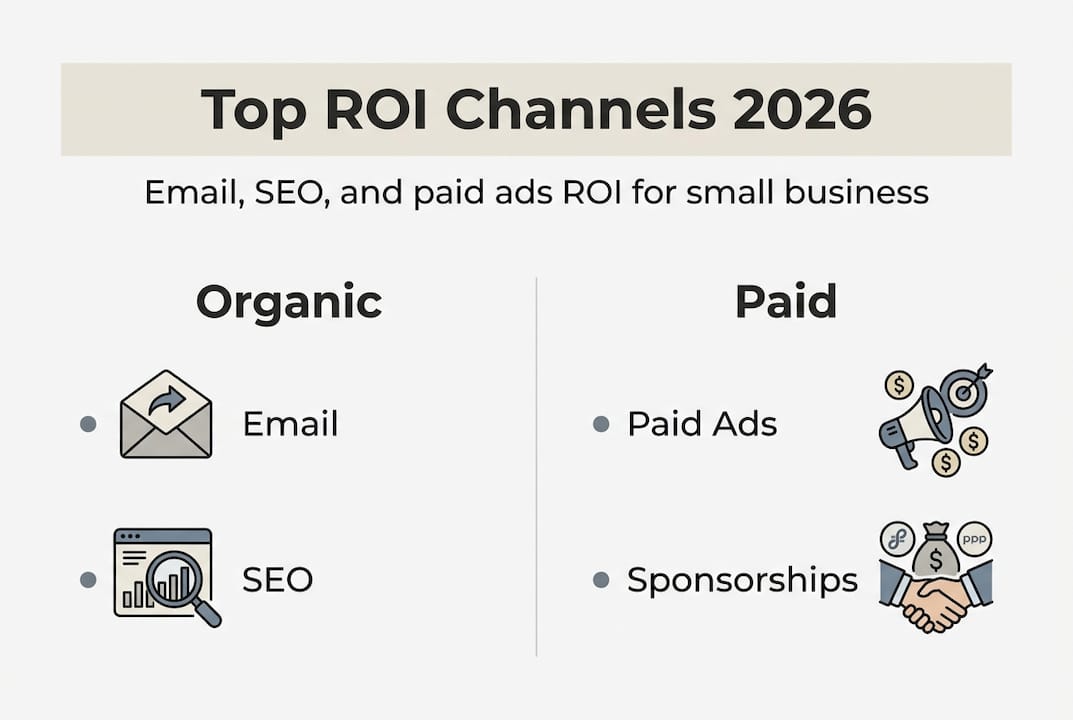
This is the compounding effect that makes organic marketing strategies so powerful for small businesses. You build an asset, not just rent attention.
Comparing the top high-ROI channels
| Channel | Average ROI | Time to results | Cost structure |
|---|---|---|---|
| Email marketing | $36:$1 | 30 to 60 days | Low monthly tool cost |
| SEO | $22:$1 | 3 to 9 months | Time or content cost |
| Social media (organic) | Variable | 60 to 90 days | Time and content creation |
| Paid ads (PPC) | $2:$1 average | Immediate | High and ongoing |
| Content marketing | $16:$1 | 6 to 12 months | Time or writing cost |
For a consultant in Austin or a health coach in San Antonio, the implication is direct. Before you spend another dollar on paid ads, ask yourself whether you have a real email list strategy and whether your website is optimized to attract search traffic.
Texas-specific tactics that work
Local context matters. Texas has a strong culture of community and referral-based business, which makes local SEO especially powerful. When someone in Houston searches for “business coach near me” or “marketing consultant Austin,” showing up in those results is worth far more than a generic ad impression.
Here are actionable steps to launch or improve these channels:
The businesses we see achieving the most consistent ROI are the ones treating email and SEO as long-term infrastructure, not quick wins. They build the foundation carefully and then let the compounding do its work.
Beyond traditional channels, new technologies offer unexpected ROI advantages. Artificial intelligence tools have moved from experimental novelty to practical business tools that small businesses can use right now to save time, reduce costs, and improve performance.
The case for AI is backed by numbers. An Adobe study found that SMBs using AI content tools save an average of $6,000 annually and generate measurable revenue gains. Microsoft Copilot delivered a 353% ROI for businesses that adopted it. These are not small improvements. They represent a meaningful shift in what a lean team can produce.
Where AI delivers real ROI for small businesses
AI is most effective when it handles repetitive, time-consuming tasks that do not require human creativity or relationship judgment. Here is where small businesses are seeing the strongest results:
Pro Tip: Start with one AI tool and one specific task. Do not try to automate your entire marketing operation at once. Pick the most time-consuming repetitive task in your workflow, test an AI solution for 30 days, measure the time saved and quality of output, then decide whether to expand. This incremental approach prevents expensive mistakes and builds real confidence in the tools.
How to get started without wasting money
The biggest mistake small business owners make with AI tools is over-investing before they understand the fit. Most AI tools offer free trials or low-cost entry tiers. Use them. Spend a month testing before committing to any paid plan.
Also, be clear about what AI cannot replace. It cannot replicate your voice, your relationships, or your deep expertise in your field. The best AI marketing software does not replace human judgment. It amplifies it. You still need to set strategy, review outputs, and make creative decisions. AI handles the volume. You supply the vision.
For Texas founders who are already stretched thin across client delivery, operations, and sales, AI tools can be genuinely freeing. Even saving five to eight hours per month on content and reporting gives you time back to do the relationship-building work that actually drives referrals and repeat business.
Here is something most ROI guides will not tell you: obsessing over short-term ROI numbers can actually damage your long-term marketing results. We have seen it happen repeatedly. A founder gets locked into optimizing for immediate returns and starts cutting every activity that does not show a direct, trackable payoff within 30 days. They kill their content program. They stop nurturing their email list. They abandon brand-building entirely.
The result? Their pipeline dries up six months later because they stopped doing the work that builds trust over time.
Good digital content strategy is an investment in future ROI, not a cost to minimize today. A blog post that takes three hours to write might generate zero leads in its first month and then consistently bring in five warm leads per month for the next two years. That ROI is enormous, but it is invisible to anyone focused only on immediate returns.
Patience and consistency are the most underrated marketing advantages available to small businesses. Large brands can buy attention. Small businesses in Texas earn it through genuine connection, local presence, and showing up reliably. The coaches and consultants we have seen build the most durable growth are not the ones who found the perfect channel or cracked some algorithm. They are the ones who committed to a clear message, stuck with their strategy long enough to see it compound, and kept showing up even when the early numbers looked unimpressive.
Experimentation matters too, but it should be structured. Test new tactics in small doses. Measure them honestly. Learn from what does not work without letting it derail your core strategy. The businesses that grow through consistent, patient effort and honest reflection consistently outperform those chasing quick marketing hits.
If you have made it through this guide, you now have a real foundation for understanding, measuring, and improving your marketing ROI. The next step is putting it into action, and that is where having the right support makes all the difference.
At Reasonate Studio, we work directly with founders, coaches, and consultants in Texas to build marketing systems that generate consistent, trackable revenue. From sales page optimization that lifts your conversion rates to full brand strategy and social media management, every service we offer is built around your specific goals and growth stage. We do not do generic. We do not hand you off. You work directly with Kaitlyn and a small, trusted team that treats your business like it matters because it does. If you are ready to stop guessing and start growing with intention, Reasonate Studio is here to help you build the engine.
You need to count ad spend, tools, content creation, labor, and overhead for an accurate ROI calculation, since leaving any category out will overstate your actual returns.
A 5:1 ROI, meaning $5 returned for every $1 spent, is the standard benchmark for strong performance, though email marketing at $36:$1 and SEO at $22:$1 consistently exceed that bar.
Attribution models determine which marketing touchpoint receives credit for a conversion, so the model you choose directly changes how ROI is calculated across channels.
AI tools automate time-consuming tasks, sharpen campaign performance, and reduce overhead costs, with documented results like a 353% ROI and $6,000 in annual savings for small businesses using Microsoft Copilot.

