
July 25, 2026
McKinsey Marketing Strategy Frameworks for Business Leaders

Struggling to find consulting clients consistently? Discover 5 proven strategies for 2026 covering branding, referrals, social proof, digital marketing, and measurement to build a reliable client pipeline.

TL;DR:
- Consistent client acquisition relies on clear value propositions and strategic branding across platforms.
- Leveraging systematic referral requests and partnerships significantly increases high-quality client leads.
- Measuring ongoing efforts with simple tools ensures sustainable growth and prevents feast-and-famine cycles.
You can be the most skilled consultant in your niche and still struggle to find clients consistently. That gap between expertise and a full pipeline is one of the most frustrating realities in professional services. The problem rarely comes down to talent. It almost always comes down to the absence of reliable systems. Most consultants rely on word of mouth, hope, and occasional bursts of outreach, none of which create predictable growth. This article walks you through five proven strategies to attract and retain clients in 2026, covering brand clarity, referral systems, social proof, digital marketing, and the measurement habits that hold it all together. Each section gives you something actionable you can start using immediately.
| Point | Details |
|---|---|
| Systematize referrals | Referrals bring most new clients, but only when you ask and track them consistently. |
| Leverage social proof | Showcasing client reviews and testimonials builds powerful trust with prospects. |
| Expand with digital marketing | Going beyond referrals with targeted online strategies helps you scale your client base. |
| Measure and adapt | Consistent tracking and adjustment keep your approach effective over time. |
Before anyone can hire you, they need to understand exactly what you do and why you are the right person for the job. That sounds simple. In practice, most consultants describe their work in vague, process-heavy language that fails to connect with potential clients. The first real step in consistent client acquisition is getting your value proposition razor sharp.
A value proposition is not a job title or a list of services. It is a clear, specific statement of who you help, what problem you solve, and what result clients can expect. The difference between “I help businesses with marketing” and “I help independent financial advisors fill their calendar with qualified leads in 90 days or less” is enormous. The second version speaks directly to a specific person with a specific problem and a specific outcome.
Building your personal brand means making sure that value proposition shows up clearly and consistently across every place a potential client might find you. That includes your LinkedIn profile, your website, your email signature, your content, and even the way you introduce yourself in conversation.
To start sharpening your niche and building a credible presence, work through these questions honestly:
Your answers become the raw material for your brand messaging, your LinkedIn headline, your website homepage, and your outreach copy. Once you have clarity here, every other strategy in this article works significantly better.
On LinkedIn specifically, your profile should function as a landing page, not a resume. Lead with the result you create for clients. Use your featured section to showcase case studies, testimonials, or a lead magnet. Post consistently about the problems your ideal clients face and how you think about solving them. If you want a deeper breakdown of proven coach client-getting steps, the same principles apply to consultants building visibility from scratch.
Note that 60 to 80% of new business for professional services firms comes through referrals. But most firms lack the systems to capture that potential consistently. Brand clarity is the foundation that makes referrals easier to generate because people can only refer you if they clearly understand what you do.
Pro Tip: Lead with transformation, not tasks. Instead of saying “I provide strategic planning services,” say “I help consulting firm owners double their revenue without adding headcount.” The second version gives a potential referrer the exact language they need to introduce you to someone new.
Once your value is clear and visible, the next priority is leveraging proven relationship-driven channels. Referrals are the highest-converting source of new clients for consultants. They arrive pre-sold on your credibility and often require far less time to close. The challenge is that most consultants treat referrals as something that just happens rather than something they actively manage.
Passive referrals, the kind where a former client casually mentions your name, yield only 20 to 30% of what a systematic approach can produce. The data is clear: systematic asks timed to client wins, reciprocal partnerships, and consistent tracking unlock the full potential of your referral network.
“80% of missed opportunities aren’t about skill, but about not asking or tracking.”
Here is a look at how different referral approaches compare:
| Referral type | How it works | Typical yield |
|---|---|---|
| Passive | Client mentions you without prompting | 20 to 30% of potential |
| Active/systematic | You ask directly after a client win | 50 to 70% of potential |
| Reciprocal partnerships | Mutual referrals with complementary providers | High and compounding |
Setting up a simple referral request system does not require software or complexity. Follow these steps to get started:
For partnership strategies, look for professionals who serve the same type of client but offer different services. A business attorney and a business consultant, for example, share a client base without competing. Propose a mutual referral arrangement and check in monthly. These relationships compound over time and become a consistent source of warm introductions.
You can explore marketing strategy examples that show how relationship-based strategies integrate with broader plans. And if you want to see how referral thinking fits into a complete system, essential marketing strategies for entrepreneurs provide a useful broader framework.
Pro Tip: Time your referral asks strategically. The best moment to ask is immediately after delivering a result your client is excited about. Their enthusiasm is contagious and makes their recommendation far more compelling.
With warm channels supporting your pipeline, amplifying trust through social proof multiplies your authority. When someone discovers you through digital search or a cold outreach message, they immediately look for evidence that you are credible and effective. Social proof, meaning reviews, testimonials, case studies, and video proof from real clients, provides that evidence without you having to make the case yourself.

92% of B2B buyers trust peer reviews over any other form of content when evaluating a service provider. That number is not a minor data point. It means nearly every potential client you speak with is already looking for what other people say about working with you before they make a decision.
User-generated content (UGC) refers to any content created by your clients rather than by you. It is the most trusted form of marketing available, and it costs nothing to collect if you know how to ask for it. Here is a breakdown of the most effective UGC formats for consultants:
| UGC format | Best use case | Where to feature it |
|---|---|---|
| Written testimonial | Quick trust-building, website, proposals | Homepage, LinkedIn, proposals |
| Case study | Demonstrates full process and outcome | Website, sales conversations |
| G2 or third-party review | AI-driven search discovery | Google, G2, Clutch profiles |
| Video testimonial | Highest trust, emotional resonance | Website, social media, email |
To collect reviews and testimonials consistently, build these habits:
Where you feature social proof matters as much as having it. Place testimonials near your calls to action on your website, include case study links in proposals, and pin your strongest social proof to the top of your LinkedIn profile. For digital marketing best practices, social proof placement is consistently one of the highest-impact conversion levers.
For additional context on how proof-driven content works in practice, B2B campaign examples and the broader B2B marketing strategy framework both show how to sequence trust-building content effectively.
Stat to know: Brands that actively collect and feature UGC see significantly higher engagement and conversion rates than those relying entirely on self-produced content.
After establishing a referral and trust engine, digital strategy accelerates your growth beyond your own network. Referrals are powerful, but they have a ceiling. Once you exhaust your existing network, you need digital channels to bring in genuinely new clients who have never heard of you before.
The good news is that referral systems integrate alongside digital marketing for compounded results. They are not competing strategies. They reinforce each other. A potential client who sees your content online and then hears a referral from a mutual contact converts at a dramatically higher rate than either channel alone.
Here are four high-ROI digital strategies worth prioritizing as a consultant:
Avoid these common mistakes that undermine digital outreach:
To see how personalization powers sustainable results, explore how top brands personalize marketing for growth at every stage of the client journey.
Pro Tip: Repurpose your strongest testimonials and case studies into digital content. Turn a client’s outcome into a LinkedIn post, a website section, and an email sequence. One great result, shared three different ways, does three times the work.
To maintain momentum and keep growth sustainable, continuous measurement is essential. Most consultants set up parts of a system and then forget to check whether it is actually working. Without tracking, you have no way of knowing which activities are generating clients and which are just consuming your time.
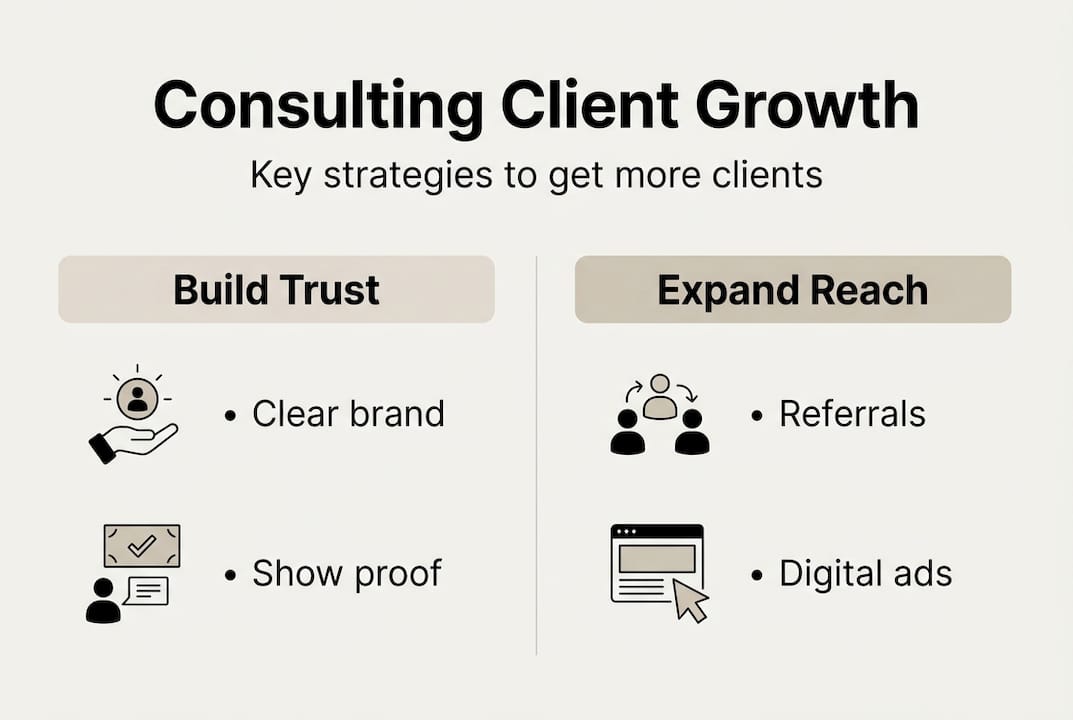
Tracking referral effectiveness and UGC conversion is what allows you to compound your wins rather than starting over from scratch every quarter. Measurement closes the loop and turns isolated efforts into a self-improving system.
Start by tracking these core inputs and outputs:
Simple tools and habits that make this sustainable:
Here is a simple tracking table to guide your monthly review:
| Metric | Target | If falling short |
|---|---|---|
| Referral asks per month | 5 to 10 | Re-engage top 3 past clients |
| New reviews collected | 1 to 2 | Add a review ask to project closeout |
| Inbound leads from content | 2 to 4 | Publish one additional piece of content |
| Discovery calls booked | 3 to 5 | Increase LinkedIn post frequency |
The goal is not perfection. It is progress through iteration. One small improvement per month, applied consistently, creates dramatically different results over 12 months than occasional heroic pushes followed by long periods of inactivity. For a deeper look at building this into a broader plan, the coach marketing strategy framework applies equally well to consultants refining their approach over time.
Here is the uncomfortable pattern we see repeatedly: consultants who struggle with growth are not lacking in skill, expertise, or even motivation. What they lack is the discipline to treat client acquisition as an ongoing system rather than a reaction to feeling slow.
When the calendar is full, outreach stops. When the calendar empties, panic sets in. This feast-and-famine cycle is not a character flaw. It is a structural problem caused by the absence of habits and systems that run regardless of how busy you feel.
Waiting passively for referrals while hoping the phone rings is not a strategy. It is optimism dressed up as a plan. The consultants who scale consistently are not necessarily more talented. They are more systematic. They block time for outreach every week, not just when they feel desperate. They ask for referrals right after wins, not months later when the moment has passed. They track what works and double down on it.
The biggest mindset shift available to you right now is this: stop thinking of client acquisition as something you do between projects and start treating it as a core part of your business that runs in the background all the time. Even 30 minutes a week of consistent, systematic effort compounds in ways that sporadic bursts never can. For inspiration on how authentic growth marketing principles apply to service businesses, the same consistency-over-intensity logic holds.
Pro Tip: Systems beat heroics for long-term consulting success. Build one small, repeatable habit into your calendar this week, whether that is a weekly outreach block, a monthly referral ask, or a quarterly content review, and protect it like a client commitment.
The strategies in this article work. But knowing what to do and having the time, clarity, and support to actually execute it consistently are very different things. That is where having a strategic partner makes a real difference.
At Reasonate Studio, we help founders, coaches, and consultants build brands that attract the right clients and marketing systems that keep the pipeline moving. Whether you need sharper messaging, stronger search visibility through SEO keyword research, or a higher-converting sales page optimization, we bring both the strategy and the execution. Our clients see results within 60 days, and our 85% retention rate reflects what happens when the work is done right. If you are ready to stop guessing and start growing, we would love to talk.
Activating your referral network is the fastest path. Systematically asking satisfied clients for introductions accounts for 60 to 80% of new business in professional services, and it converts faster than any cold channel.
Showcase testimonials, case studies, and third-party reviews prominently on your website and LinkedIn. 92% of B2B buyers rely on peer feedback when selecting a service provider, making social proof your most powerful credibility tool.
Digital channels extend your reach well past your existing network. SEO content, LinkedIn thought leadership, and personalized outreach allow you to target new prospects systematically, and integrated alongside referrals, they produce compounding results.
Review which referral or outreach channel has gone quiet, then re-engage your top five past clients with a genuine check-in. Ask for testimonials and targeted introductions to reignite both your credibility and your warm pipeline at the same time.

