September 22, 2026
Why Update Brand Messaging: Essential Guide for Growth


Discover what brand purpose is and how it drives growth, builds trust, and creates deep connections with your audience. Start redefining yours!

TL;DR:
- Brand purpose is the core reason a business exists beyond making money and creates lasting trust.
- Authentic purpose drives faster growth, customer loyalty, and meaningful differentiation from competitors.
- Implementing purpose involves genuine reflection, consistent actions, and regular review to avoid superficial branding.
You’ve probably heard that your brand needs a “purpose.” But here’s the thing: most founders treat it like a tagline tweak or a values section buried at the bottom of their About page. That’s not brand purpose. That’s decoration. 64% of consumers choose brands based on shared societal beliefs, and the brands winning their loyalty aren’t the ones with the cleverest copy. They’re the ones whose purpose shows up in every decision, every offer, and every piece of content. If you’re a founder, coach, or consultant wondering why your marketing feels scattered or your audience isn’t sticking around, the answer is almost always rooted in unclear purpose. This article breaks down what brand purpose actually means, why it directly drives growth, and how you can define and live yours in a way that builds real, lasting trust.
| Point | Details |
|---|---|
| Brand purpose defined | A brand’s purpose is its core reason for existing beyond making a profit, anchoring its values and actions. |
| Drives business growth | Purpose-led brands consistently outperform competitors in growth, loyalty, and trust. |
| Authenticity is essential | Inauthentic or performative brand purpose can create backlash and undermine trust. |
| Make purpose actionable | Defining and consistently acting on brand purpose amplifies results for founders, coaches, and consultants. |
Brand purpose is one of those terms that gets used so loosely it loses all meaning. Some people think it’s their mission statement. Others think it’s a social cause they slap on their website. But brand purpose is something much more specific and powerful than either of those things.
At its core, brand purpose is the reason your brand exists beyond making money. It’s the answer to: “Why does this business need to exist in the world, and what changes because of it?” It speaks to the impact you want to have on the people you serve and the world around you. It connects your day-to-day work to something larger than a revenue target.
These three terms often get lumped together, but they do different jobs.
| Term | What it answers | Time orientation |
|---|---|---|
| Brand purpose | Why do we exist beyond profit? | Timeless |
| Mission | What do we do and for whom? | Present-focused |
| Vision | Where are we going? | Future-focused |
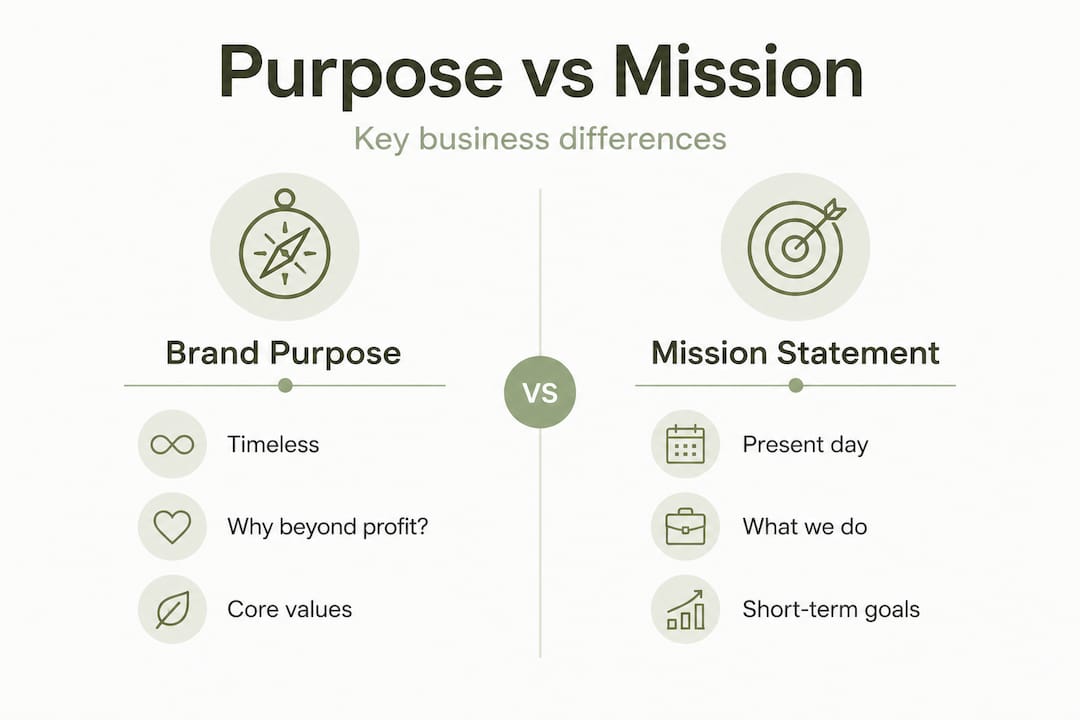
Your mission tells people what you do today. Your vision tells them where you’re headed. But your brand essence and purpose tell people why any of it matters. This is the piece most founders skip, and it’s the most important one.
Here’s a simple way to think about it. A fitness coach’s mission might be “to help busy professionals lose weight through sustainable habits.” Their vision might be “a world where no one sacrifices their health for their career.” But their purpose? “To prove that taking care of yourself is an act of strength, not selfishness.” One of these statements creates a movement. The other two describe a service.
Today’s buyers aren’t just purchasing products or services. They’re deciding which brands deserve their loyalty, their money, and their social endorsement. And they’re paying close attention to what brands stand for.
Brand purpose drives trust on two levels: personal (“this brand improves my life”) and societal (“this brand makes the world better”), with 80% of people saying they trust purpose-led brands more than institutions. That’s a staggering number. It means your brand has a real opportunity to build the kind of credibility that governments and corporations have lost.
Here’s what that means in practical terms for founders, coaches, and consultants:
“People don’t buy what you do. They buy why you do it.” This idea, made famous by Simon Sinek, isn’t just a motivational quote. It’s a strategic truth that shows up in purchase data, loyalty metrics, and brand valuation research every single year.
When you lead with purpose, you stop competing on price or features. You start competing on meaning. And meaning is something a competitor can’t easily copy.
Understanding the definition is only half the journey. Seeing how brand purpose comes to life in practice makes its value real. Two of the most studied examples in modern branding are Patagonia and Dove. Both built their growth not on product superiority alone, but on a purpose so clear and consistent it became a competitive moat.
Patagonia doesn’t just say they care about the environment. They’ve made environmental activism the actual operating system of their company. They tell customers not to buy their products if they don’t need them. They donate 1% of sales to environmental causes. They’ve taken legal action against the U.S. government to protect public lands. Every business decision runs through their purpose.

Patagonia’s environmental activism and public stance on sustainability helped build a billion-dollar brand valuation while maintaining fierce customer loyalty in a crowded outdoor apparel market. The key isn’t that they found a good cause. It’s that the cause and the business are genuinely inseparable.
For founders and coaches, the lesson here isn’t “take a political stance.” It’s that when your purpose is woven into your actual business decisions, not just your marketing language, people feel the difference immediately.
Dove’s Real Beauty campaign didn’t start as a marketing idea. It started with research. The brand discovered that only 2% of women globally felt comfortable describing themselves as beautiful. That finding became the foundation of a purpose-driven campaign that reached millions of people, challenged industry norms, and helped Dove grow into a billion-euro brand.
What made the campaign work wasn’t its production value. It was the authenticity of the insight. Dove wasn’t inventing a purpose to capitalize on a trend. They uncovered a real tension in their audience’s life, named it honestly, and built their brand around being the company that addresses it.
Here’s a side-by-side comparison of how purpose-led brands differ from transactional ones:
| Factor | Purpose-led brand | Transactional brand |
|---|---|---|
| Customer loyalty driver | Emotional alignment | Price or convenience |
| Content strategy | Story and meaning-centered | Feature and promotion-centered |
| Crisis resilience | High (trust buffer) | Low (no goodwill reserve) |
| Growth trajectory | Sustained, compounding | Peaks with campaigns |
| Competitive differentiation | Hard to replicate | Easily undercut |
You don’t need a billion-dollar budget to apply these lessons. The pattern is consistent across size and industry:
Pro Tip: The fastest way to test if your purpose is real is to ask: “Would we still do this if no one was watching?” If the answer is no, it’s a marketing line. If the answer is yes, you’ve found something worth building on.
Strong purpose also fuels your growth content marketing strategy because it gives every piece of content a consistent why behind it. And if you’re trying to reach younger demographics, purpose is especially critical because marketing to younger customers requires values alignment, not just value proposition clarity.
Real stories inspire, but what does the data say? Here’s how purpose becomes measurable business value.
The numbers on purpose-driven growth are not subtle. Brands that lead with a clear, authentic purpose don’t just feel better. They perform better. Consistently. Across markets, industries, and business sizes.
Research from Kantar BrandZ shows that brands with Meaningful, Different, and Salient positioning have generated $6.6 trillion in brand value over 20 years. Purpose plays a central role in what makes a brand feel meaningful to its audience. This isn’t a soft metric. It’s a direct driver of enterprise value.
Purpose-driven brands grow 2-3x faster than their competitors. That benchmark shows up repeatedly in research from Deloitte, Edelman, and brand strategy consultancies. The growth gap isn’t a coincidence. It’s the compounding effect of customer loyalty, organic referrals, media attention, and talent attraction that authentic purpose generates.
Here’s how the impact breaks down across key business areas:
| Business area | Impact of clear brand purpose |
|---|---|
| Customer retention | Loyal customers spend 67% more over time |
| Referral rate | Purpose-aligned customers are 3-5x more likely to recommend |
| Content performance | Purpose-driven content generates higher engagement rates |
| Hiring and team culture | Purpose attracts mission-aligned talent, reducing turnover |
| Pricing power | Customers pay premium prices for brands they trust and believe in |
To make purpose measurable, you need to track the right signals. Vague intention doesn’t show up on a dashboard, but the outcomes of genuine purpose do. Here’s a practical list of KPIs (key performance indicators, or measurable business outcomes) worth tracking:
According to HBR’s research on purpose initiatives, authenticity and measurability are the two factors that determine whether a purpose-driven approach creates real business value or falls flat. Purpose without measurement is aspiration. Purpose with measurement is strategy.
If you want to make sure your purpose investments are tied to real outcomes, building a clear marketing budget optimization plan is essential. You should also align your purpose with a growth-focused marketing strategy and make sure your marketing goals are structured to capture purpose-driven outcomes alongside revenue targets.
The bottom line: Brands that treat purpose as a core business driver, not a branding exercise, create sustainable competitive advantages that are genuinely hard to replicate. And for founders, coaches, and consultants, that kind of differentiation isn’t a nice-to-have. It’s the whole game.
Once you see why purpose matters and how it drives value, the next question is: how do you craft and genuinely live out your own brand purpose?
The good news is that you don’t need a brand strategy firm or a six-figure consulting engagement to get there. What you need is honest reflection, a clear framework, and the discipline to activate your purpose consistently. Here’s how to do it.
Start with your “why.” Ask yourself: If my business disappeared tomorrow, what would be missing from the world? What gap would go unfilled? This question cuts through the noise and surfaces the real reason you built what you built.
Identify the tension your audience lives with. Every strong purpose is rooted in a real human problem or frustration. What does your ideal client struggle with before they find you? What do they feel when that problem goes unsolved?
Define your unique stance. Your purpose isn’t just about what you do. It’s about the perspective you bring to doing it. What do you believe that your competitors don’t? What would you fight for even if it cost you business?
Write it in plain language. A good purpose statement doesn’t require a translator. It should be short, clear, and impossible to mistake for a generic tagline. Aim for one to two sentences that a twelve-year-old could understand.
Pressure test it against your decisions. Before finalizing your purpose, run it through three real business decisions you’ve made recently. Does it explain why you made those choices? If yes, it’s real. If it doesn’t connect, keep digging.
Build activation touchpoints. Purpose has to show up everywhere: your website copy, your offer design, how you handle a client complaint, what you post on social media, who you choose to work with. Create a list of every place your audience interacts with your brand and ask how your purpose shows up at each point.
“Purpose is not what you say in your brand manifesto. It’s what you do when no one is testing you. It’s visible in your refund policy, your client onboarding, and the content you create even when nobody’s watching.”
Many brands have good intentions but fall into traps that undermine their credibility. Brands risk backlash and boycotts when their purpose appears performative, with consumers increasingly skeptical of purpose statements that aren’t backed by consistent action.
The biggest pitfalls to avoid:
Pro Tip: Build a quarterly purpose review into your business rhythm. Ask: Are we still making decisions that reflect our purpose? What’s drifted? Where are we showing up most authentically? What feedback from clients points to purpose alignment or misalignment? This habit keeps your brand sharp and trustworthy over time.
Understanding your brand positioning types also helps you see where purpose fits into your broader market strategy and how to make it work in the positioning choices you make daily.
Here’s an uncomfortable truth we’ve seen repeatedly working with founders and coaches: most brands that claim to be purpose-driven are actually purpose-decorated. They’ve written a beautiful purpose statement, maybe even built a page around it, and then proceeded to make every strategic decision based entirely on short-term revenue. The purpose exists as a costume, not a compass.
The reason this happens isn’t dishonesty. It’s that defining purpose is an introspective exercise, but activating it requires structural change. Most founders don’t want to restructure. They want better messaging. So they take a genuine belief, reduce it to a tagline, and wonder why it doesn’t build connection.
What actually separates purpose-led brands from purpose-decorated ones is where purpose lives in the decision-making process. For brands that get it right, purpose isn’t consulted after the strategy is set. It’s the starting point. It filters what offers to build, what clients to accept, what content to create, and what partnerships to pursue.
We’ve worked with founders who had genuinely powerful purposes buried under generic marketing language. When we helped them surface it and build their messaging around it, the change wasn’t just aesthetic. Their content started performing better because it had an emotional throughline. Their sales conversations became easier because their audience already felt aligned. Their retention improved because clients didn’t just buy a service. They joined a perspective.
If your brand purpose feels vague or disconnected from your daily work, don’t rewrite the statement. Dig deeper into the belief underneath it. Your purpose should feel like something you’d defend in public, something that costs you something to hold. If it doesn’t, keep going until you find something that does. That’s where your real brand lives.
Ready to put your brand purpose into action? Here’s how Reasonate Studio can help you bridge the gap from strategy to results.
Defining your purpose is only the beginning. The harder work is building the systems that bring it to life consistently, across every channel, every offer, and every piece of content your audience touches. That’s where most founders get stuck. They have clarity in their head but chaos in their marketing.
At Reasonate Studio, we help founders, coaches, and consultants move from scattered purpose statements to marketing that actually reflects who they are and converts. Our Brand Intelligence work gives your purpose a strategic foundation. Our sales page optimization service makes sure your purpose shows up in the copy that drives real decisions. And our SEO keyword research and on-page SEO optimization ensure that the right audience finds you when they’re already looking for what you stand for. Start with a free Brand Audit Report and see exactly where your purpose is landing and where it’s getting lost.
Brand purpose defines why a brand exists for society and its audience, while mission describes what the company does and vision describes where it wants to go. Purpose is timeless; mission and vision are operational.
Yes. Purpose-driven brands grow 2-3x faster than competitors regardless of company size, as long as the purpose is authentic and measurable rather than aspirational marketing language.
Brands face real backlash, including boycotts and sustained skepticism, when their stated purpose doesn’t match their actual behavior. Performative purpose erodes trust faster than having no stated purpose at all.
Track a combination of business metrics like customer retention rate, NPS, and lifetime value alongside perception measures like trust scores and purpose initiative outcomes. Both matter and neither tells the full story alone.