September 22, 2026
Why Update Brand Messaging: Essential Guide for Growth


Learn how therapists can clarify their positioning, build trust, and attract better-fit clients through focused, ethical marketing that supports growth.

TL;DR:
- Focused niche definition and authentic branding attract more ideal clients than broad marketing efforts.
- Consistent, value-driven content and strategic online presence build trust and visibility over time.
- Tracking results and refining marketing strategies ensures sustained growth and practice sustainability.
Most therapists assume that casting a wide marketing net means reaching more clients. The logic seems reasonable: the more people who see your name, the more inquiries you get. But that approach usually produces a calendar full of consultations that go nowhere and a brand that blends into the background. The truth is that clarity and focus are your most powerful marketing tools. Therapists who define their niche, build a targeted brand, and show up intentionally on a few key channels consistently outperform those chasing everyone at once. This guide walks you through every essential layer of a sustainable therapy marketing plan, from defining your ideal client to tracking what actually works.
| Point | Details |
|---|---|
| Niche targeting wins | Focusing on a specific client profile attracts more suitable clients than broad outreach. |
| Consistent online presence | A professional website and brand build trust with your ideal audience. |
| Smart content marketing | Educational content and expertise position you as a go-to solution in your niche. |
| Community engagement | Social media and email help nurture relationships, increasing loyalty and referrals. |
| Track and adjust | Regularly reviewing marketing results enables ongoing improvement and sustainable practice growth. |
When you try to speak to everyone, you resonate with no one. This is especially true in therapy, where potential clients are searching for someone who gets them specifically. A therapist who markets to “anyone with anxiety” will almost always lose ground to a therapist who speaks directly to “new parents navigating relationship anxiety.” The specificity creates trust before the first message is ever sent.
Defining your niche does not mean turning people away. It means becoming the obvious, most credible choice for a particular group. When someone in your target audience reads your website or social post, they should feel like you wrote it just for them. That feeling is what drives inquiries.
As specific targeting like “burnout in tech millennials” resonates far more than broad terms like “adults with anxiety,” the most effective strategy is to master 2-3 channels around a well-defined niche before expanding anywhere else.
How to pinpoint your niche:
Once you have a rough niche, build an ideal client profile. This is a one-page description that captures:
“The most effective marketing feels like a mirror. When a potential client reads your words and thinks, ‘This is exactly me,’ the decision to reach out becomes almost automatic.”
Two common traps therapists fall into: going too broad (“I help adults with mental health challenges”) or too narrow (“I only work with left-handed engineers with social anxiety in Austin”). The sweet spot is a defined group with a real, searchable problem and enough volume to sustain a practice.
Pro Tip: Before committing to a niche, test your message. Have real conversations with people in that group, or run a short survey on social media or in a community forum. Ask what language they use, what they’ve already tried, and what they wish a therapist understood. Their words are your marketing copy.
Pairing your niche with strong branding to stand out creates a foundation that every other marketing effort can build on.
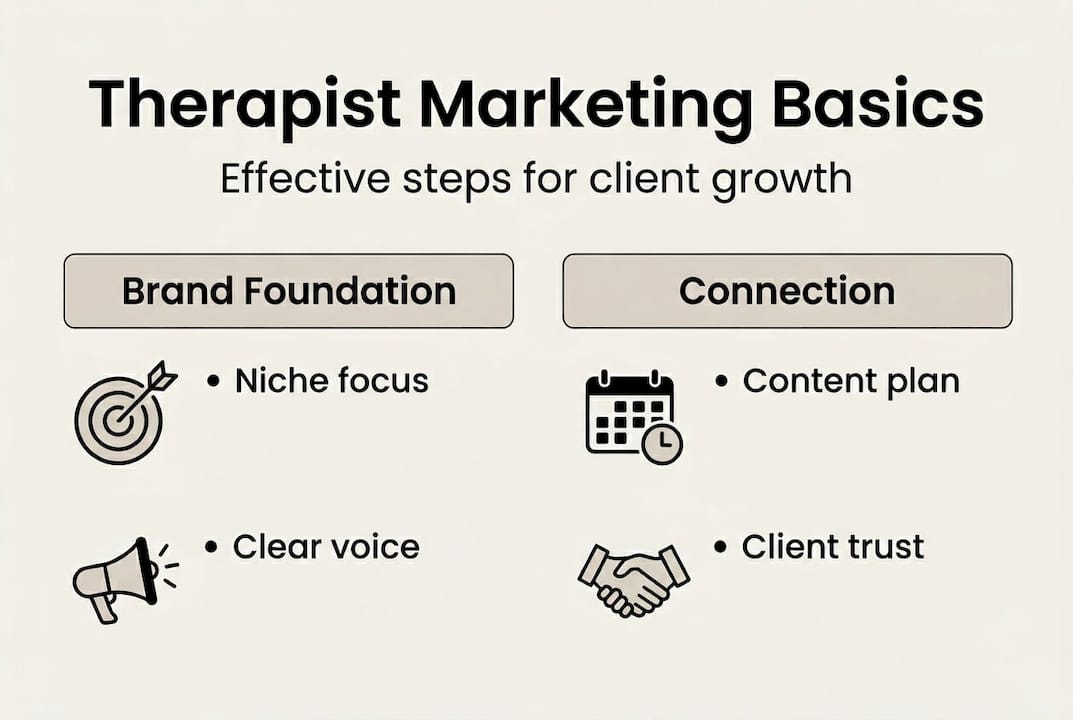
Your online presence is an essential tool for attracting and converting therapy clients. Think of your website as your most hardworking team member. It is available 24/7, answers your clients’ most pressing questions, and either earns trust immediately or sends visitors elsewhere.
Every effective therapist website needs these core elements:
Here is how a generic website compares to a niche-forward one:
| Element | Generic therapist website | Niche-forward therapist website |
|---|---|---|
| Headline | “Licensed therapist accepting new clients” | “Helping healthcare workers recover from burnout” |
| Bio tone | Clinical and credential-focused | Personal, warm, and client-centered |
| Services page | Lists therapy modalities by name | Explains what clients experience and what they can expect |
| Call to action | “Contact me” | “Book your free 20-minute consultation” |
| Visual style | Stock photos, neutral palette | Authentic photos, intentional brand colors |
| Client testimonials | Absent or generic | Specific, relatable, and privacy-compliant |
Your brand voice is equally important. It is how your writing sounds across your website, social profiles, and emails. A therapist who works with high-achieving professionals might use crisp, confident language. One who serves young adults in emotional crisis might use a softer, more conversational tone. Neither is better than the other. Both need to be deliberate and consistent.
Visual identity matters too. Colors, fonts, and imagery all communicate something before a word is read. Choose a palette and a style that aligns with the emotional state you want your ideal client to feel when they land on your page.
Pro Tip: Testimonials are among the most persuasive elements on any therapist website, but they must be handled carefully. Request written permission. Remove identifying details. Focus on transformation language, what the client felt before, what shifted, and how they feel now. These brief stories build trust-building branding faster than any credential ever could.
Content marketing is how you become findable and trustworthy before a potential client has ever spoken to you. When someone searches “how to manage panic attacks at work” and finds your blog post, you have just introduced yourself as a credible, helpful expert. That is the compounding power of strategic content.

As one marketing guide puts it, developing content that addresses your ideal client’s challenges and goals positions you as the specialized solution they need. Content does not replace clinical work. It signals that you understand the problems your clients are struggling with before they even pick up the phone.
The most effective content types for therapy audiences:
| Content type | Best use | Platform |
|---|---|---|
| Blog articles | SEO visibility, deep education | Website |
| Short videos | Trust, personality, reach | Instagram, TikTok, YouTube |
| Email newsletters | Nurturing leads and referrals | Email provider |
| Free guides or PDFs | Lead generation | Website landing page |
| Q&A webinars | Community building, live trust | Zoom, Instagram Live |
| Podcasts | Long-form authority building | Spotify, Apple Podcasts |
Finding topics your audience cares about is simpler than it sounds. Here is a repeatable process:
Once you have a list of topics, build a simple content calendar. You do not need a complex spreadsheet. A basic monthly plan with four to eight pieces of content per month, one per week at minimum, is enough to build momentum. Explore these content marketing tips to sharpen your approach, and if you need fresh inspiration, these content ideas for therapists cover themes that resonate with therapy audiences specifically. A solid content calendar for consistency will keep you from falling off the posting schedule when clinical work gets busy.
Start small. Two quality pieces of content per month beats eight scattered, rushed ones every time.
Social media and email are not about going viral. For therapists, they are about showing up consistently enough that the right people remember you when they are ready to ask for help. Consistency and authenticity carry far more weight than clever campaigns.
Choosing the right platforms matters. A therapist serving corporate professionals will likely find more traction on LinkedIn and email than on TikTok. One working with young adults navigating identity might thrive on Instagram or even Reddit. As the research on channel mastery shows, mastering 2-3 marketing channels before expanding elsewhere is what leads to sustainable growth.
Here is a quick reference for social media strategy steps specific to service-based practitioners:
Social media dos and don’ts for therapists:
Email newsletters are one of the most underused tools in a therapist’s marketing plan. Unlike social media, your list belongs to you. An algorithm change cannot erase it. Here is how to build a simple, effective newsletter:
Review email best practices to set up your list correctly from the start, and use these tips to increase social media visibility so each new post reaches more of the right people.
Pro Tip: Use a free scheduling tool like Buffer, Later, or Meta Business Suite to batch and schedule social posts one week at a time. This prevents the all-too-common situation where a busy week in the clinic means total silence online.
Many therapists do the work of creating content, updating their website, and sending newsletters, and then have no idea whether any of it is helping. Without tracking, marketing becomes guesswork. With even basic metrics, it becomes a tool you can actually improve.
Here are the core metrics every therapist should monitor:
As one marketing framework confirms, continual monitoring and refining of your marketing ensures optimal use of time and resources. The goal is not perfection on the first attempt. The goal is to make small, informed adjustments over time so your marketing compounds in effectiveness.
When you improve your consultation booking rate by just 10%, and improve your email open rate by 15%, and improve your website traffic by 20%, those small gains together can mean a dramatically fuller caseload within a few months.
Simple tools that do the job without overwhelming you:
Reviewing your numbers once a month is enough. Set aside 30 minutes at the end of each month, look at what moved, and make one small change going forward. For deeper search visibility, improving website visibility through keyword research can directly affect how many people find you in the first place.
Most marketing guides for therapists hand you a checklist and send you off to execute. Post three times a week. Start a newsletter. Optimize your Psychology Today profile. And while none of that advice is wrong, it skips the part that actually determines whether any of it works: authenticity.
Therapists have a clinical superpower that most marketers never develop. You know how to listen deeply, name emotions accurately, and reflect experience back in a way that makes people feel truly seen. That exact skill is what separates a compelling brand from a forgettable one. The problem is that most marketing templates ask therapists to mute that skill and sound like every other practice online.
Formulaic marketing fails in therapy for a straightforward reason. Potential clients are not shopping for the cheapest service. They are looking for a person they believe can genuinely help them. That belief comes from resonance, not from a perfectly formatted Instagram grid.
We see this consistently in our work. The therapists who grow the fastest are the ones brave enough to let their actual perspective come through, to share a real viewpoint on a misunderstood topic, to write in their own voice, and to build a brand that reflects who they actually are. If you want to learn how building trust in your practice works at a deeper level, start by asking yourself: does my current marketing sound like me, or does it sound like a template? That question alone will tell you where to start.
If you have absorbed everything in this guide and still feel like managing all of it alone is not sustainable, you are not wrong. Marketing a therapy practice well takes consistent time, strategic thinking, and execution across multiple channels. Most therapists simply do not have that bandwidth after a full week of clinical work.

At Reasonate Studio, we help therapists and other service-based professionals build marketing systems that work without burning them out. From social media management services that keep your practice visible week after week, to local SEO optimization that helps ideal clients find you through search, to on-page SEO for therapists that strengthens every page of your website, we bring the strategy and execution so you can stay focused on your clients. When you are ready to grow with a clear, intentional marketing plan behind you, we are here.
Begin by defining your ideal client and niche before investing in any specific channel or tool. Specific targeting resonates far more than broad messaging, and every other marketing decision becomes easier once your focus is clear.
Focus on mastering 2-3 platforms your audience already uses, providing consistent value-driven content, and engaging authentically. Mastering 2-3 channels before expanding leads to more sustainable growth than spreading yourself thin.
Tracking results helps you know which strategies work best so you can refine your efforts and grow your practice efficiently. Continual monitoring ensures your time and resources are being used on what actually moves the needle.
An effective therapist website offers a clear niche, compelling bio, professional visuals, clear service offerings, and authentic credibility. As online presence research shows, your website is your most important tool for attracting and converting ideal clients.