September 22, 2026
Why Update Brand Messaging: Essential Guide for Growth


Learn how strategic branding helps interior designers clarify their value, attract better-fit clients, strengthen pricing, and grow with confidence.
TL;DR:
- Strong branding helps interior designers stand out and command premium prices.
- Building a strategic, consistent brand attracts better clients and reduces price competition.
- Ongoing brand management and clear messaging are key to sustainable growth and client trust.
Your portfolio is stunning. Your Instagram is curated to perfection. But your inquiry inbox is quiet, and you’re still competing on price with designers who have half your talent. Sound familiar? The US interior design industry generated $26.5 billion in revenue in 2026 across more than 157,000 businesses, which means visual talent alone is not enough to win clients. The designers and home stagers who consistently attract better projects and charge premium rates are not necessarily the most talented. They are the most strategically branded. This guide walks you through exactly what that looks like, from clarifying your message and defining your niche to activating your brand across every client touchpoint that matters.
| Point | Details |
|---|---|
| Differentiation is key | Competing on style alone leads to low pricing—clarity and niche focus attract better clients. |
| Strategy before visuals | A cohesive brand strategy should guide every design and marketing choice for growth. |
| Activate everywhere | Consistently showcase your brand in every client touchpoint, from first impression to follow-up. |
| Refine and adapt | Regularly review your brand experience and messaging to stay relevant and competitive. |
Here is the uncomfortable math: you are one of over 157,000 interior design businesses competing for attention in the US market alone. And while the global market is projected to reach $214.35 billion by 2034, that growth does not automatically trickle down to every designer equally. The businesses that capture that upside are the ones with a clear, consistent brand that prospects can recognize, trust, and choose without hesitation.
Branding is not your logo or your font choice. It is the full picture of who you are, who you serve, what you stand for, and why a client should choose you over every other option in your market. When a potential client lands on your website or sees your proposal, your brand either earns trust or raises doubt. There is rarely a middle ground.
“A brand is no longer what we tell the consumer it is. It is what consumers tell each other it is.” This is exactly why interior designers need to be intentional about every signal they send, from their bio language to their client onboarding process.
For home stagers specifically, branding carries a particular kind of weight. Staging is a service built on emotional cues. You are not decorating for the homeowner’s taste; you are creating a feeling that makes a buyer imagine themselves living there. Your brand needs to communicate neutrality, expertise, and warmth simultaneously. That is a nuanced message, and it only lands when it is deliberate.
Strong branding also directly affects your ability to charge what you’re worth. When your message is vague, you invite price comparison. When your brand is clear, you become a category of one. Clients stop asking “how does your price compare?” and start asking “how do we get started?” That shift happens because of brand clarity, not because of a prettier portfolio.
Here is a quick look at what separates designers with strong brands from those without:
| Branding element | Weak brand | Strong brand | |—|—|—|| | Value proposition | “I create beautiful spaces” | “I design calm, functional homes for busy families” | | Target client | Anyone who needs a designer | Defined niche with specific needs | | Visual consistency | Varies by platform | Cohesive across all touchpoints | | Pricing confidence | Discounts to compete | Commands premium rates | | Client trust signals | Portfolio only | Testimonials, process, brand voice |
Building a brand with this kind of clarity is what we mean when we talk about building impactful branding for a service business. Understanding why branding matters in design goes far deeper than picking pretty colors. It is about giving your business a spine, a voice, and a reason to be chosen. The designers who embrace that shift stop competing and start leading. For home stagers, the evidence is clear: proven staging business growth consistently ties back to reputation, relationships, and strategic visibility, not just the quality of the staging itself.
Most designers think of branding as a visual exercise. Pick a logo. Choose a color palette. Build a website. Done. But that approach produces brands that look fine and perform poorly. A brand that actually attracts and converts clients is built on strategy first, and aesthetics second.
Here are the core elements every interior design and staging brand needs to get right:
Pro Tip: Before you redesign your website or rebrand your Instagram, write out your positioning strategy. Define your audience, your promise, and your differentiators in plain language. If you cannot explain your brand in two sentences, your visuals cannot save you.
The most common pitfalls we see are undefined messages, lack of niche, or generic value propositions that make one designer indistinguishable from the next. Strategy before aesthetics is not just advice. It is the difference between building a sustainable business and staying stuck in a race to the bottom on price.
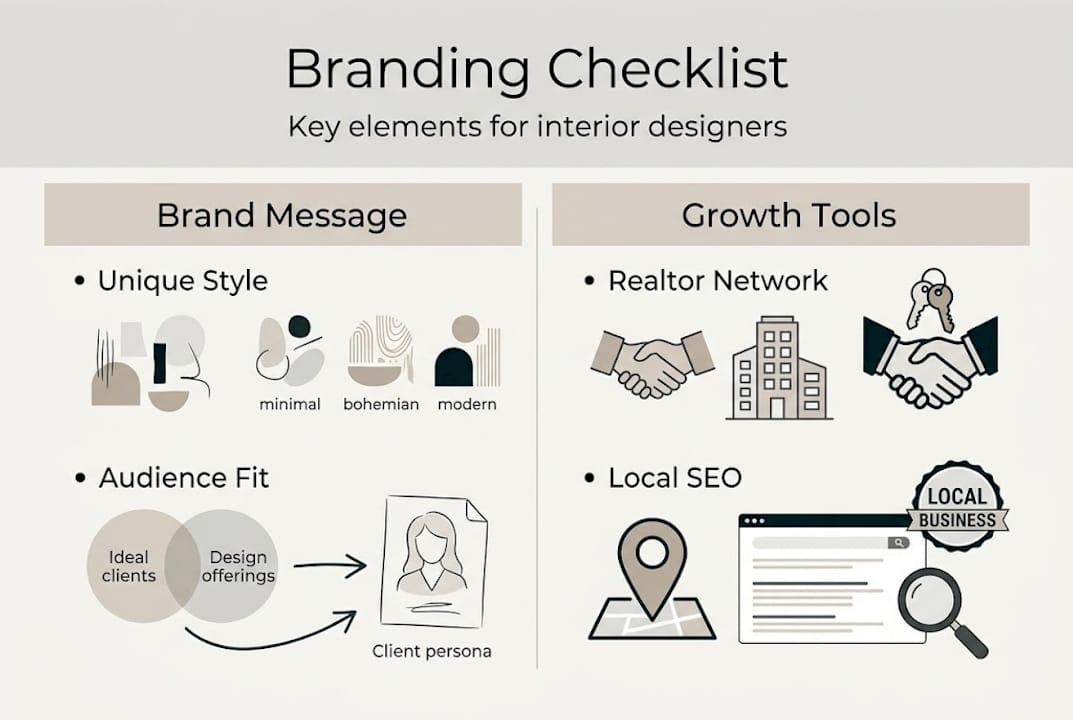
For home stagers, the brand challenge is unique. Your work needs to appeal broadly to buyers while also convincing realtors and sellers to hire you. That means your brand must communicate emotional intelligence, speed, reliability, and range, all at once. Leaning on branding strategies for small business principles, combined with strategic design for clarity, gives stagers a framework for building a brand that speaks to multiple audiences without losing its focus.
One more thing worth noting: a strong brand does not just attract clients. It repels the wrong ones. When your positioning is clear, clients who are not a fit self-select out before they ever book a call. That saves you time, energy, and the frustration of projects that drain you.
Building a brand is not a one-afternoon project. But it is also not as complicated as most designers fear. Here is a practical five-step process you can use to build or refine your brand from the ground up.
Pro Tip: Map your full client journey from first discovery to final invoice. At each stage, ask yourself: does this experience reflect my brand? The gaps you find are your biggest opportunities.
Here is a quick comparison of going it alone versus working with a specialist:
| Approach | DIY branding | Specialist support |
|---|---|---|
| Time investment | High (months of trial and error) | Fast (weeks with guided strategy) |
| Strategic depth | Limited by your own blind spots | Informed by outside perspective |
| Consistency | Often inconsistent across channels | Systemized and cohesive |
| ROI timeline | Slower | Typically faster, measurable results |
The risk of skipping the strategy phase is race-to-bottom pricing, where you compete on cost because nothing else sets you apart. A solid framework for marketing strategy prevents that by giving your business a clear direction before you spend a dollar on content or ads. When you are developing a brand strategy, the most important question is not “what should my logo look like?” It is “what do I want clients to feel when they interact with my business?” That feeling, shaped by an intentional marketing strategy, is what builds a brand that earns loyalty and commands better rates.
Building your brand is phase one. Activating it is where growth actually happens. Brand activation means showing up with consistency and intention across every channel and every client interaction, not just when you launch something new.
Here is what brand activation looks like in practice:
For home stagers, realtor networks and local SEO are two of the most powerful growth levers available. Realtors are repeat clients who can send consistent project volume, which makes relationship-building a core brand activity, not just a sales tactic. Local SEO ensures that when someone searches for staging services in your area, your business appears. Emotional triggers like warmth, flow, and aspirational lifestyle imagery also drive buyer responses, which means your staging brand should speak to those feelings visually and verbally.
Pro Tip: After every completed project, review client feedback for phrases that reveal how they describe your work and your process. Those phrases are your brand language. Use them in your marketing copy, because your clients’ words will always resonate more than yours.
The brands that grow fastest are the ones that treat marketing as a continuous brand expression, not a series of one-off campaigns. A strong marketing strategy for growth keeps your brand consistent across channels while remaining flexible enough to respond to what is working. Aligning marketing and sales ensures that the story your marketing tells matches the experience your sales process delivers. That alignment is what turns interested prospects into committed clients. When you grow your home staging business through brand activation rather than random visibility tactics, the results compound over time.
Here is what most branding advice gets wrong: it treats branding as a one-time project. Design a logo. Write a bio. Launch a website. Move on. But the designers and stagers who build genuinely strong brands treat branding as an ongoing practice, not a deliverable.
The biggest risk in this industry is not that your aesthetics are weak. It is that your strategy is nonexistent. Most designers imitate what other successful designers look like without understanding why those brands work. They copy the muted tones, the minimalist layouts, the curated grids, and they end up with a brand that looks like everyone else. Visuals without strategy produce forgettable brands. And forgettable brands compete on price.
Choosing a niche feels terrifying at first. Narrowing your focus feels like you are turning away money. But the data and real-world experience consistently prove the opposite. Designers with a defined niche attract more qualified leads, convert at higher rates, and hold their pricing firm because they are the obvious expert in their lane. The discomfort of niching down is temporary. The reward is a client base that seeks you out specifically.
The other truth that most designers avoid is that undefined messages and generic value propositions are not just a marketing problem. They are a business model problem. When your brand does not clearly communicate who you are and who you serve, every lead becomes a negotiation, and every project becomes a guessing game. Clarity is not a luxury. It is the foundation of a profitable business.
Top brands also know when to pivot. They review their positioning regularly and refine it as their business evolves. The danger is not in changing direction. It is in assuming you are done. Your brand should grow with you. A good approach is to start with scaling marketing with clarity so that every change you make is intentional, not reactive.
You now have a clear picture of what separates thriving interior design brands from the ones that stay stuck competing on price. Strategy comes first. Clarity attracts better clients. And consistency across every touchpoint is what builds a brand that compounds over time.
Knowing the framework is one thing. Executing it while running a full project load is another. That is where Reasonate Studio comes in. We work directly with founders, designers, and service professionals to build brand strategy that is both emotionally intelligent and results-driven. From sharpening your positioning to optimizing your sales page optimization so your client-facing pages convert better, we handle the strategy and execution so you can focus on the work you love. Our clients see real results within 60 days, and our 85% retention rate reflects how much they value the partnership. If you are ready to stop blending in and start attracting the clients you actually want, we would love to help.
The most common mistake is having an undefined brand message or trying to appeal to everyone, which makes you indistinguishable from competitors and forces you to compete on price rather than value.
Stagers can focus on neutral, emotionally resonant design while building strong realtor partnerships and local SEO for consistent visibility and referral volume in their market.
Without a strategic foundation, even the most polished brand gets lost because strategy before aesthetics defines your unique promise and positions you as the obvious choice rather than just another option.
Your website, social media profiles, project proposals, and client onboarding experience all work together to reinforce your brand message, and consistency across all of them is what builds recognition and trust over time.