September 1, 2026
Understanding B2C Business to Consumer Dynamics


Unlock the role of trust in branding with proven strategies to enhance client connections, boost loyalty, and drive referrals for your business.
TL;DR:
- Building brand trust is essential for loyalty, premium pricing, and organic growth, beyond just visual branding efforts.
- Trust is developed through integrity, competence, and benevolence demonstrated consistently across interactions and digital platforms.
You could have the most polished logo in your industry, a color palette pulled straight from a design award winner, and a tagline that practically sings. But none of that will make a new client sign a contract, refer a friend, or come back for your next offer. 88% of consumers need to trust a brand before they even consider making a purchase, putting trust on the same level as price and quality. For founders, coaches, and consultants, that number is the difference between a business that compounds and one that plateaus. This guide is a practical, no-fluff roadmap for building the kind of brand trust that creates loyal clients, premium pricing power, and referrals you did not have to beg for.
| Point | Details |
|---|---|
| Trust drives loyalty | Clients only buy and refer when they truly trust your brand. |
| Consistency is crucial | Consistent actions, messaging, and tone build long-term trust. |
| Transparency matters | Honesty and openness in interactions and digital channels strengthen credibility. |
| Trust evolves in stages | Brand trust grows from first contact to true advocacy with intentional steps at every stage. |
Before diving into tactical steps, it helps to understand exactly why trust sits at the root of everything. Most founders assume that if their marketing is clever enough or their content is consistent enough, sales will follow. That is a very seductive idea. It is also incomplete.
Brand trust is the confidence consumers have in a brand’s ability to deliver on its promises. It drives loyalty, higher lifetime client value, pricing power, and the kind of organic growth that no ad budget can manufacture. When a client trusts you, they stop comparing you to competitors. They stop negotiating on price. They start sending referrals without being prompted. That shift from “considering you” to “advocating for you” is one of the most valuable transitions in business, and it is built entirely on trust.
“Trust is not a feature you can bolt onto your marketing after the fact. It is the core infrastructure beneath every message, every offer, and every client interaction.”
Here is what trust actually produces for your brand:
Understanding the brand management elements that support trust gives you a clearer picture of where to focus your energy. And building a strong brand strategy for growth is the container that holds all of it together. Without strategy, trust-building efforts are just random acts of goodwill with no cumulative effect.

Understanding how trust works is just step one. The practical building blocks are what let you implement trust day-to-day without turning it into a performative exercise.
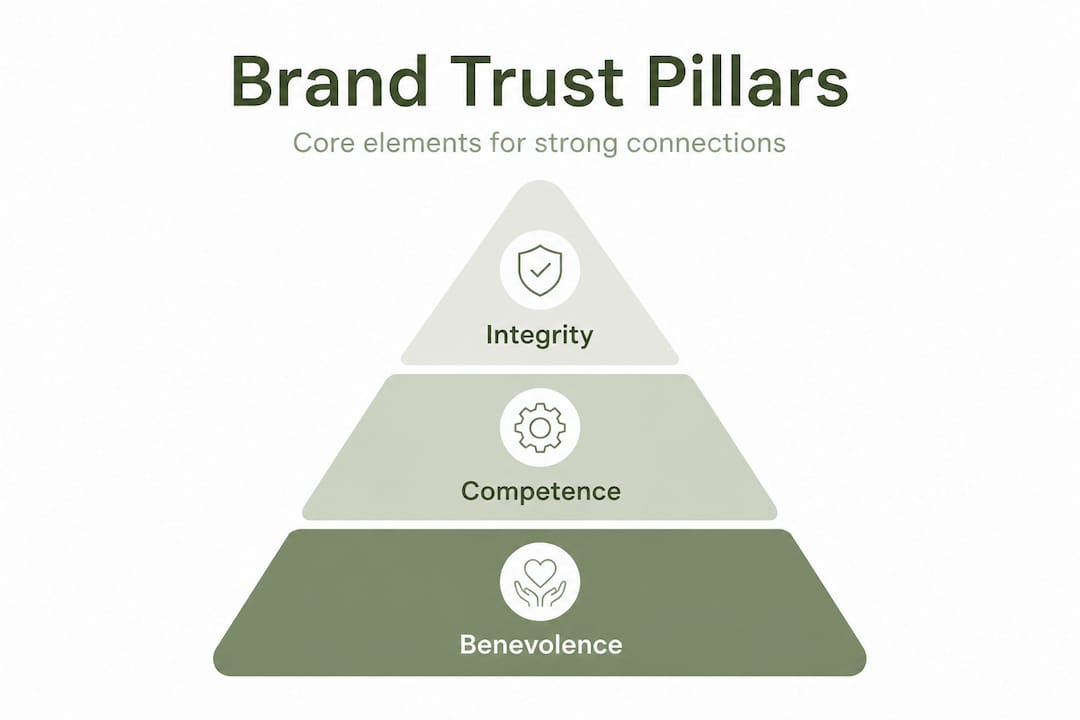
Brand trust is built on three core pillars: integrity, competence, and benevolence. These are not abstract values. They are behavioral standards that your clients measure you against whether they realize it or not. Let’s break down each one and what it looks like in practice.
| Pillar | What it means | How to demonstrate it |
|---|---|---|
| Integrity | You are honest, transparent, and do what you say you will do | Clear terms, no hidden fees, honest case studies |
| Competence | You have the skills, knowledge, and execution ability to deliver results | Portfolio, testimonials, credentials, consistent delivery |
| Benevolence | You genuinely care about the client’s success, not just your revenue | Proactive check-ins, personalized advice, going beyond the brief |
Here is a numbered breakdown of concrete actions to reinforce all three:
Pro Tip: When something goes wrong with a client delivery, address it openly before they bring it up. Say what happened, take responsibility, and explain what you are doing to fix it. Counterintuitively, this often strengthens relationships more than a flawless delivery would, because it shows your character under pressure.
Referencing the brand messaging checklist can help you audit whether your current messaging actually reflects these three pillars or just sounds like it does. There is a meaningful gap between branding that looks trustworthy and branding that is trustworthy, and it shows up in client retention numbers over time.
With the key components in place, let’s look at the fuel that makes trust sustainable: consistency. Not the kind of consistency that means posting every Tuesday at 9 a.m. The kind of consistency that means your client always knows what to expect from you, and you always deliver it.
Consistency in messaging, tone, and actions is essential for building brand trust because it creates predictability and reduces what psychologists call cognitive dissonance. When your brand behaves the same way across every channel and every interaction, clients stop second-guessing you. That removal of doubt is worth more than any clever campaign.
A major research effort by Chadwick Martin Bailey identified six key dimensions of brand trust: dependability, transparency, integrity, customer-first orientation, responsiveness, and relevance. Brands that score high across all six see significantly higher consideration rates and client satisfaction scores. That is not a coincidence. Those six dimensions map almost perfectly onto consistent, emotionally intelligent behavior.
Here is what a brand consistency audit actually looks like in practice:
Pro Tip: One of the fastest ways to erode trust is over-promising. It feels good to say yes to everything and paint an optimistic picture, but when the reality does not match the expectation, trust collapses quickly. Being honest about what you cannot do is one of the most credibility-building things a brand can practice. Clients respect limitations more than they respect broken promises.
Deepening your understanding of consistency in branding will help you see where the gaps are in your current approach. There are also practical brand consistency tips designed specifically for entrepreneurs and a thorough guide to branding consistency worth working through if you want to build a brand clients can count on.
Knowing what makes trust possible, it is time to look at how trust actually develops across the client journey. Trust does not arrive all at once. It is earned incrementally, through a sequence of experiences that each either add to or subtract from a client’s confidence in you.
Brand trust develops in clear stages: an initial cold contact phase where you establish basic credibility through audits, social proof, and clear positioning; a strengthening phase where first interactions exceed expectations; a deepening phase driven by personalization and proactive support; and finally an advocacy phase where the client becomes a voluntary promoter of your work.
Here is what each stage demands from you:
Initial exposure (cold contact). At this stage, the client does not know you. Your website, social media, and public-facing content do all the heavy lifting. This is where strong positioning, clear messaging, and visible social proof do their work. A single compelling case study or testimonial can move someone from skeptical to curious.
First interaction. This is the most leveraged moment in the entire trust arc. When a new client has their first real experience with you, whether it is a discovery call, an onboarding session, or a first deliverable, the impression you make will either accelerate or stall the trust-building process. Exceed expectations. Over-deliver on communication. Make them feel like the most important client you have.
Repeated experience. Consistency across multiple interactions is where trust solidifies into loyalty. This stage is about predictability. The client should be able to anticipate your quality, your communication style, and your responsiveness. Every positive interaction compounds the previous ones.
Personalization and proactivity. Once a client is comfortable, deepening trust requires showing that you actually know them as an individual. Reference their specific goals, their challenges, their language. Reach out before they have to ask. Send a resource that is relevant to something they mentioned three weeks ago. These small acts signal deep attentiveness and care.
Advocacy. This is the stage most founders forget to design for. An advocate is not just a satisfied client. An advocate is someone who feels emotionally invested in your success because you made them feel seen, understood, and genuinely supported. Creating this level of connection requires intentional touchpoints throughout the relationship, not just at the beginning.
Working on your brand identity for attracting clients supports the initial exposure stage powerfully, while strategies around improving brand recognition help sustain visibility as clients move through each stage.
Beyond your private interactions, digital platforms shape trust at scale. This is especially true for founders, coaches, and consultants whose personal brand is inseparable from their business brand. What you post, how you respond to comments, and how you handle criticism in public all send loud signals about whether you are trustworthy.
A significant study using a structural equation modeling approach found that social media marketing significantly influences brand trust and mediates purchase intention, with the model explaining 57.5% of the variance in buying behavior. In plain terms, your social media presence is not a nice-to-have for trust. It is a core driver of whether people choose to buy from you.
Here are the most impactful ways to use digital channels to build rather than erode trust:
Pro Tip: Sharing a case study that includes a moment where something went wrong, and showing how you resolved it, can increase conversion trust more than a purely positive story. Research consistently shows that acknowledging failure with accountability is perceived as more honest and trustworthy than presenting only success. Vulnerability, when paired with resolution, is a powerful conversion tool.
Understanding how to increase brand recognition through strategic digital presence, alongside a clear grasp of understanding brand messaging in a digital context, will help you build social media habits that actually accumulate trust over time rather than just generating noise.
Let’s consider a deeper angle on what really makes brands trustworthy in practice. Because there is a version of trust-building that looks right on the surface but fails at the root level, and it shows up constantly in the coaching and consulting world.
The conventional wisdom says: be consistent, show up every day, stay positive, and eventually clients will trust you. That advice is not wrong. But it is incomplete, and in some cases it actively misleads founders into prioritizing volume over quality, presence over depth, and polish over honesty.
Here is what we have observed working directly with founders, coaches, and consultants over years of practice. The brands that earn the deepest trust are not necessarily the most consistent posters or the most visible names. They are the brands that demonstrate the courage to be honest when honesty is inconvenient. They admit when a strategy did not work. They tell potential clients when their offer is not the right fit. They set realistic expectations even when optimism would be easier to sell.
Admitting failures in case studies can boost conversions by 55% through honesty, and over-promising consistently erodes the trust that took months to build. Trust cannot be purchased through advertising or manufactured through aesthetics. It is earned through disciplined, repeated honest behavior over time.
The emotionally intelligent approach to branding recognizes that your clients are perceptive. They can feel the difference between a brand that is performing trustworthiness and one that is genuinely trustworthy. Performed trust relies on tactics: testimonials placed strategically, urgency manufactured artificially, objections handled through scripts. Genuine trust is built through aligned values, honest communication, and the willingness to prioritize the client’s outcome over your own comfort.
Founders who focus on developing brand identity from a place of genuine self-knowledge tend to build brands that sustain trust far longer than those who build identity from market research alone. When you know who you are and why you do what you do, your brand communication has a coherence that no amount of polished copywriting can fake. Clients feel it. And over time, they stay because of it.
The bottom line is this: emotionally intelligent branding is not softer or less commercial than traditional marketing. It is actually more effective, more durable, and more aligned with how human beings actually make purchasing and loyalty decisions. Swap the relentless promotion for genuine connection, and you will find that trust compounds faster and lasts longer.
If the principles in this article resonate, the logical next question is where to start. Understanding trust is one thing. Implementing it consistently across your brand, your messaging, your content, and your client experience is a different challenge entirely, especially when you are running a business at the same time.

At Reasonate Studio, we help founders, coaches, and consultants move from scattered brand efforts to a trust-first marketing system that actually produces results. Whether you need a full brand audit, sharper messaging, or a social media strategy that builds real connection, our work is designed to make your brand the obvious choice for the clients you most want to serve. Our sales page optimization service is a particularly powerful entry point for founders who want to translate brand trust into stronger conversion rates, because the place where trust meets revenue is often your sales page. Start with a free Brand Audit Report and get a clear, strategic picture of where your brand stands and what your next best move is.
Integrity, competence, and benevolence are the three foundational pillars, supported in practice by transparency, honest reviews, and clear communication at every client touchpoint.
The fastest path is to exceed expectations during first interactions and communicate proactively throughout the relationship, because trust builds in clear stages that begin with that very first impression.
Absolutely. 87% of shoppers pay more for brands they trust, which means strong trust directly reduces price sensitivity and supports premium positioning without requiring justification every time.
When managed with transparency and consistency, social media is one of the most powerful trust accelerators available. Research shows that social media significantly influences brand trust and purchase intention, but inconsistency or dishonest behavior in public spaces can damage credibility faster than almost any other factor.