September 22, 2026
Why Update Brand Messaging: Essential Guide for Growth


Learn how a focused branding workshop can clarify positioning, align decision-makers, and help teams move into marketing with confidence.

Most founders assume their brand is struggling because of bad design or inconsistent posting. The real culprit is almost always something deeper: a lack of shared clarity about who the brand is, who it serves, and why anyone should care. A branding workshop is one of the most underused tools for fixing exactly that. In fact, workshops fail at a 73% rate when teams skip proper preparation, which means the difference between a session that transforms your brand and one that wastes a full day comes down to how you approach it. This guide walks you through everything you need to know.
| Point | Details |
|---|---|
| Brand clarity | Branding workshops create shared understanding and alignment among key team members. |
| Strategic advantage | Well-run workshops lead to stronger positioning and more effective marketing campaigns. |
| Preparation is critical | Failing to prepare or engage the right people significantly increases workshop failure rates. |
| Facilitation matters | The right facilitator can prevent common pitfalls and maximize actionable outcomes. |
A branding workshop is not a brainstorming free-for-all. It is a structured, collaborative session where key stakeholders come together to align on brand strategy, clarify positioning, and make decisions that will shape every piece of marketing that follows. Think of it as a focused operating room for your brand, where the goal is diagnosis and alignment, not just ideas.
A well-run workshop typically covers:
Participants usually include founders, marketing leads, and key decision-makers. Sessions range from three hours for a focused team to a full day for larger organizations with more complex brand identity elements to work through.
“The facilitator’s job is not to have all the answers. It’s to create the conditions where the right answers can surface from the people who know the brand best.” — Brand strategy practitioner
Facilitation quality matters enormously here. A skilled facilitator keeps the conversation productive, prevents one voice from dominating, and ensures every decision connects back to the brand’s strategic goals.
Here is what most founders discover after their first branding workshop: they thought they were aligned with their team, and they were not. Not even close. Different people on the same team often hold completely different ideas about who the ideal customer is, what the brand stands for, and how it should sound online.
Branding workshops align stakeholders, define critical brand aspects, and create actionable outcomes that make every downstream marketing task faster and more effective. When your team shares a single, clear brand foundation, writing a social caption takes minutes instead of hours. Choosing a content direction stops feeling like a debate.
The benefits stack up quickly:
Founders benefit from workshops because they finally get their vision out of their head and into a format the whole team can use. In-house marketing teams benefit because they stop guessing. Agencies and consultants benefit because they can execute faster with less back-and-forth.
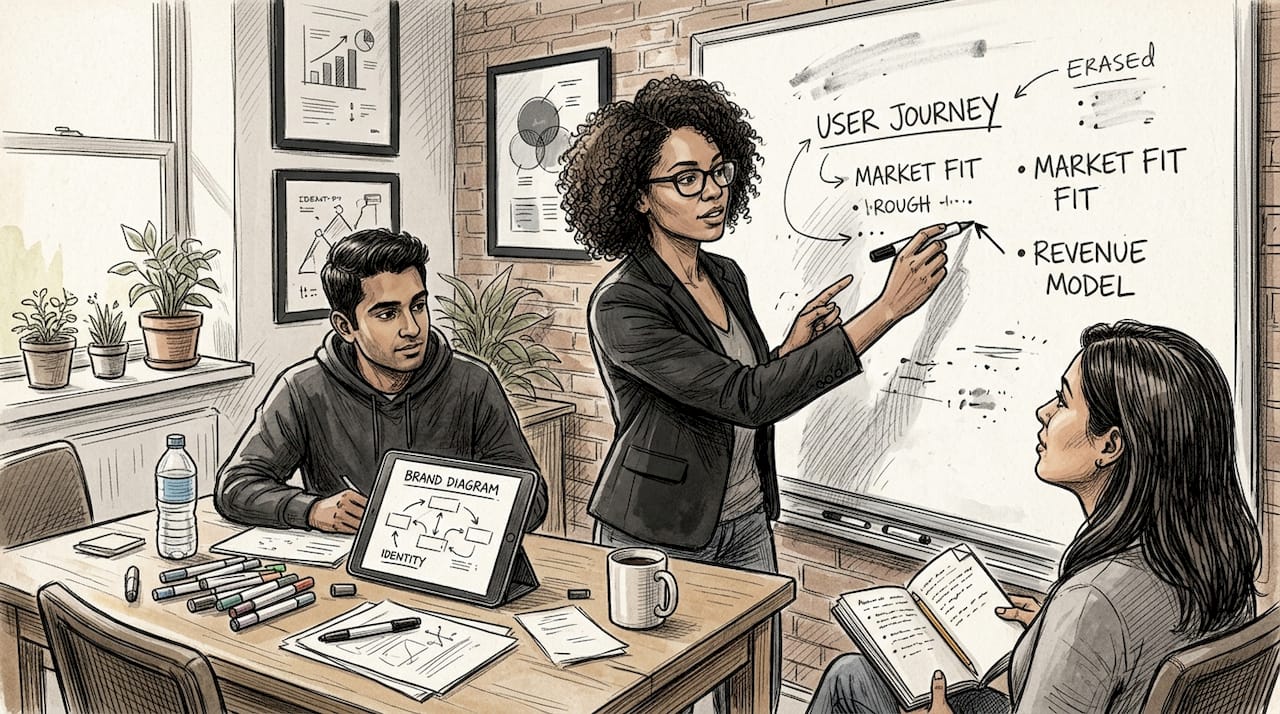
Pro Tip: The workshop itself is only half the value. Build a simple one-page brand reference document immediately after the session while decisions are fresh. This becomes the filter every future marketing decision runs through. Check out these essential branding tips to keep momentum going after the session ends.
Not every strategy meeting is a branding workshop, and confusing the two leads to wasted time. Here is how the most common session types compare:
| Session type | Primary focus | Typical output | Best for |
|---|---|---|---|
| Branding workshop | Brand strategy and alignment | Brand guidelines, messaging framework | Founders, growing teams |
| Design sprint | Prototyping and testing solutions | Prototype or MVP | Product teams |
| Standard meeting | Updates and decisions | Action items | Ongoing operations |
| Messaging workshop | Copy and voice refinement | Taglines, positioning statements | Pre-launch or rebrand |
The key distinction is that a branding workshop is about strategy vs. prototyping. A design sprint assumes you already know who you are and jumps to solving a specific problem. A branding workshop figures out who you are first.
Facilitation source also matters. Internal facilitators know the business deeply but can struggle with objectivity when opinions get heated. External facilitators bring neutrality and a structured process, which is why they tend to produce cleaner outcomes. Use your branding checklist to decide which session type fits your current stage.
“Choosing the wrong session type is like hiring a surgeon to do a physical. Both are valuable, but only one is right for the moment.” — Marketing strategist
Knowing a workshop is valuable is one thing. Knowing what actually happens inside one is another. Here is a typical agenda for a half-day session:
Workshops define elements like purpose, positioning, identity, values, and personality through guided exercises that keep the conversation structured and productive.

| Exercise | Time needed | Best for |
|---|---|---|
| Brand values sort | 20-30 min | Early-stage founders |
| Competitor mapping | 30-45 min | Brands in crowded markets |
| Audience empathy map | 30-40 min | Teams with unclear ICP |
| Brand archetype selection | 20-30 min | Voice and tone clarity |
Pro Tip: Tailor your exercise selection to your company’s stage. A solo founder in year one needs purpose and positioning clarity above all else. A team of ten needs alignment exercises that surface hidden disagreements. Use the develop brand identity framework to guide which exercises belong in your session.
Even well-intentioned workshops fall apart. Workshops fail due to poor preparation, too many participants, or lack of implementation, and each of these is entirely preventable.
Here are the most common traps and how to sidestep them:
Pro Tip: End every workshop with a 15-minute “what happens next” conversation. Assign specific owners to specific deliverables with real deadlines. Clarity without accountability is just a good conversation.
Preparation is where most teams underinvest. Proper data gathering is essential before any workshop session, and skipping it is the single fastest way to waste everyone’s time.
Here is a step-by-step prep sequence:
Use the branding pre-work checklist to make sure nothing falls through the cracks before your session.
The proof is in the outcomes. Here are a few examples of what focused brand alignment can produce for founders and teams:
These outcomes are not accidents. They are what happens when a brand stops guessing and starts operating from a clear, shared foundation. Explore more branding workshop examples to see how other founders have applied these principles.
Reading about branding workshops is a great start. Actually running one with expert facilitation is where the real shift happens. At Reasonate Studio, we work directly with founders, coaches, and consultants to build the brand clarity that makes every marketing effort more effective and more efficient.
Our Marketing Jump Start program is designed to take you from scattered and overwhelmed to clear, aligned, and ready to grow. We combine brand strategy, messaging development, and done-for-you execution inside one focused engagement. You bring the expertise. We build the engine that gets it seen, understood, and purchased. If you are ready to stop guessing and start growing, this is your next step.
Founders, key executives, marketing leads, and anyone responsible for brand decisions should attend. A structured, collaborative session only works when the right decision-makers are in the room.
Most effective branding workshops run three to six hours, though larger teams with more complex brand challenges may need a full day to reach meaningful alignment.
External facilitators are generally preferred because they bring objectivity and a structured process. Internal vs. external facilitation is a real trade-off, but internal leads can succeed when they follow a clear, pre-built framework.
Success means walking away with documented brand guidelines, unified messaging, and a clear action plan. Workshops that create actionable outcomes give your team a shared reference point that makes every future marketing decision faster and more consistent.