September 22, 2026
Why Update Brand Messaging: Essential Guide for Growth


Learn how brand consistency builds recognition and trust, and apply practical systems that support stronger customer relationships and revenue.

You might think brand consistency is a minor detail, something you can fine tune later once your business is fully scaled. Research tells a different story. Consistent brands achieve 10-33% revenue growth compared to those with fragmented messaging and visuals. For founders, coaches, and consultants trying to stand out in crowded markets, brand consistency is not optional. It is the invisible thread connecting every touchpoint with your audience, building trust, recognition, and loyalty over time. This article will show you what brand consistency really means, why it drives measurable business results, and how to implement it strategically without becoming rigid or losing your authentic voice.
| Point | Details |
|---|---|
| Revenue impact | Brand consistency drives revenue growth between ten and thirty three percent as consistent visuals and messaging build trust across touchpoints. |
| Core elements | Visual identity, messaging, and storytelling must align across platforms so audiences instantly recognize the brand. |
| Coherence over rigidity | For larger or global brands coherence is often preferable to rigid uniformity because it maintains recognizability while allowing authentic voice. |
| Recognition and loyalty benefits | Consistency increases brand recognition by up to eighty percent, reduces cognitive load, and strengthens customer loyalty and repeat business. |
| Tools to stay aligned | Use practical tools like checklists and style guides to maintain alignment across channels without sacrificing an authentic voice. |
Brand consistency means showing up the same way across every platform, piece of content, and customer interaction. It covers three core dimensions: visual identity (logos, colors, fonts, imagery), messaging (tone, language, key phrases), and storytelling (the narratives you use to connect emotionally). When these elements align, your audience recognizes you instantly, understands what you stand for, and feels confident choosing you over competitors.
The business impact is measurable. Consistent brands see 10-33% revenue increases across multiple studies, and 68% of businesses report that brand consistency contributes directly to revenue growth of 10% or more. This happens because consistency builds trust. When your audience encounters the same visual style, message, and story whether they find you on Instagram, your website, or a podcast interview, they perceive you as reliable and professional. Trust shortens the decision-making process, making it easier for potential clients to say yes.
For founders, coaches, and consultants, this matters even more. You are not selling widgets. You are selling expertise, transformation, and relationship. Your brand is often inseparable from your personal identity. Inconsistency signals confusion, lack of direction, or worse, inauthenticity. When your LinkedIn profile talks about data-driven strategy but your Instagram feels purely inspirational with no substance, potential clients wonder which version is real. Brand consistency explained shows how alignment across channels removes this friction and accelerates trust.
Consistency is not about being boring or robotic. It is about being recognizable and reliable so your audience can focus on your value instead of figuring out who you are.
The benefits extend beyond revenue. Consistent branding increases recognition by up to 80%, making your marketing more efficient because people remember you after fewer exposures. It simplifies customer decisions by reducing cognitive load. It strengthens loyalty because clients know what to expect and feel part of a cohesive brand experience. For service-based businesses where word of mouth and referrals drive growth, consistency makes you easier to describe and recommend.
Key advantages of brand consistency:
Building brand consistency starts with clarity about who you serve and what makes you different. Niche definition is foundational. When you try to appeal to everyone, your messaging becomes generic and your visuals default to safe, forgettable choices. A clear niche lets you speak directly to specific pain points, desires, and values. This focus naturally creates consistency because every piece of content answers the same core question: how do I help this specific person solve this specific problem?
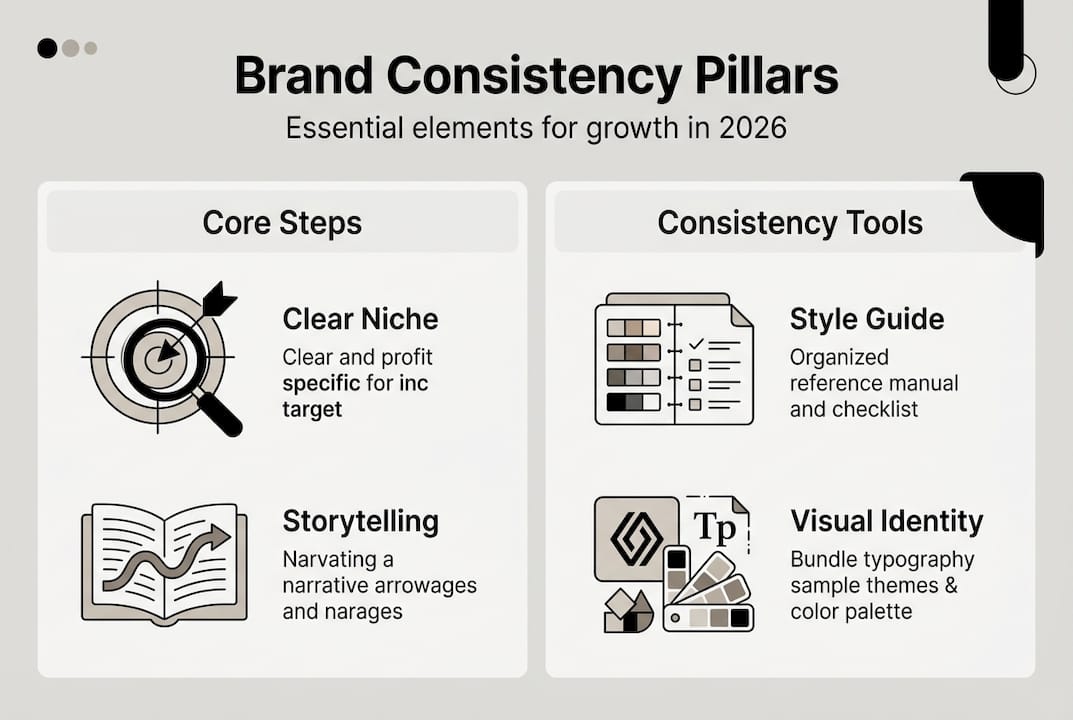
Authentic storytelling is the second pillar. Prioritize clear niche, authentic storytelling, and visual uniformity for effective brand building. Your story is not just your origin tale. It is the narrative framework you use to explain why you do what you do, what you believe, and how you help clients transform. When this story stays consistent, your audience builds an emotional connection that goes beyond features and benefits. They start to see themselves in your journey and trust that you understand their struggles.
Visual consistency ties everything together. Your website, social media profiles, email newsletters, and any physical materials should share the same color palette, typography, logo usage, and image style. This does not mean every post looks identical. It means someone scrolling through your Instagram feed or landing on your website immediately recognizes the aesthetic as yours. Small details matter: using the same filter style on photos, maintaining consistent spacing and layout, applying your brand colors in the same proportions.

Practical tools make consistency sustainable. A brand style guide documents your visual standards, tone of voice, key messages, and usage rules. It becomes the reference point when you or anyone helping with your marketing creates new content. A content checklist ensures every piece aligns with your brand before it goes live. These tools prevent drift over time and make delegation possible without losing your brand identity.
Pro Tip: Create a simple one-page brand cheat sheet with your core message, three key values, primary and secondary colors with hex codes, and two to three example posts. Keep it visible whenever you create content so alignment becomes automatic.
Brand building strategies for coaches and brand storytelling tips provide deeper frameworks for implementing these elements in your specific context.
| Brand element | Implementation cost | Time to implement | Impact on consistency |
|---|---|---|---|
| Niche clarity workshop | Low (self-guided) to Medium (coached) | 2-4 hours | High (foundation for all messaging) |
| Brand story framework | Low (templates available) | 3-6 hours | High (guides all content narratives) |
| Visual style guide | Medium (designer recommended) | 1-2 weeks | Very high (ensures visual recognition) |
| Content checklist | Low (DIY template) | 1-2 hours | Medium (maintains quality and alignment) |
| Social media templates | Low to Medium (Canva or designer) | 1 week | High (speeds creation, ensures consistency) |
Brand consistency and brand coherence are related but distinct concepts. Consistency means using the same elements in the same way everywhere. Coherence means maintaining a recognizable thread while adapting to context. For small businesses with a single brand and limited platforms, strict consistency works well. But as you grow, add sub-brands, serve global markets, or expand across many channels, rigid uniformity can become a constraint.
Coherence over strict uniformity helps manage complex brand portfolios and global challenges. Think about a coach who offers both group programs and high-ticket one-on-one services. The visual identity might stay consistent, but the messaging tone could shift. Group program content might feel more energetic and community focused, while one-on-one messaging emphasizes personalization and transformation depth. Both are coherent with the overall brand promise, but not identical.
This distinction matters because overestimating how famous or unique your brand elements are is a common mistake. You might think your logo is instantly recognizable, but unless you are a major corporation, most people need repeated exposure. Forcing the exact same layout or message across every platform can feel robotic and miss opportunities to connect authentically with different audience segments. Coherence allows you to maintain your core identity while respecting platform norms and audience expectations.
| Approach | Best for | Advantages | Disadvantages |
|---|---|---|---|
| Strict brand consistency | Single brand, limited platforms, early stage businesses | Clear recognition, simple to maintain, strong alignment | Can feel rigid, may miss platform-specific opportunities |
| Flexible brand coherence | Multiple sub-brands, global reach, diverse audiences | Adapts to context, respects cultural differences, allows creativity | Requires stronger governance, risk of drift without guidelines |
Common pitfalls when pursuing brand consistency include overestimating element fame (assuming people recognize your brand faster than they do), underestimating uniqueness (thinking your brand is more generic than it actually is), and ignoring consumer data in favor of internal preferences. Your brand exists in the minds of your audience, not in your own perception. What you think is a minor visual tweak might confuse your audience, while an element you consider essential might go unnoticed.
Pro Tip: Define your sacred brand elements (never change these) versus adaptable elements (can flex by platform or audience). Sacred might include your core message, primary brand colors, and logo. Adaptable might include image style, content formats, and tone intensity. This framework gives you consistency where it counts and flexibility where it helps.
Brand alignment explained dives deeper into how internal clarity and external perception must match for true consistency. Global brand consistency challenges explores how large organizations navigate these trade-offs across markets and cultures.
Implementing brand consistency requires a systematic approach. Start with these sequential steps:
Define your niche and ideal client clearly. Write a one-paragraph description of who you serve, what problem you solve, and what makes your approach unique. This becomes the filter for all branding decisions.
Establish your visual identity. Choose two to three primary colors, one to two fonts, a logo (simple is better), and an image style (bright and airy, moody and dramatic, clean and minimal). Document these in a simple style guide.
Unify your messaging framework. Identify your core brand message (the single sentence that captures your value), three supporting pillars (the main themes you talk about), and your brand voice characteristics (professional yet approachable, bold and direct, warm and nurturing).
Audit and align all existing touchpoints. Review your website, social profiles, email signature, any marketing materials, and client-facing documents. Update anything that does not match your defined brand standards.
Create templates and systems for new content. Build social media post templates, email newsletter layouts, and presentation decks that reflect your visual identity. Use checklists before publishing to ensure alignment.
Monitor and measure brand performance regularly. Track metrics like brand recall (do people remember you after one interaction?), message consistency across channels, visual alignment scores, and ultimately, conversion rates and customer acquisition cost.
Using checklists ensures consistent messaging while relying on consumer data improves brand element effectiveness. Many founders skip measurement, assuming their brand is working if sales are happening. But understanding which specific elements drive recognition and trust lets you double down on what works and fix what does not.
Avoid measuring brand strength with gut feeling alone. Use simple surveys asking new clients how they found you and what made them choose you. Track which content gets the most engagement and leads. Test different versions of key brand elements (your tagline, hero image, core offer description) to see what resonates. This data-driven approach prevents you from protecting brand elements that do not actually matter to your audience while neglecting the ones that do.
Pro Tip: Every quarter, do a brand consistency audit. Spend 30 minutes reviewing your last 20 social posts, three recent emails, and your homepage. Ask: would someone new to my brand immediately understand what I do and who I serve? Does everything feel like it comes from the same business? If not, identify the gaps and update your templates or guidelines.
Branding checklist for founders provides a downloadable tool to systematize this process and ensure nothing falls through the cracks as you grow.
If you are a founder, coach, or consultant who knows brand consistency matters but feels overwhelmed by the execution, we built our services specifically for you. At Reasonate Studio, we help you clarify your message, align your visuals, and build marketing systems that show up consistently without requiring you to become a full-time marketer.
Our approach starts with deep brand clarity through The Aligned Impact Model™. We uncover your unique positioning, craft your brand story, and develop the visual and messaging frameworks that make consistency natural instead of forced. Then we handle the execution: creating content, managing your social media, optimizing your website, and building email systems that reinforce your brand at every touchpoint.
Whether you need full done-for-you marketing or strategic coaching to guide your internal efforts, we offer flexible options. Our Marketing Jump Start program gets you from scattered marketing to strategic alignment in 60 days. We have helped over 100 small businesses transform their brands, with an 85% client retention rate because the results speak for themselves.
Working with Reasonate Studio means:
Brand consistency means presenting the same visual identity, messaging, and story across every customer touchpoint. It builds trust and recognition, making your business memorable and reliable. Studies show consistent brands achieve 10-33% higher revenue growth because customers feel confident choosing them.
Use a brand style guide that documents your colors, fonts, logo usage, tone of voice, and key messages. Create content templates for social media, emails, and presentations. Audit your platforms quarterly to ensure alignment. Checklists before publishing help catch inconsistencies before they go live.
Avoid overestimating how recognizable your brand elements are to new audiences. Do not be so rigid that you lose authenticity or miss platform-specific opportunities. Never ignore consumer data in favor of personal preference. Your brand exists in your audience’s perception, not just your own vision.
Brand consistency means using identical elements everywhere. Brand coherence means maintaining a recognizable thread while adapting to context. Coherence works better for complex portfolios, multiple audiences, or global markets. It allows flexibility without losing your core identity.
Track brand recall through customer surveys asking how they found you and what made them choose you. Monitor engagement rates and conversion metrics across channels. Conduct quarterly audits comparing your content to your brand guidelines. Test different brand elements to see which drive the strongest response and recognition.