September 22, 2026
Why Update Brand Messaging: Essential Guide for Growth


Build a digital marketing strategy that connects audience insight, clear goals, focused channels, useful content, and measurable performance.

Running your side business often feels like guessing what will finally move the needle. Without a clear plan, marketing is just another expense, not an investment. Getting specific about your brand positioning and target audience changes that. By understanding your unique edge and the real needs of your ideal customer, you build a digital marketing strategy that gives every dollar a purpose—and points your business toward full-time success.
Before you start running ads, creating content, or building a social media calendar, you need to answer the fundamental question: What does your brand actually stand for, and where do you want it to go? This step is about getting crystal clear on your positioning and goals because everything that comes after depends on these foundations being solid. Without clarity here, you’ll spend money and energy on marketing activities that don’t align with your actual business direction.
Your brand positioning is essentially how you want to be perceived in the market relative to your competitors. It’s not about creating something fancy or different just for the sake of it. It’s about defining a clear competitive advantage and the specific value you deliver to your ideal customers. According to research from Harvard Business School, a clear brand positioning statement acts as a North Star guiding both your marketing strategies and messages, ensuring alignment with your business goals and giving you clearer insights into what your customers actually need and why they’d choose you. Start by identifying what makes your service or expertise genuinely different. Maybe you’re faster than competitors, work with a specific niche nobody else serves well, or approach problems in a way that gets better results. Write this down in plain language. Your positioning statement doesn’t need to be poetic, just honest and specific. For example, instead of “We help entrepreneurs grow their businesses,” try “We help bootstrapped service entrepreneurs transition their side business into a full-time venture through strategic positioning and systems.” See the difference? One is generic. The other tells someone exactly who you serve and what problem you solve.
Now let’s talk about goals. Many entrepreneurs skip this or write goals that are too vague to actually work toward. Your goals need to be tied directly to your business vision. If you’re trying to turn your side hustle into full-time income, what does that actually look like? Is it hitting a specific monthly revenue number in 12 months? Is it generating a certain number of qualified leads per week? Is it building an email list of 5,000 subscribers who trust you enough to buy? Get specific. Then work backward. If you need 30 clients per year at $5,000 each to hit your revenue target, you now know what your marketing strategy needs to produce. You might realize you need 100 qualified leads per month to hit that number. That’s a concrete goal that informs every marketing decision you make. Understanding the 7 types of brand positioning every entrepreneur should know can also help you figure out which positioning approach fits your business best and resonates with your audience. Your goals should span different timeframes. What do you want to achieve in the next 30 days? Three months? One year? This creates momentum and helps you track whether your marketing strategy is actually working. Write your positioning statement and your goals down. Share them with someone you trust. If they can understand what you do and why it matters in less than a minute, you’ve got clarity. If they seem confused, keep refining until the message becomes unmistakable.
Pro tip: Your positioning and goals will likely evolve as you learn what actually resonates with customers, so write them down but revisit them quarterly. The version you create today doesn’t have to be perfect, just clearer than it was yesterday.
Now that you know who you are as a brand and where you’re headed, it’s time to get ruthlessly specific about who you’re actually trying to reach and what you’re going to say to them. This step separates entrepreneurs who waste money on scattered marketing from those who build sustainable growth. You can’t speak to everyone, so you need to identify and understand your ideal audience before you write a single piece of content or launch any campaign.
Identifying your target audience starts with understanding demographics, behaviors, and motivations. But here’s where most entrepreneurs go wrong: they think bigger is better. They want to reach “everyone who needs my service.” That approach guarantees you’ll reach nobody effectively. Instead, get specific. Think about who you’ve already helped successfully. What age range are they? What’s their income level? Where do they spend time online? What problems keep them up at night? What does their day look like? According to research from Harvard Business School, identifying and understanding your target audience through demographics, behaviors, and psychographic data is fundamental to building effective digital marketing strategies. The more specific you get, the better your messaging will resonate. For example, “small business owners” is too broad. “Service based business owners earning 50k to 150k annually who’ve been running their business for 2 to 5 years and want to transition to full-time” is a real person you can speak to. Write down everything you know about this person. Include their frustrations, their aspirations, the language they use, and the outcomes they care about most.
Once you’ve defined your audience, your messaging needs to speak directly to them. This is where segmentation and tailored messaging come in. You’re not crafting generic messages anymore; you’re speaking to a specific person with specific needs. Think about what transformation they actually want. Not what you think they should want, but what they genuinely care about achieving. Maybe your ideal client doesn’t care about having the most cutting-edge strategy. They care about having one cohesive strategy they can actually execute without hiring a huge team. That becomes your message. Your messaging should address their current situation, the struggle they’re facing, and the specific outcome you help them reach. According to research on target audience segmentation, tailored messaging enables campaigns to speak directly to audience needs, increasing engagement and return on marketing investment. The messaging you create should feel like you’re speaking to one person in a coffee shop, not broadcasting to a crowd. Test your messaging by running it by people in your target audience. Do they immediately recognize themselves in what you’re saying? Do they feel understood? If they’re nodding along thinking “yes, that’s exactly me,” you’ve nailed it. If they’re confused or think you’re talking about someone else, keep refining. Your messaging lives everywhere: your website headline, your email subject lines, your social media posts, your sales conversations. When it’s aligned with what your audience actually cares about, everything converts better. You’ll notice people reaching out who are already half-sold because your message spoke directly to their situation.
Pro tip: Interview three to five of your best current or past clients and ask them specifically why they chose you and what problem they were trying to solve. Record these conversations or take detailed notes. The exact language they use to describe their situation becomes gold for your messaging.
You know who you are, you know who you’re talking to, and you know what you’re going to say. Now comes the practical part: choosing where to actually show up and how much to spend. This is where your budget becomes a strategic tool rather than just an expense. You can’t be everywhere, so you need to pick the channels that will reach your ideal audience most effectively and allocate your resources accordingly.

Start by looking at where your ideal audience actually spends their time. Are they scrolling Instagram at 6 PM after work? Are they searching Google for solutions to their problems? Are they in LinkedIn professional communities discussing industry challenges? Are they reading blogs and long-form content? Your audience’s behavior determines where you should be, not the other way around. If you’re a service-based entrepreneur selling to other business owners, being on TikTok might not make sense, but LinkedIn, Google search, and email could be goldmines. If you’re selling to younger audiences, Instagram or YouTube might be where the action is. Research from Harvard Business School highlights that a strategic digital marketing budget aligns with business goals and adapts to market conditions, with social media and mobile channels projected to grow significantly. The key is matching channels to where your specific audience is, not just chasing where everyone else happens to be marketing. Once you’ve identified the right channels, you need to think about what kind of work each channel requires. Some channels are low-touch once they’re set up (like a blog that gets found through search), while others demand consistent attention (like social media). Be honest about what you can actually maintain. It’s better to own one channel completely than to spread yourself thin across five channels and do a mediocre job on all of them.
Now let’s talk budget allocation. Your marketing budget should directly support your business goals from Step 1. Remember those revenue targets? Your budget needs to be large enough to actually reach the number of qualified leads you need. Many entrepreneurs underfund their marketing and then wonder why it doesn’t work. If you determined you need 100 qualified leads per month, what’s that going to cost? Research indicates that prioritizing budget for high-performing channels ensures agility and efficiency, and you should analyze past performance if you have it. If you’re just starting out, you don’t have past performance data, so instead allocate a test budget of 1000 to 2000 dollars across your top two channels for a month or two. Track what actually happens. Which channel brings in leads? Which channel brings in the RIGHT leads? Which converts to paying clients? That data becomes your roadmap. If LinkedIn ads bring you three qualified leads for 300 dollars while Facebook ads bring you one qualified lead for 400 dollars, LinkedIn is your winner. Double down there. You can also explore how to optimize marketing budget for sustainable growth to refine your allocation strategy as your business evolves. Most importantly, your budget needs to scale with your goals. If your goal is to transition to full-time income in 12 months, your budget in month 1 might be smaller than your budget in month 9 when you’re getting closer to your target. Plan for growth. Your budget isn’t fixed; it’s a living tool that changes as you learn what works. Test channels, measure results, and reallocate ruthlessly toward what’s actually producing.
Pro tip: Set up simple tracking from day one by assigning unique URLs or promo codes to each channel so you can literally see which channel brings in paying customers, not just clicks. This removes guesswork from your budget decisions and lets you make adjustments based on real data rather than assumptions.
Below is a comparison of digital marketing channels and their strengths for entrepreneurs:
| Channel | Best Fit Audience | Maintenance Level | Example Business Goal |
|---|---|---|---|
| B2B, professionals | Moderate-High | Generate qualified leads | |
| Younger, creative users | High | Build brand awareness | |
| Google Search | Solution seekers | Low-Moderate | Drive website conversions |
| Existing contacts | Low | Nurture leads, increase retention | |
| Blogs | Knowledge-driven | Low | Educate audience, boost SEO |
You have your positioning locked in, your ideal audience clearly defined, your messaging refined, and your channels selected with budget allocated. Now it’s time to actually build and launch campaigns that tie everything together. This is where strategy becomes action. An integrated campaign means all your marketing efforts work together across different channels, reinforcing the same message and moving your audience toward the same outcome rather than pulling them in different directions.
Start by thinking about what one campaign is actually trying to accomplish. Not your overall business goal, but the specific campaign goal. Maybe this campaign is about getting 50 new email subscribers. Maybe it’s about generating awareness among a specific niche that has never heard of you. Maybe it’s about converting interested prospects into paying clients. Whatever it is, everything in the campaign should ladder up to that single objective. According to research from Coursera, executing digital marketing campaigns successfully demands an integrated approach that aligns paid, owned, earned, and shared media to amplify messages across consumer touchpoints. This means if you’re running a paid ad on LinkedIn, that ad should link to a landing page on your website that makes the same offer and uses the same language. Your email sequence should echo the same message. Your social media posts should reference the campaign theme. Your website headline should reinforce it. When your audience encounters your message on multiple channels saying the same thing, they’re far more likely to believe it and act on it. Start by planning your content across channels. What content do you need to create? A landing page, email templates, social media graphics, ad copy, maybe a video? Once you know what you need, create it all with one cohesive message at the center. Then coordinate the timing. You don’t want to launch everything at once and have it fizzle, but you also don’t want to spread it so thin that nothing has impact. A typical campaign runs for two to three weeks, with paid ads running while you’re also emailing subscribers and posting on social media. Understanding the fundamentals of advertising campaign strategy for success will help you structure your campaigns to maximize reach and resonance. Set up tracking before you launch anything. Assign UTM parameters to your URLs so you can see exactly which specific post or ad is driving traffic and conversions. Create unique promo codes for different channels. Set up a Google Analytics goal for signups or purchases. You want to know exactly what’s working so you can adjust in real time if something isn’t landing.
As your campaign runs, you’ll have real data telling you what’s working and what’s not. Maybe your LinkedIn ads are crushing it but your Facebook ads are flopping. Reallocate budget from Facebook to LinkedIn. Maybe your email subject line gets a 45 percent open rate while your second email subject line gets 12 percent. Stop sending the second one and test variations of the first. This is not about being perfect from day one. It’s about launching, measuring, and optimizing. The first campaign you ever run won’t be your best campaign. But if you measure what happens and adjust the next one based on that data, your second campaign will perform better. Your third will be even better. Each campaign teaches you something about what your audience responds to, and that information compounds over time. The goal isn’t to build one perfect campaign that solves everything. The goal is to build a system where you launch campaigns repeatedly, learn from them, and keep improving.
Pro tip: Create a simple campaign tracker spreadsheet where you document your campaign goal, budget, channels used, launch date, and results. After each campaign ends, review it and write down the top three things you learned. This becomes your institutional knowledge and helps you avoid repeating mistakes while doubling down on what works.
You’ve launched your campaigns and they’re out in the world. Now comes the part that separates successful entrepreneurs from those who spin their wheels: actually measuring what happened and using that data to get better. Without measurement, you’re just guessing. With measurement, you have clarity on what’s working and where you need to change direction. This step is about creating a simple system to track results and then having the discipline to act on what you learn.
Start by going back to the metrics that matter for your specific goals. If your campaign goal was to get 50 email subscribers, did you get them? If your goal was 100 qualified leads per month, how many actually came in? If your goal was to convert 10 prospects into clients, how many converted and at what cost? According to research from Harvard Business School, measuring marketing effectiveness requires setting clear objectives and identifying metrics at each funnel stage, from awareness to consideration to decision. The key is that your metrics need to ladder up to your actual business objectives. Vanity metrics like total impressions or page views feel good but don’t actually tell you if your marketing is working. What matters is whether people are taking the actions you want them to take. Set up simple tracking for the metrics that actually matter to your business. Use Google Analytics to see traffic, conversions, and where that traffic came from. Check your email platform to see open rates and click rates. Look at your social media insights to see engagement. If you’re running ads, review the cost per lead or cost per conversion. Create a simple spreadsheet where you log these numbers at the end of each campaign or each month. Don’t make it complicated. You just need to know what came in, how much it cost, and whether it hit your target.
Once you have the data, the real work begins. Evaluate your campaign metrics against your performance goals and identify patterns about what’s working and what isn’t. According to research from Coursera, using data from web analytics and A/B testing helps marketers refine budgets, messaging, and channels for maximum impact. If one email subject line got a 45 percent open rate and another got 12 percent, you now know what language resonates with your audience. Use that learning in your next campaign. If LinkedIn ads cost you 100 per qualified lead and Facebook ads cost you 400 per qualified lead, you know where to focus your budget. If a particular type of content gets 10 times more engagement than other content, create more of that. The businesses that grow fastest are the ones that treat each campaign as a learning opportunity and then compound those learnings over time. You’re not looking for perfection in campaign one. You’re building a feedback loop. Campaign one teaches you something. Campaign two applies that lesson and adds a new experiment. Campaign three does the same. After six months of this, you’ll have a marketing system that actually works because it’s based on real data about what your audience responds to, not hunches or what worked for someone else’s business. Plan for regular review cycles. Maybe you review your metrics weekly during a campaign and monthly after it ends. Schedule this time on your calendar so it actually happens. When you review, ask yourself three questions: What worked better than expected? What underperformed? What should I test differently next time? Write down the answers. This becomes the roadmap for your next campaign. How to build a marketing strategy that delivers results includes understanding how to interpret data and make strategic adjustments that keep your efforts aligned with your objectives. Most importantly, be willing to kill things that aren’t working. If a channel isn’t producing, stop pouring money into it. If a message isn’t resonating, scrap it and try something new. The cost of continuing to do something that doesn’t work is higher than the cost of stopping and pivoting.
Pro tip: Create a simple one-page monthly report that shows your key metrics, what you spent, what you got back, and what you’re changing next month. Review this with someone you trust who understands your business. External perspective often catches patterns you’ve missed and helps you stay objective about what’s actually working.
Here’s a summary of the five strategic steps and what each aims to achieve:
| Step | Core Focus | Intended Outcome | Business Impact |
|---|---|---|---|
| Clarify Brand Positioning | Define brand identity and goals | Clear competitive advantage | Better alignment and marketing ROI |
| Define Audience & Messaging | Understand target customer | Powerful, resonant communication | Increased engagement, lower ad waste |
| Select Channels & Budget | Choose platforms and allocate funds | Efficient resource use, reach ideal clients | Improved lead quality, cost control |
| Launch Integrated Campaigns | Coordinate multi-channel strategies | Unified and consistent message | Higher conversion rates, brand trust |
| Measure & Adjust | Track and refine efforts | Data-informed optimization | Continuous business growth and learning |
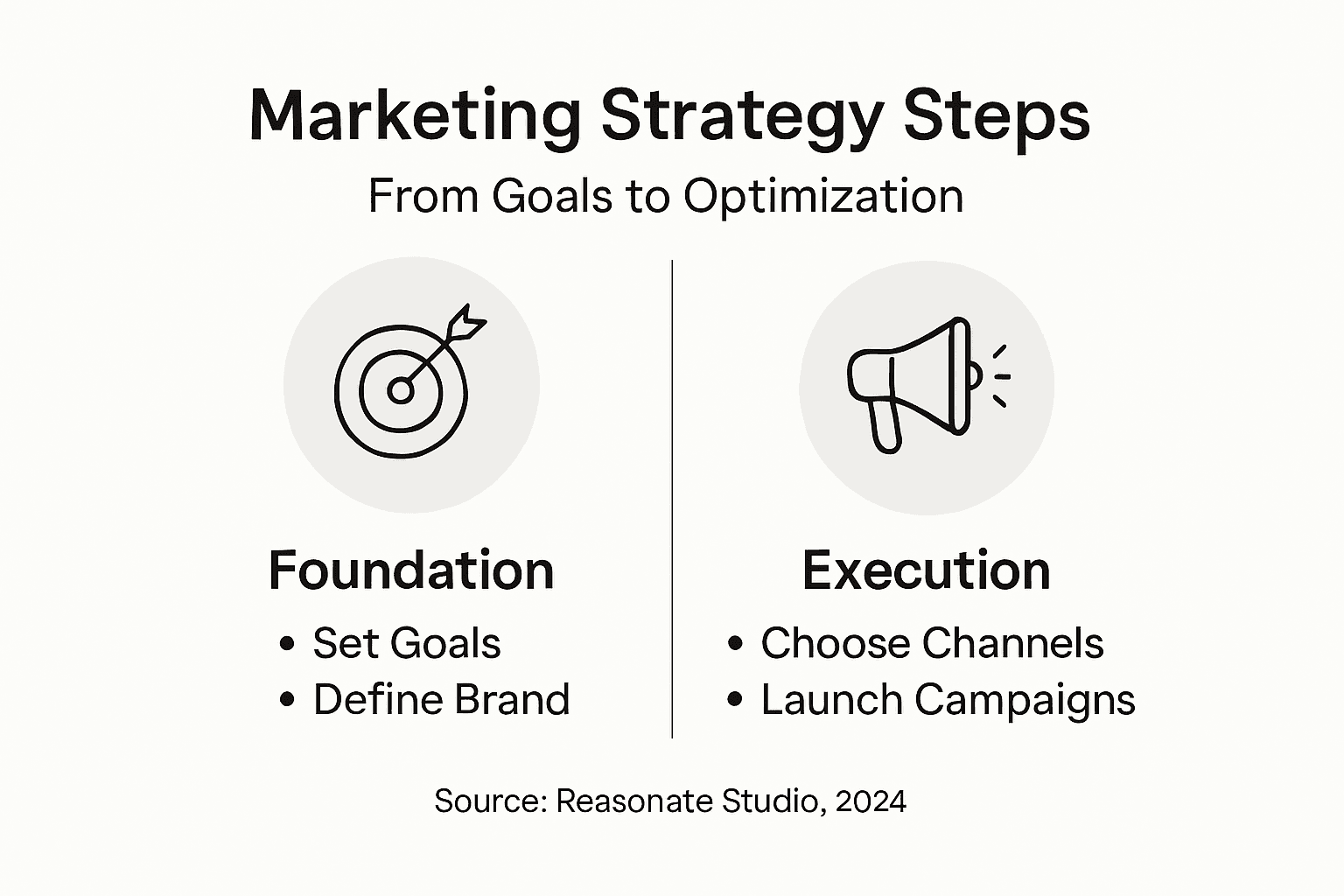
Struggling to translate your digital marketing plans into real growth? This article reveals the essential steps from clarifying your brand positioning to measuring campaign success — all critical to avoid wasting budget and energy on unfocused efforts. If you resonate with the challenge of turning scattered marketing actions into a coherent, goal-driven system that connects deeply with your ideal audience, you are not alone. The pain of vague goals, unclear messaging, and unclear budgets can hold back even the most talented entrepreneurs.
At Reasonate Studio, we specialize in partnering with entrepreneurs and small business owners who want to stop guessing and start scaling with clarity and precision. Our proprietary Aligned Impact Model™ simplifies these exact challenges by helping you uncover your brand foundations, pinpoint your audience, design integrated campaigns, and adapt based on real data — matching every step of the strategy laid out in the article. Experience marketing that is strategic and sustainable, not a short term scramble.
Ready to stop spinning your wheels and start building a digital marketing strategy that delivers measurable results? Visit Reasonate Studio today to discover how our blend of brand identity, storytelling, and growth frameworks can turn your side hustle into a thriving full-time business. Learn how to align your positioning with your goals, refine your messaging, and optimize your budget so that each dollar works harder. Dive deeper with insights on how to build a marketing strategy that delivers results and how to optimize marketing budget for sustainable growth. Take control of your marketing and start thriving now.
To clarify your brand positioning, identify what sets your business apart from competitors and what specific value you provide to your ideal customers. Write a clear statement that defines your competitive advantage and aligns with your business goals.
Start by gathering detailed demographic and psychographic information about your current customers. Narrow down your target audience to specific groups, like service-based business owners making a certain income, and document their motivations and challenges.
Analyze where your ideal audience spends their time online, such as social media platforms or search engines. Pick two to three channels that align with your audience’s behavior and allocate your budget based on their effectiveness within the first month.
Your integrated campaign should feature a unified message, linking all marketing materials, such as social media posts and email communications, to a central campaign goal. Make sure each element speaks to your audience’s needs and drives them towards the same desired action.
To measure success, track key performance metrics directly aligned with your campaign goals, such as lead generation or conversion rates. Set up a simple tracking system and review your results at least once a month to identify areas for improvement and adjust your strategy accordingly.
Evaluate the metrics you tracked during your campaigns to determine what worked and what didn’t. Use this data to test new messaging or reallocate your budget towards the highest-performing channels, aiming for continuous improvement in each subsequent campaign.