September 22, 2026
Why Update Brand Messaging: Essential Guide for Growth


Learn how a brand audit reveals gaps in strategy, messaging, and positioning, then use a practical five-step process to address them.

Most small business owners, coaches, and consultants think of a brand audit as a logo refresh or a color palette update. That instinct is understandable, but it misses the point entirely. Most leaders think about their logo, not strategy, when considering a brand audit, which means the real gaps stay hidden while marketing spend keeps draining. This article walks you through what a brand audit actually covers, why it matters for your growth in 2026, and how to run one that creates real, lasting clarity.
| Point | Details |
|---|---|
| Go beyond visuals | A brand audit examines both visible assets and deeper strategic gaps. |
| Objectivity is critical | Scoring tools and outside feedback reveal issues you might miss. |
| Trust drives growth | An effective audit builds trust and positions your brand for success. |
| Update for 2026 | Include AI search readiness and internal culture in every brand audit. |
A brand audit is a systematic review of everything that shapes how your business is perceived, both what people can see and what they cannot. The visible side includes your logo, website design, color palette, and social media presence. The invisible side is where most of the real work happens.

Brand audits go beyond the visible to the invisible brand architecture, which includes your positioning, your values, your reputation, and how well your messaging actually connects with the people you want to serve. Changing a logo without addressing these deeper layers is like repainting a house with a cracked foundation. It looks better for a moment, but the structural problem remains.
Understanding what brand strategy is helps clarify why the invisible elements matter so much. For coaches and consultants especially, your brand is often built on trust and perceived expertise, not just visual identity. If your messaging is unclear or your positioning is weak, no amount of design work will fix your conversion rate.
Here is what a real brand audit examines:
“A brand audit is not just a design review. It is a strategic diagnostic that reveals whether your brand is working as hard as your business needs it to.”
When you approach it this way, building a brand strategy becomes a natural next step after the audit, not a separate project.
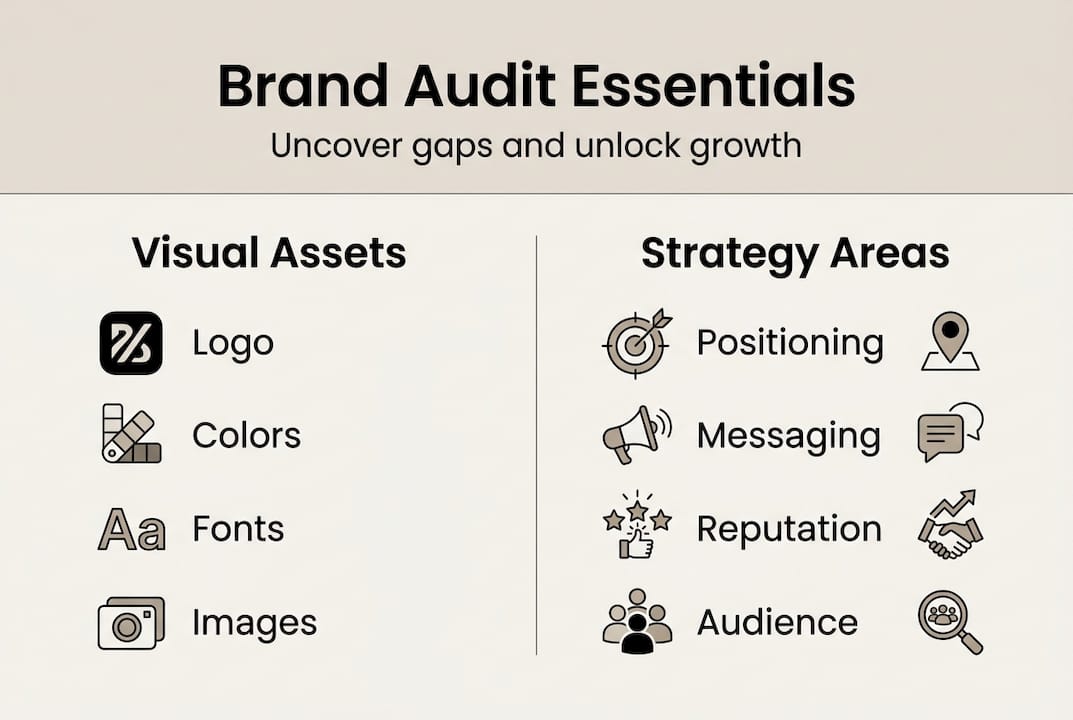
With a working definition in place, it is time to break down the specific areas included in a thorough brand audit. Each component serves a different purpose, and skipping any one of them leaves a blind spot.
1. Visual identity review Check every branded touchpoint for consistency. Your Instagram profile, website header, email signature, and proposal templates should all feel like they belong to the same brand.
2. Messaging and voice audit Read your website copy, your social bios, and your last ten posts out loud. Do they sound like the same person? Do they clearly explain who you help and how?
3. Positioning and differentiation check Search your competitors. What are they saying? Where do you overlap? Where do you stand apart? This is where key reasons for brand strategy become obvious.
4. Reputation and perception review Google your business name. Read your reviews. Ask three recent clients what words they would use to describe working with you. Their answers may surprise you.
5. Audience alignment assessment Look at who is actually engaging with your content and buying from you. Does that match who you designed your brand to attract?
Scoring matrices help ensure objectivity in small business brand audits, and personal brand equity inventories are especially useful for coaches. A simple scoring range, where 56 to 70 signals a competitive brand and anything below 40 signals urgent attention needed, gives you a clear benchmark instead of vague impressions.
| Audit area | Visual elements | Strategic elements |
|---|---|---|
| What it covers | Logo, colors, fonts, imagery | Positioning, values, voice, differentiation |
| How to assess | Side-by-side visual review | Client interviews, competitor research |
| Common gap | Inconsistency across platforms | Unclear or generic messaging |
| Impact when fixed | Stronger first impressions | Higher trust and conversion rates |
Pro Tip: Do not skip your digital search and reputation check. Google your name and your business name separately. What shows up on page one tells you exactly what a potential client sees before they ever reach your website.
After understanding the core elements, it is crucial to see how they connect to real business outcomes. A brand audit is not a vanity exercise. It is a revenue tool.
When your positioning is unclear, potential clients cannot tell why they should choose you over anyone else. When your messaging is inconsistent, people lose confidence before they even reach out. These are not abstract problems. They show up as slow referral rates, low conversion on discovery calls, and marketing that costs money without producing results.
CMOs rank branding as the #1 lever for differentiation and trust amid volatility. That finding is not just for Fortune 500 companies. It applies directly to the solo coach who keeps losing clients to a competitor with a clearer message, and to the consultant whose referrals have slowed because past clients struggle to explain what she does.
Here is what a well-executed audit can unlock quickly:
A marketing strategy that drives growth in 2026 also needs to account for AI search readiness. Search engines and AI tools now evaluate your brand as a digital entity, looking at consistency, authority, and clarity across platforms. If your brand signals are scattered, you lose visibility in the places your ideal clients are searching.
Pro Tip: Schedule a brand audit at least once per year, and always run one before launching a new offer, entering a new market, or raising your prices. Regular audits make adapting to market changes faster and far less stressful.
Realizing the business impact is great, but many small business owners miss critical details during a brand audit. The most common mistake is treating the audit as a design project and stopping there.
Perception gaps appear through Google searches and audience feedback, not just visual reviews. If your clients describe your work differently than you do, that gap is costing you referrals. If your Google search results surface outdated information or inconsistent profiles, that is a trust problem before a potential client ever contacts you.
Here are the most frequent pitfalls and how to avoid them:
“The most dangerous brand gaps are the ones you cannot see from the inside. Client feedback and a simple Google search often reveal more than any internal review.”
For brand strategy for startups and early-stage coaches, this is especially important. The habits you build around brand clarity in the early stages determine how much harder or easier growth becomes later.
To put these insights into action, here is a practical framework you can use for your next brand audit. This process works whether you are a solo consultant or a small team.
Gather all brand assets. Collect your logo files, website screenshots, social media profiles, email templates, and any sales or proposal documents. Lay them side by side and look for inconsistencies in color, font, tone, and messaging.
Collect direct feedback. Send a short survey to three to five recent clients. Ask them what words they would use to describe your brand, what made them choose you, and what could be clearer. Their language is gold for refining your messaging.
Run a Google search. Search your name and your business name. Review the first page of results. Check your Google Business profile if you have one. Look for outdated bios, inconsistent descriptions, or missing information.
Score each audit area. Use a simple 1 to 10 scale across the five components covered earlier: visual identity, messaging, positioning, reputation, and audience alignment. A total score below 35 signals urgent work needed. A score of 40 to 50 means you are competitive but have clear room to grow.
Build an action list from your findings. Prioritize the gaps that most directly affect trust and conversion. Fix those first before moving to aesthetic improvements.
Modern audits need to address AI search readiness, entity authority, and internal culture for differentiation. That means checking whether your brand information is consistent across all platforms, whether your content demonstrates genuine expertise, and whether the people connected to your brand reinforce the same message you are putting out.
| Audit area | Score (1-10) | Priority level | Action needed |
|---|---|---|---|
| Visual identity | — | Medium | Standardize fonts and colors across platforms |
| Messaging clarity | — | High | Rewrite homepage headline and social bio |
| Positioning | — | High | Define one clear differentiator |
| Reputation | — | High | Collect and publish three new testimonials |
| Audience alignment | — | Medium | Review who is engaging vs. who you want to attract |
For a deeper walkthrough of this process, the guide on auditing your brand for growth and clarity covers each step with more detail and examples built for coaches and consultants.
You have learned how to audit your brand. Now here is how Reasonate Studio can help you take the next confident step without doing it alone.
The DIY process above is genuinely useful, but it has a real limitation: it is hard to see your own blind spots. That is exactly where professional support changes the outcome. At Reasonate Studio, we built our entire approach around the idea that brand clarity is the foundation of every marketing decision that follows. Our Marketing Jump Start program is designed to give you a hands-on, expert-led brand audit experience that goes beyond checklists. You get a strategy workshop, a social media audit, a message and story review, an audience clarity check, and a set of quick-win recommendations you can act on immediately. If you are ready to stop guessing and start growing with a brand that actually reflects your expertise, this is your next step.
Conduct a brand audit at least once per year or whenever you launch a new campaign, raise your prices, or face a major business change. Brand audits are critical in volatile markets and should align with significant business shifts.
Google your business name and read the first-page results alongside your most recent client feedback for any misalignments or inconsistencies. Perception gaps appear through Google searches and audience feedback more clearly than any internal review.
Yes, with a clear step-by-step framework and a commitment to honest self-assessment, small businesses can self-audit effectively. That said, scoring matrices help ensure objectivity and expert support often surfaces gaps that are invisible from the inside.
Absolutely. Internal culture is a branding foundation in 2026, especially for service-based businesses where the client experience is inseparable from the brand itself.