September 22, 2026
Why Update Brand Messaging: Essential Guide for Growth


Learn how to conduct a strategic brand audit that reveals gaps, strengthens positioning, and drives sustainable growth for founders, coaches, and consultants.

Most founders, coaches, and consultants pour energy into building their expertise but struggle to understand why their brand isn’t resonating the way they hoped. You’re showing up, creating content, and putting yourself out there, yet the audience connection feels inconsistent. The truth is, without a systematic brand audit, you’re operating on assumptions rather than insights. A brand audit is a structured review that reveals exactly where your brand stands, what’s working, and what needs refinement. This guide walks you through how to audit your brand step by step so you can build clarity, strengthen your positioning, and create sustainable growth.
| Point | Details |
|---|---|
| Perception gaps revealed | Brand audits identify where your messaging and visuals miss audience expectations and guide refinements. |
| Audit tools boost precision | Social listening and scoring checklists turn impressions into measurable, actionable data. |
| Regular quarterly reaudits | Setting a quarterly schedule helps track progress, adapt to shifts, and stay ahead of competitors. |
| Data privacy protection | Audit processes should follow privacy rules and obtain proper consent to safeguard customer information. |
| Brand architecture for growth | A clear architecture supports scalable expansion after events like mergers and acquisitions. |
A brand audit is a systematic evaluation of your brand’s current position in the market, measuring how well your messaging, visuals, and overall presence align with your business goals and audience expectations. For founders, coaches, and consultants, this process is essential because your personal brand directly impacts client trust and revenue. Without regular audits, you risk operating on outdated assumptions while competitors gain ground.
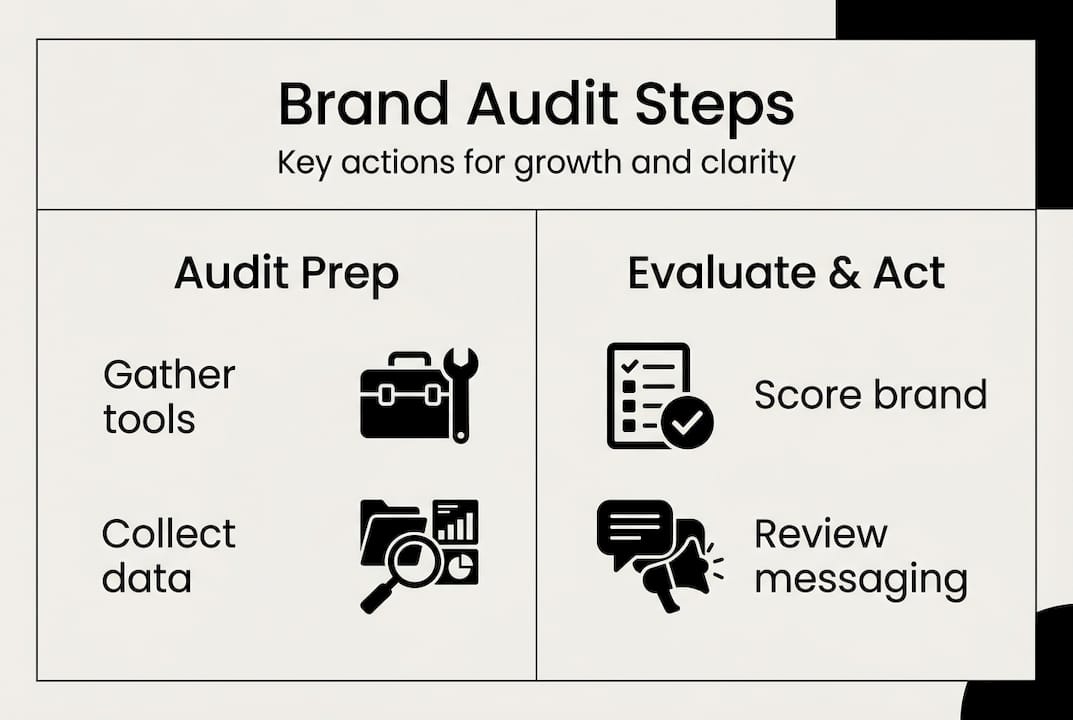
Before you begin, gather the right tools to make your audit efficient and accurate. Social listening tools like Brand24 help you monitor mentions, sentiment, and conversations about your brand across digital channels. Media monitoring platforms like Prowly track how your brand appears in press and publications. Scoring checklists, such as the Brand Vision framework, let you rate individual brand elements systematically. These tools transform subjective impressions into measurable data you can act on.
Data privacy compliance matters during audits, especially if you’re collecting customer feedback or analyzing user behavior. If you operate in markets covered by GDPR or similar regulations, ensure you have proper consent for data collection and storage. Document your audit process and findings in a way that respects customer privacy while still giving you actionable insights. This protects both your business and your audience.
Your audit should also connect to broader brand recognition strategies you’re already using. Think of the audit as a diagnostic tool that tells you which recognition tactics are working and which need adjustment. It’s also helpful to cross-reference your findings with a branding checklist for founders to ensure you’re covering all essential brand elements during your review.
Pro Tip: Set a quarterly schedule for brand audits to maintain updated insights. Markets shift, audience preferences evolve, and your competitors adapt. Regular audits keep you ahead of these changes rather than reacting after you’ve already lost ground. Schedule your audits at the start of each quarter so you can adjust your strategy before launching new campaigns or offers.
Start your audit by conducting social listening to collect mentions and sentiment data about your brand. Set up monitoring for your brand name, key products or services, and relevant industry terms. Track not just volume but sentiment, whether conversations are positive, negative, or neutral. Pay attention to where these conversations happen, which platforms generate the most engagement, and what themes emerge repeatedly. This gives you a baseline understanding of your current brand perception.
Next, evaluate your personal brand elements for online presence clarity and conversion effectiveness. Review your website, social profiles, email signatures, and any other touchpoint where potential clients encounter your brand. Ask yourself: Is my value proposition immediately clear? Do my visuals feel cohesive across platforms? Does my messaging speak directly to my ideal client’s needs? Rate each element on consistency, clarity, and alignment with your positioning.

AI and LLM visibility has become increasingly important as more people use tools like ChatGPT to research services and recommendations. Test how your brand appears in AI-generated responses by running prompt audits. Ask these tools questions your ideal clients might ask and see if your brand surfaces in the results. Note the context, accuracy, and sentiment of any mentions. This reveals whether you’re building the digital footprint needed for modern discovery.
Build a scoring table to rate key brand attributes systematically. Create a simple 0-2 scale where 0 means absent or poor, 1 means present but needs improvement, and 2 means strong and consistent. Rate elements like brand clarity, visual consistency, message alignment, audience targeting, content quality, social proof, and conversion optimization. Here’s an example structure:
| Brand element | Score (0-2) | Notes |
|---|---|---|
| Brand clarity | 1 | Value proposition unclear on homepage |
| Visual consistency | 2 | Strong cohesion across platforms |
| Message alignment | 1 | Messaging varies between LinkedIn and website |
| Audience targeting | 1 | Persona definition needs refinement |
| Content quality | 2 | High-value content, good engagement |
| Social proof | 0 | Limited testimonials, no case studies |
| Conversion optimization | 1 | CTAs present but not compelling |
This scoring approach helps you prioritize improvements based on where gaps are largest. Focus first on elements scored 0 or 1 that directly impact revenue, such as conversion optimization and social proof.
Your audit should also assess brand visibility strategies currently in play. Are you showing up where your ideal clients spend time? Is your content discoverable through search and social algorithms? Visibility without clarity won’t convert, but clarity without visibility won’t scale. Balance both in your audit findings.
Review your brand messaging with fresh eyes. Read your website copy, social bios, and email sequences as if you’re encountering your brand for the first time. Does the messaging immediately communicate who you serve, what problem you solve, and why you’re the right choice? Inconsistent messaging confuses potential clients and weakens trust.
Pro Tip: Document findings carefully to streamline quarterly re-audits and trend analysis. Create a simple spreadsheet or document template you can reuse each quarter. Include sections for scores, observations, competitive insights, and action items. When you run your next audit, you’ll be able to spot trends, measure progress, and identify whether changes you implemented actually moved the needle.
Once you’ve completed your initial audit, verify your findings against key performance metrics to ensure accuracy. Compare your audit scores with measurable data like Net Promoter Score (NPS) and share of voice. If your audit suggests strong brand perception but your NPS is low, dig deeper to understand the disconnect. Similarly, if you scored well on visibility but your share of voice is declining, your competitors may be outpacing you in key channels.
Recognize common pitfalls that undermine brand audits. Incomplete data collection is the most frequent mistake, often because founders only audit the channels they’re most active on while ignoring others where their audience actually spends time. If you’re focused on Instagram but your ideal clients are making decisions based on LinkedIn content or podcast appearances, your audit will miss critical insights. Audit every channel where your brand has a presence, even if you’re not actively managing it.
Ignoring digital channels, particularly emerging ones like AI and voice search, leaves blind spots in your brand understanding. As search behavior shifts toward conversational queries and AI-assisted research, your brand needs to be discoverable in these contexts. Test your brand’s visibility in AI tools, voice assistants, and newer platforms your audience might be exploring.
Unclear brand messaging creates the most damage because it compounds across every touchpoint. If your core message isn’t sharp, every piece of content, every social post, and every sales conversation will feel slightly off. During your audit, if you notice messaging inconsistency, pause other marketing efforts and fix this first. Everything else builds on this foundation.
Here’s a comparison of common audit mistakes versus corrective actions:
| Common mistake | Corrective action |
|---|---|
| Auditing only active channels | Review all brand touchpoints including dormant profiles |
| Skipping competitor analysis | Benchmark against 3-5 direct competitors |
| Ignoring negative feedback | Actively seek and analyze critical reviews and comments |
| Using outdated data | Collect fresh data from the past 90 days maximum |
| Focusing only on aesthetics | Prioritize message clarity and conversion metrics |
| One-time audit approach | Schedule quarterly audits to track trends |
When troubleshooting your brand clarity and audience connection, start with these key steps. First, survey your current clients or audience to understand how they perceive your brand versus how you intend it to be perceived. Second, analyze where prospects drop off in your funnel to identify messaging or trust gaps. Third, review customer service interactions and sales call recordings to hear the actual language your audience uses when describing their problems and your solutions.
Improving brand perception requires addressing gaps systematically rather than making random changes. Use your audit findings to create a prioritized action plan. Tackle foundational issues like unclear positioning before optimizing secondary elements like color schemes or posting frequency. Each improvement should be measurable so your next quarterly audit can confirm whether the change worked.
Your brand audit findings become valuable only when you translate them into strategic action. Use the insights to clarify and unify your brand messaging and visuals across all platforms. If your audit revealed inconsistencies, create a simple brand guide that documents your core message, visual standards, tone of voice, and key differentiators. This guide becomes your reference point for all future content and marketing decisions.
Develop an action plan that prioritizes areas with the largest impact gaps. Look at your scoring table and identify which low-scoring elements most directly affect revenue and client acquisition. For most founders, coaches, and consultants, this typically means focusing on conversion optimization, social proof, and message clarity before perfecting visual details or expanding to new platforms.
Here’s a practical framework for post-audit brand strategy refinement:
Align your brand architecture to support scalable growth, especially if you’re planning expansion, launching new offers, or considering partnerships. Post-M&A brand architecture requires particularly careful planning because you need to integrate multiple brand identities while maintaining clarity for your audience. Your audit provides the baseline data to make these architectural decisions strategically rather than reactively.
If you’re developing your brand identity for the first time or refining an established one, treat your audit as the foundation for all identity work. Don’t redesign your logo or refresh your website before understanding what your audit reveals about perception gaps and audience expectations. Design decisions should solve problems your audit identified, not just reflect aesthetic preferences.
A brand audit isn’t a one-time project but a foundation for sustainable brand evolution. The insights you gather become more valuable over time as you track trends, measure improvements, and adapt to market shifts with confidence rather than guesswork.
Your quarterly audit rhythm creates a feedback loop that keeps your brand relevant and competitive. Each audit builds on the previous one, letting you see which strategies are working and which need adjustment. This ongoing process transforms your brand from a static asset into a dynamic growth engine that evolves with your business and audience.
Conducting a thorough brand audit takes time, expertise, and objectivity that’s hard to maintain when you’re inside your own business. That’s where our Marketing Jump Start service comes in. We guide founders, coaches, and consultants through a strategic brand audit that uncovers exactly where your brand stands and what needs to shift for sustainable growth.
Our team translates audit insights into actionable marketing plans you can implement immediately. Rather than handing you a report full of observations, we help you prioritize improvements, refine your messaging, and build systems that support ongoing brand clarity and stronger audience connection. We’ve helped over 100 small businesses transform their brand strategy with an 85% client retention rate because we focus on results, not just recommendations. See how Marketing Jump Start can save you time and drive measurable growth for your brand.
Social listening tools like Brand24 and media monitoring platforms like Prowly are highly effective for gathering comprehensive brand data across digital channels. These tools track mentions, sentiment, and engagement patterns that reveal how your audience actually perceives your brand. Checklists like Brand Vision help you systematically score brand elements for thorough evaluation. Combining automated tools with structured frameworks gives you both quantitative data and qualitative insights for a complete audit picture.
Conduct brand audits quarterly to reliably track progress against baseline metrics and adjust your strategy based on market shifts and audience feedback. Quarterly timing aligns with business planning cycles and gives you enough data to spot meaningful trends without waiting so long that you miss important changes. Regular re-audits support sustained brand clarity and stronger audience connection by keeping your brand aligned with evolving customer needs and competitive dynamics. Annual audits are too infrequent in today’s fast-moving markets, while monthly reviews often don’t allow enough time to measure the impact of changes.
Avoid incomplete data collection by auditing all channels where your brand has a presence, not just the platforms you actively manage or prefer. Ignoring digital channels like AI and LLM mentions leaves critical blind spots as search behavior evolves toward conversational and AI-assisted research. Ensure your brand messaging is clear and consistent across all touchpoints to prevent mixed signals that confuse your audience and weaken trust. Other mistakes include relying on outdated data, skipping competitor benchmarking, and focusing only on aesthetics while neglecting conversion metrics and message clarity.
A thorough audit identifies strengths and gaps in both brand identities, guiding the development of scalable brand structures that integrate multiple entities while maintaining clarity for your combined audience. Audit-based strategies for post-M&A brand architecture help you decide which brand elements to keep, merge, or retire based on data rather than internal politics or assumptions. Audit data informs the messaging and visual consistency needed for a unified brand identity that feels intentional rather than cobbled together. This strategic foundation prevents the brand confusion that often undermines merger success and helps you capture the full value of the combined business.